Sony ZV-E10 II vs Sony A6700 • Which one is better?
Sony ZV-E10 II vs Sony A6700 – Which One Is Better?
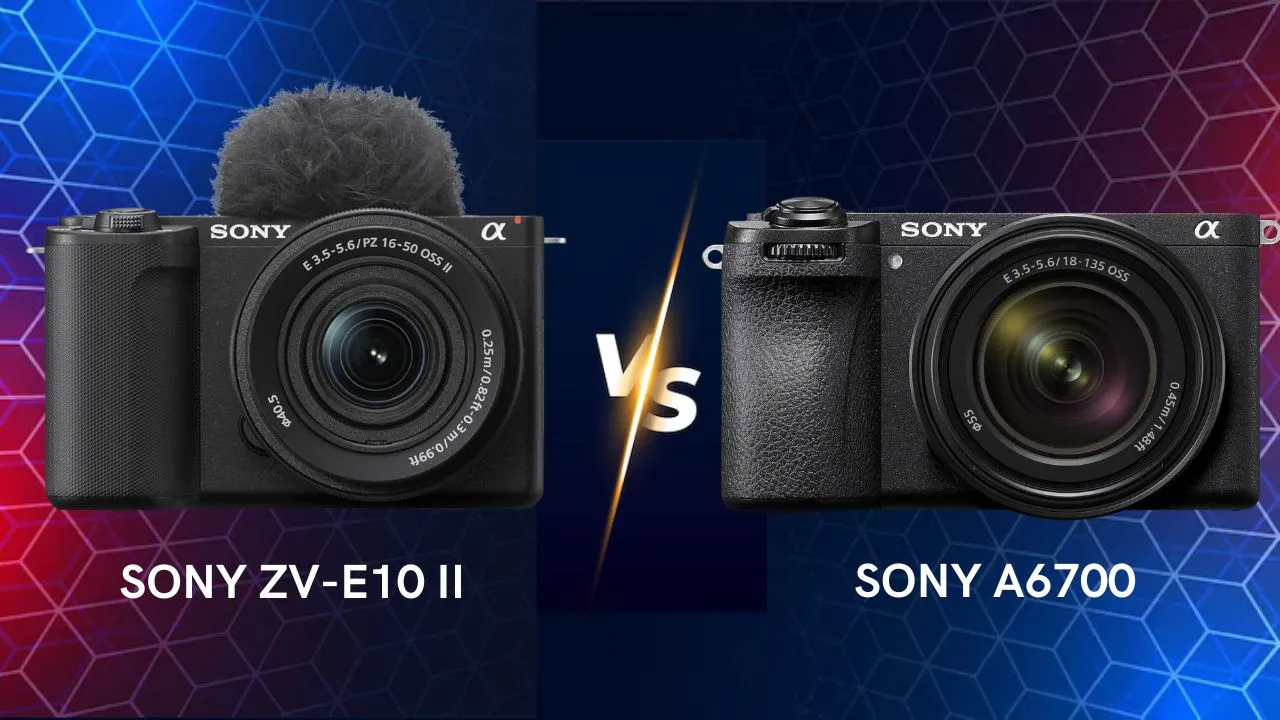
The Sony ZV-E10 II and Sony A6700 are two of Sony’s latest APS-C mirrorless cameras — both packed with powerful specs, cutting-edge autofocus, and impressive 4K video capabilities.
At first glance, they share many similarities: the same 26 MP BSI sensor, BIONZ XR processor, and advanced subject recognition AI. But they are built for different types of creators.
The ZV-E10 II is a creator-first camera, lightweight and optimized for solo content production and vlogging. The A6700, meanwhile, is a professional hybrid powerhouse, combining superior ergonomics, viewfinder, IBIS, and better cooling for long shoots.
So, which one is better? Let’s find out.
⚙️ Overview – Creator Simplicity vs Pro Hybrid Power
Sony ZV-E10 II:
A compact APS-C camera built for modern creators. It offers a 26 MP BSI sensor, 4K 60p 10-bit video, advanced AI autofocus, and a fully articulating touchscreen. It’s perfect for vloggers, YouTubers, and hybrid shooters on the go.
Sony A6700:
Sony’s flagship APS-C hybrid — the most advanced A6000-series camera yet. It features the same sensor and processor, but adds in-body stabilization, a viewfinder, dual control dials, and a larger grip, making it ideal for professionals who demand precision and control.
In short:
-
ZV-E10 II = Streamlined, video-focused creator camera.
-
A6700 = Professional hybrid camera for advanced users.
📸 Specifications Comparison
| Feature | Sony ZV-E10 II | Sony A6700 |
|---|---|---|
| Release Date | July 2024 | July 2023 |
| Camera Type | APS-C Mirrorless (Creator Focused) | APS-C Mirrorless (Professional Hybrid) |
| Sensor | 26 MP APS-C Exmor R BSI CMOS | 26 MP APS-C Exmor R BSI CMOS |
| Processor | BIONZ XR | BIONZ XR + AI Processing Unit |
| Lens Mount | Sony E-Mount | Sony E-Mount |
| ISO Range | 100–32,000 (expandable to 102,400) | 100–32,000 (expandable to 102,400) |
| Dynamic Range | ~14 Stops | ~14 Stops |
| In-Body Stabilization (IBIS) | ❌ No (Digital Active only) | ✅ 5-Axis IBIS (up to 5 stops) |
| Autofocus System | 759 Phase-Detection Points + AI Tracking | 759 Phase-Detection Points + AI Tracking |
| Continuous Shooting | 11 fps | 11 fps |
| Video Recording | 4K 60p (10-bit 4:2:2) / 4K 120p (crop) | 4K 120p (10-bit 4:2:2) / 4K 60p (no crop) |
| Slow Motion | Full HD 240p | Full HD 240p |
| Color Depth | 10-bit 4:2:2 | 10-bit 4:2:2 |
| Log Profiles | S-Cinetone, S-Log3, HLG | S-Cinetone, S-Log3, HLG, LUT Preview |
| Cooling System | Passive | Improved passive cooling design |
| Screen | 3.0” Fully Articulating Touch LCD | 3.0” Vari-Angle Touch LCD |
| Viewfinder | ❌ No | ✅ 2.36M-dot OLED EVF |
| Mic / Headphone Ports | ✅ Yes / ✅ Yes | ✅ Yes / ✅ Yes |
| Connectivity | USB-C 3.2, Wi-Fi 5GHz, Bluetooth | USB-C 3.2, Wi-Fi 5GHz, Bluetooth |
| Battery Type | NP-FZ100 | NP-FZ100 |
| Battery Life (CIPA) | ~570 shots | ~570 shots |
| Body Material | Polycarbonate + Magnesium Alloy | Full Magnesium Alloy |
| Weather Sealing | ❌ No | ✅ Yes |
| Weight (Body Only) | 377 g | 493 g |
| Price (Body Only) | ~$899 (check on Amazon) | ~$1,398 (check on Amazon) |
🧱 Build and Handling
The ZV-E10 II is designed for creators who need a portable and simple setup. It’s compact, lightweight, and intuitive — ideal for handheld shooting or mounting on a gimbal. Its fully articulating screen and clean interface make self-recording effortless.
The A6700, by contrast, feels much more professional. Its deeper grip, weather sealing, and physical dials make it perfect for longer shoots and hybrid workflows. It also includes a high-resolution viewfinder, which the ZV-E10 II lacks.
👉 Verdict:
-
ZV-E10 II: Best for handheld creators and vloggers.
-
A6700: Best for hybrid pros who want full control.
🎯 Autofocus and Performance
Both cameras share Sony’s advanced AI-powered AF system, with subject detection for humans, animals, birds, cars, and even insects.
The A6700 has a slight edge due to its dedicated AI processor, offering more consistent subject recognition and tracking during fast-moving scenes.
The ZV-E10 II still performs brilliantly for vlogs, interviews, and travel videos — especially with auto-framing and product showcase modes.
👉 Verdict:
-
ZV-E10 II: Simplified, creator-friendly AF automation.
-
A6700: More precise and customizable for professionals.
🎥 Video Capabilities
This is where both cameras shine — but the A6700 still has a few pro-level advantages.
Sony ZV-E10 II
-
4K 60p (10-bit 4:2:2)
-
4K 120p with crop
-
Dynamic Active Stabilization
-
Auto Framing and Product Showcase
-
No IBIS, lighter body
Sony A6700
-
4K 120p (no crop, full sensor readout)
-
10-bit 4:2:2 color
-
Full 5-Axis IBIS
-
S-Cinetone, S-Log3, and LUT Preview
-
Better heat management and color processing
👉 Verdict:
-
ZV-E10 II: Best for creators who need top-tier video in a compact form.
-
A6700: Best for filmmakers and hybrid pros needing IBIS and longer takes.
🧠 Image Quality
Both share the same 26 MP BSI sensor, delivering excellent detail, dynamic range, and color.
However, the A6700’s image pipeline benefits from more robust color science, IBIS-assisted sharpness, and greater flexibility in professional workflows.
The ZV-E10 II produces equally impressive footage and photos, but lacks in-body stabilization for handheld stills.
👉 Verdict:
-
ZV-E10 II: Great quality for creators and travel photographers.
-
A6700: Better for professional stills and hybrid work.
🔋 Battery Life and Workflow
Both use the same NP-FZ100 battery and deliver excellent endurance (~570 shots or over 2 hours of 4K video).
The A6700 offers better thermal management and weather sealing for extended use, while the ZV-E10 II prioritizes lighter portability.
👉 Verdict:
-
ZV-E10 II: Compact, efficient workflow for creators.
-
A6700: More reliable for all-day professional use.
💰 Price and Value
| Model | Approx. Price | Ideal For |
|---|---|---|
| Sony ZV-E10 II | ~$899 | Creators, vloggers, hybrid shooters |
| Sony A6700 | ~$1,398 | Filmmakers, professionals, hybrid pros |
_
The ZV-E10 II delivers 90% of the A6700’s performance for much less money — a fantastic deal for most creators.
The A6700 justifies its higher price with IBIS, a viewfinder, and professional controls, making it better suited for long-term, demanding work.
👉 Verdict:
-
ZV-E10 II: Best value for creators and vloggers.
-
A6700: Best long-term investment for hybrid professionals.
Check availability and price on Amazon 🛒
📷 Sony ZV-E10 II — Amazon USA / Amazon Canada / Amazon UK / Amazon Australia
📷 Sony A6700 — Amazon USA / Amazon Canada / Amazon UK / Amazon Australia
(As an Amazon Associate, I earn from qualifying purchases — at no extra cost to you.)
🏁 Final Verdict – Sony ZV-E10 II vs A6700
| Type of User | Recommended Camera |
|---|---|
| Beginner Creator / Vlogger | ZV-E10 II |
| Professional Filmmaker | A6700 |
| Hybrid Photo + Video Shooter | A6700 |
| Travel Creator / YouTuber | ZV-E10 II |
| Studio or Documentary Filmmaker | A6700 |
| Budget Buyer | ZV-E10 II |
_
✅ In short:
Choose the Sony ZV-E10 II if you want a compact, creator-friendly APS-C camera with excellent 4K 60p video, AI automation, and modern color science.
Choose the Sony A6700 if you need in-body stabilization, a viewfinder, and full professional control for hybrid or cinematic work.
🧠 Final Thoughts
Both cameras are exceptional — they share the same core imaging technology but are tailored for different workflows.
The ZV-E10 II is a dream for solo creators, vloggers, and YouTubers — simple, smart, and capable of cinematic results without the bulk.
The A6700, meanwhile, is the ultimate APS-C hybrid for professionals who want maximum control, stabilization, and reliability in one body.
If you prioritize portability and ease of use, go for the ZV-E10 II.
If you need professional features and IBIS for serious video or hybrid production, the A6700 is the clear winner.