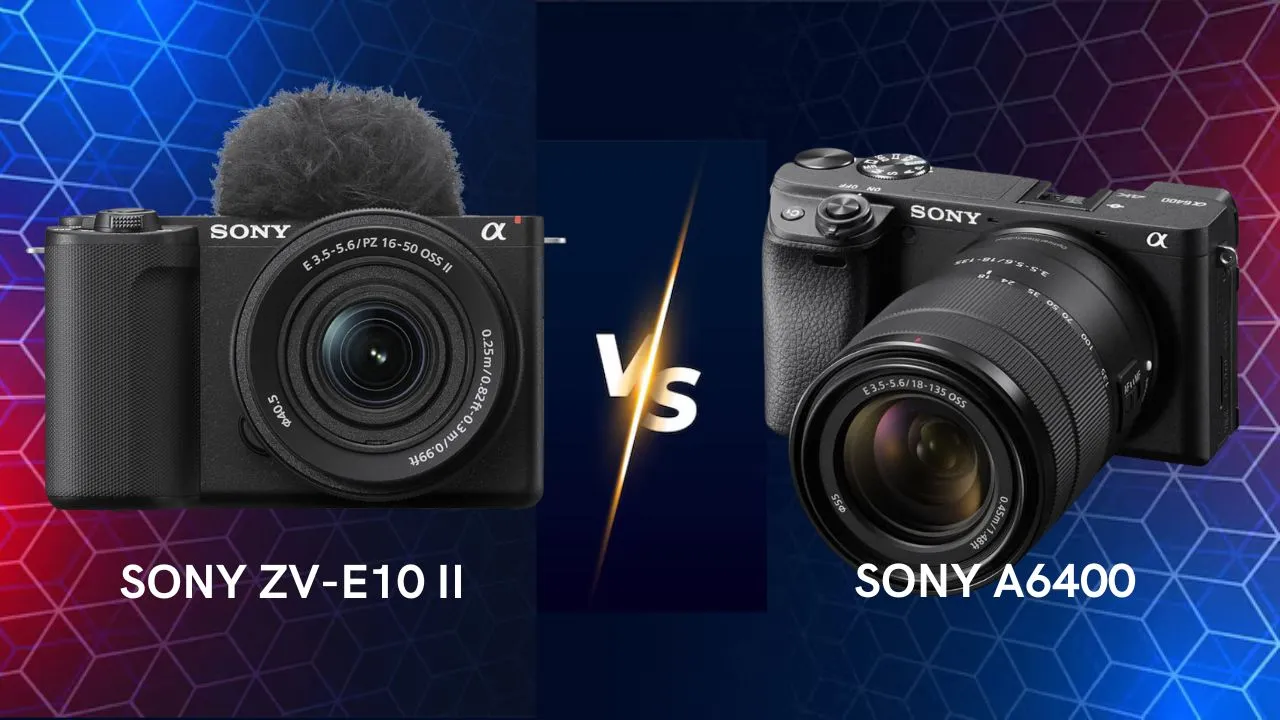
Sony ZV-E10 II vs Sony A6400 • Which one is better?
Sony ZV-E10 II vs A6400 – Which One Is Better?
The Sony ZV-E10 II and Sony A6400 are two of Sony’s most popular APS-C mirrorless cameras — both designed for creators, but aimed at slightly different audiences.
The A6400 has long been a favorite among hybrid shooters who want great stills and strong video in a durable, pro-style body.
The ZV-E10 II, on the other hand, represents Sony’s next generation of creator-focused cameras, offering advanced video specs, AI features, and 10-bit color — all in a compact, user-friendly design.
So, which one is the better choice? Let’s find out.
⚙️ Overview – Classic Hybrid vs Next-Gen Creator
Sony ZV-E10 II:
The 2024 update to Sony’s popular ZV-E10 brings major upgrades — a 26 MP BSI sensor, 4K 60p 10-bit video, and improved autofocus. It’s built for creators who prioritize video quality, simplicity, and portability.
Sony A6400:
Released in 2019, the A6400 remains a strong hybrid camera with 24 MP APS-C resolution, a robust magnesium alloy body, and exceptional autofocus. It’s ideal for photographers and videographers who prefer manual control and reliability.
In short:
-
ZV-E10 II = Modern, video-focused creator camera.
-
A6400 = Proven, professional hybrid camera.
📸 Specifications Comparison
| Feature | Sony ZV-E10 II | Sony A6400 |
|---|---|---|
| Release Date | July 2024 | January 2019 |
| Camera Type | APS-C Mirrorless (Creator-Focused) | APS-C Mirrorless (Hybrid) |
| Sensor | 26 MP APS-C BSI CMOS (Exmor R) | 24.2 MP APS-C CMOS |
| Processor | BIONZ XR | BIONZ X |
| Lens Mount | Sony E-Mount | Sony E-Mount |
| ISO Range | 100–32,000 (expandable to 102,400) | 100–32,000 (expandable to 102,400) |
| Dynamic Range | ~14 Stops | ~13 Stops |
| In-Body Stabilization (IBIS) | ❌ No (Digital Active only) | ❌ No (Lens-based only) |
| Autofocus System | 759 Phase-Detection Points + AI Tracking | 425 Phase-Detection Points + Real-Time Eye AF |
| Continuous Shooting | 11 fps | 11 fps |
| Video Recording | 4K 60p / 30p / 24p (10-bit 4:2:2) | 4K 30p / 24p (8-bit 4:2:0) |
| Slow Motion | Full HD 120p | Full HD 120p |
| Color Depth | 10-bit 4:2:2 | 8-bit 4:2:0 |
| Log Profiles | S-Cinetone, S-Log3, HLG | S-Log2/3, HLG |
| Screen | 3.0” Fully Articulating Touch LCD | 3.0” 180° Tilting LCD (non-touch) |
| Viewfinder | ❌ No | ✅ 2.36M-dot OLED EVF |
| Mic Input / Headphone Out | ✅ Yes / ✅ Yes | ✅ Mic Input / ❌ No Headphone Out |
| Connectivity | USB-C 3.2, Wi-Fi 5GHz, Bluetooth | Micro USB, Wi-Fi 2.4GHz |
| Battery Type | NP-FZ100 | NP-FW50 |
| Battery Life (CIPA) | ~570 shots | ~410 shots |
| Body Material | Polycarbonate + Magnesium Alloy | Full Magnesium Alloy |
| Weight (Body Only) | 377 g | 403 g |
| Price (Body Only) | ~$899 (check on Amazon) | ~$998 (check on Amazon) |
🧱 Build and Handling
The A6400 has a solid, weather-sealed magnesium alloy body and a classic DSLR-style grip. It’s built for durability and professional use — perfect for event shooters or hybrid creators who need reliability.
The ZV-E10 II is lighter, cleaner, and more streamlined, optimized for handheld video and self-shooting. Its fully articulating touchscreen and simplified interface make it ideal for vloggers and YouTubers.
👉 Verdict:
-
ZV-E10 II: Easier to handle, better for creators and vloggers.
-
A6400: More rugged, better for hybrid photographers.
🎯 Autofocus and Performance
Both cameras are lightning-fast, using Sony’s Real-Time Eye AF — but the ZV-E10 II uses Sony’s newest AI processing engine, offering improved subject recognition for people, animals, and products.
The A6400 remains excellent for stills and traditional hybrid use, but lacks the AI-powered automation and tracking of the newer ZV-E10 II.
👉 Verdict:
-
ZV-E10 II: Smarter and more automated AF.
-
A6400: Still fast and reliable, especially for still photography.
🎥 Video Capabilities
Here’s where the ZV-E10 II pulls ahead.
Sony ZV-E10 II
-
4K 60p recording (full sensor readout)
-
10-bit 4:2:2 color
-
S-Cinetone & S-Log3 for cinematic grading
-
Background Defocus, Product Showcase, and Auto Framing modes
-
USB-C livestreaming and AI subject detection
Sony A6400
-
4K 30p recording (8-bit 4:2:0)
-
No 10-bit or high-frame-rate 4K options
-
No in-camera stabilization
-
Excellent image quality for 2019 standards
👉 Verdict:
-
ZV-E10 II: Significantly better video camera.
-
A6400: Still capable, but aging for serious video work.
🧠 Image Quality
Both cameras produce beautiful images with great color and sharpness.
The A6400 has a slight edge in still photography with its sharper EVF and professional color accuracy.
However, the ZV-E10 II’s newer sensor and 10-bit video give it a big advantage for color depth, low-light performance, and post-production flexibility.
👉 Verdict:
-
ZV-E10 II: Better color and low-light performance.
-
A6400: Excellent image sharpness for photography.
🔋 Battery Life and Connectivity
The ZV-E10 II uses Sony’s larger NP-FZ100 battery — almost 40% longer life than the A6400.
It also features modern USB-C connectivity, faster Wi-Fi transfers, and direct livestreaming support.
The A6400, while dependable, still uses the older NP-FW50 battery and lacks USB-C.
👉 Verdict:
-
ZV-E10 II: More efficient, modern connectivity.
-
A6400: Acceptable endurance, but older tech.
💰 Price and Value
| Model | Approx. Price | Ideal For |
|---|---|---|
| Sony ZV-E10 II | ~$899 | Vloggers, creators, hybrid shooters |
| Sony A6400 | ~$998 | Photographers, professionals, hybrid users |
_
The A6400 remains a reliable camera for stills shooters and hybrid users who value build quality.
The ZV-E10 II, however, offers more advanced features, better video specs, and a modern creator-friendly design — all for a lower price.
👉 Verdict:
-
ZV-E10 II: Better value for creators and hybrid shooters.
-
A6400: Better for still photography and rugged use.
Check availability and price on Amazon 🛒
📷 Sony A6400 — Amazon USA / Amazon Canada / Amazon UK / Amazon Australia
📷 Sony ZV-E10 II — Amazon USA / Amazon Canada / Amazon UK / Amazon Australia
Note: camerafight.com participates in the Amazon Associates Program. As an Amazon Associate, we earn from qualifying purchases.
🏁 Final Verdict – Sony ZV-E10 II vs A6400
| Type of User | Recommended Camera |
|---|---|
| Beginner Creator / Vlogger | ZV-E10 II |
| Professional Photographer | A6400 |
| Hybrid Photo + Video Shooter | ZV-E10 II |
| Event / Studio Shooter | A6400 |
| Travel / YouTube Content Creator | ZV-E10 II |
| Budget Buyer | ZV-E10 II |
_
✅ In short:
Choose the Sony ZV-E10 II if you want a modern, video-focused APS-C camera with 4K 60p, 10-bit color, and advanced AI autofocus.
Choose the Sony A6400 if you want a robust hybrid camera built for reliability and stills performance.
🧠 Final Thoughts
Both cameras share Sony’s excellent image quality and autofocus system, but they represent two eras of Sony’s APS-C evolution.
The A6400 remains a solid, pro-level hybrid for photographers who value manual control, EVF precision, and durability.
The ZV-E10 II, however, brings modern processing, improved video specs, and creator-first features that make it a far better fit for today’s content creators and hybrid users.
If your focus is video, social media, or YouTube, the ZV-E10 II is clearly the smarter, future-proof choice.
If you shoot more photos than video, and value a tougher body with a viewfinder, the A6400 still delivers outstanding performance.