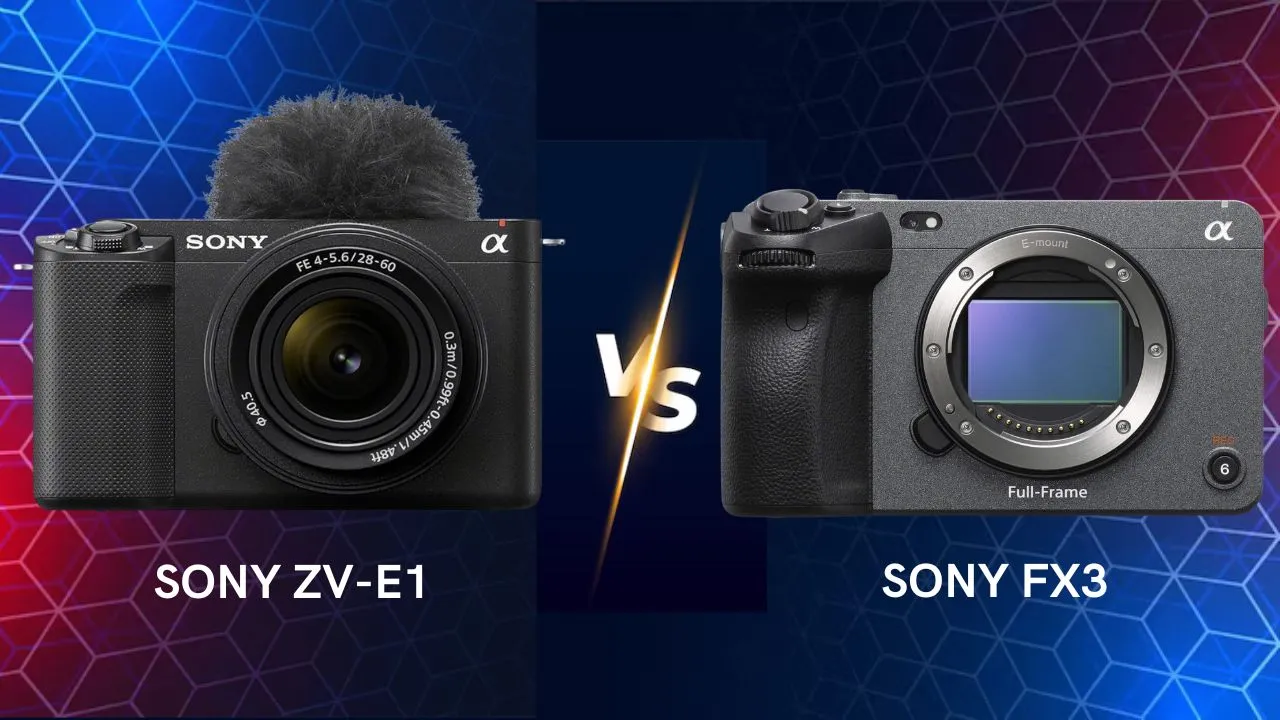
Sony ZV-E1 vs FX3 • Which one is better?
Sony ZV-E1 vs FX3 – Which One Is Better?
The Sony ZV-E1 and Sony FX3 are two of Sony’s most powerful full-frame cameras for video creators — both built around the same sensor and processor, and capable of stunning cinematic footage.
At first glance, they might look nearly identical in performance. But their design, ergonomics, and target users are very different.
The ZV-E1 is aimed at content creators, vloggers, and solo filmmakers who want professional full-frame video performance in a compact, easy-to-use package.
The FX3, on the other hand, is part of Sony’s Cinema Line — built for professional filmmakers, production teams, and those who need advanced rigging, connectivity, and reliability.
So, which one should you choose? Let’s find out.
⚙️ Overview – Compact Creator Camera vs Professional Cinema Rig
Sony ZV-E1:
A lightweight full-frame mirrorless camera that brings the cinematic performance of Sony’s high-end video cameras into a creator-friendly form. It features a 12 MP full-frame sensor, AI-based autofocus, 4K 120p recording, and Dynamic Active stabilization — all designed for solo content creators.
Sony FX3:
Part of Sony’s professional Cinema Line, the FX3 shares the same 12 MP sensor and 4K 120p recording but adds features for professional video production: built-in cooling, dual card slots, full-size HDMI, and mounting points for rigging and accessories.
In short:
-
ZV-E1 = Compact, creator-friendly cinema performance.
-
FX3 = Fully professional video tool for production workflows.
📸 Specifications Comparison
| Feature | Sony ZV-E1 | Sony FX3 |
|---|---|---|
| Release Date | March 2023 | February 2021 |
| Camera Type | Full-Frame Mirrorless (Video-Centric) | Full-Frame Cinema Line Camera |
| Sensor | 12.1 MP Full-Frame Exmor R BSI CMOS | 12.1 MP Full-Frame Exmor R BSI CMOS |
| Processor | BIONZ XR + AI Processor | BIONZ XR |
| Lens Mount | Sony E-Mount | Sony E-Mount |
| ISO Range | 80–102,400 (expandable to 409,600) | 80–102,400 (expandable to 409,600) |
| Dynamic Range | 15+ Stops | 15+ Stops |
| In-Body Stabilization (IBIS) | 5-Axis, up to 5 Stops + Dynamic Active Mode | 5-Axis, up to 5 Stops |
| Autofocus System | 759 Phase-Detection Points + AI Tracking | 627 Phase-Detection Points + Real-Time Eye AF |
| Video Recording | 4K 120p / 60p / 30p (10-bit 4:2:2) | 4K 120p / 60p / 30p (10-bit 4:2:2) |
| Recording Limit | Unlimited | Unlimited (with active cooling fan) |
| Log Profiles | S-Cinetone, S-Log3, HLG | S-Cinetone, S-Log3, HLG |
| Slow Motion | Up to 240 fps (Full HD) | Up to 240 fps (Full HD) |
| Active Cooling System | Passive (optimized internal design) | ✅ Active cooling fan |
| Audio Options | 3.5mm Mic / Multi Interface Shoe | XLR Handle with 2 Pro Inputs + 3.5mm |
| Dual Card Slots | 1× SD UHS-II | 2× CFexpress Type A / SD UHS-II |
| Screen | 3.0” Vari-Angle Touch LCD | 3.0” Vari-Angle Touch LCD |
| Viewfinder | ❌ No | ❌ No |
| Mounting Points | Tripod thread only | ¼”-20 Mounts Built-in (no cage required) |
| Connectivity | USB-C, Wi-Fi 5GHz, Micro HDMI | Full-size HDMI, USB-C, Wi-Fi 5GHz |
| Battery Type | NP-FZ100 | NP-FZ100 |
| Battery Life (CIPA) | ~570 shots | ~600 shots |
| Body Material | Polycarbonate & Magnesium Alloy | Full Magnesium Alloy |
| Weight (Body Only) | 483 g | 715 g |
| Price (Body Only) | ~$2,199 (check on Amazon) | ~$3,899 (check on Amazon) |
🧱 Build and Handling
The ZV-E1 is compact, portable, and minimalistic — ideal for solo creators, vloggers, and run-and-gun shooters. Its user interface and AI tools make it one of the most approachable full-frame video cameras on the market.
The FX3, on the other hand, is built for professionals. It features a magnesium alloy chassis, built-in cooling fan, and ¼-inch mounting points for cages, mics, or monitors. It also comes with an XLR handle for pro audio and better grip when shooting handheld or on gimbals.
👉 Verdict:
-
ZV-E1: Lightweight, perfect for handheld and vlogging.
-
FX3: Rugged, designed for professional production rigs.
🎯 Autofocus and Performance
Both cameras share the same sensor and processor architecture, delivering near-identical image quality.
However, the ZV-E1 adds Sony’s latest AI Processing Unit, which introduces Auto Framing, Multi-Subject Recognition, and more intelligent Eye AF tracking. This gives solo creators an edge in automated video shooting.
The FX3, while lacking AI framing, offers more stable long-duration recording and full professional control over exposure, gamma, and LUT workflows.
👉 Verdict:
-
ZV-E1: Best for automated, solo shooting.
-
FX3: Best for professional crews and controlled environments.
🎥 Video Capabilities
This is where both cameras shine — and overlap. They share the same 12.1 MP full-frame sensor and deliver identical video quality.
Sony ZV-E1
-
4K 120p / 60p / 30p (no crop)
-
10-bit 4:2:2 internal recording
-
Dynamic Active Stabilization
-
S-Cinetone, S-Log3, and HLG profiles
-
Auto Framing for solo creators
Sony FX3
-
4K 120p / 60p / 30p (no crop)
-
10-bit 4:2:2 internal and external recording
-
Dual CFexpress slots for redundancy
-
Active Cooling for extended sessions
-
XLR Handle for professional audio
👉 Verdict:
-
ZV-E1: Best for creators and mobile filmmakers.
-
FX3: Best for long productions and professional shoots.
🧠 Image Quality
Since both use the same sensor, their image quality is identical: full-frame depth of field, exceptional low-light performance, and over 15 stops of dynamic range.
The ZV-E1’s processing makes footage easier for quick workflows and social media-ready delivery, while the FX3 supports more flexible professional color grading pipelines and full Cine EI modes.
👉 Verdict:
-
ZV-E1: Optimized for quick cinematic results.
-
FX3: Optimized for color-accurate, professional post-production.
🔊 Audio and Connectivity
The FX3 is miles ahead when it comes to audio and ports. Its included XLR handle provides professional-grade preamps, dual XLR inputs, and better sound control.
The ZV-E1 supports external microphones via 3.5mm and Sony’s Multi Interface Shoe, but it lacks XLR options.
👉 Verdict:
-
ZV-E1: Simpler audio setup, best for compact rigs.
-
FX3: Professional audio and full connectivity for production crews.
🔋 Battery Life and Reliability
Both use the NP-FZ100 battery, offering excellent endurance, but the FX3 has better thermal management thanks to its active cooling fan, allowing unlimited 4K recording even in hot environments.
The ZV-E1 has great efficiency but relies on passive cooling, which may limit 4K 120p recording during long takes in high temperatures.
👉 Verdict:
-
ZV-E1: Great for short to medium shoots.
-
FX3: Best for long production sessions.
💰 Price and Value
| Model | Approx. Price | Ideal For |
|---|---|---|
| Sony ZV-E1 | ~$2,199 | YouTubers, vloggers, small film crews |
| Sony FX3 | ~$3,899 | Professional cinematographers, production teams |
_
The ZV-E1 brings nearly the same image quality as the FX3 for almost half the price, making it an incredible value for creators.
The FX3, however, is worth the premium for professionals who need rigging options, active cooling, and XLR audio.
👉 Verdict:
-
ZV-E1: Best value for content creators and indie filmmakers.
-
FX3: Best choice for professional production workflows.
Check availability and price on Amazon 🛒
📷 Sony FX3 — Amazon USA / Amazon Canada / Amazon UK / Amazon Australia
📷 Sony ZV-E1 — Amazon USA / Amazon Canada / Amazon UK / Amazon Australia
Note: camerafight.com participates in the Amazon Associates Program. As an Amazon Associate, we earn from qualifying purchases.
🏁 Final Verdict – Sony ZV-E1 vs FX3
| Type of User | Recommended Camera |
|---|---|
| Solo Creator / YouTuber / Vlogger | ZV-E1 |
| Professional Filmmaker / Production Crew | FX3 |
| Travel Filmmaker | ZV-E1 |
| Commercial / Documentary Work | FX3 |
| Low-Light Shooter | Both (Identical Sensor) |
| Budget-Conscious Creator | ZV-E1 |
_
✅ In short:
Choose the Sony ZV-E1 if you want FX3-level cinematic quality in a smaller, more affordable, and creator-focused package.
Choose the Sony FX3 if you need professional-grade features, unlimited recording, and rigging flexibility for serious filmmaking.
🧠 Final Thoughts
Both cameras share the same cinematic DNA — the FX3’s heart inside the ZV-E1’s body.
The ZV-E1 democratizes full-frame filmmaking for creators who want simplicity and portability, while the FX3 delivers the full professional experience — built for reliability, control, and customization.
If you’re a solo filmmaker or YouTuber, the ZV-E1 offers unbeatable value and image quality.
If you’re part of a production team or professional crew, the FX3 remains the gold standard in Sony’s compact cinema lineup.