Sony ZV-E1 vs A7 IV • Which one is better?
Sony ZV-E1 vs A7 IV – Which One Is Better?
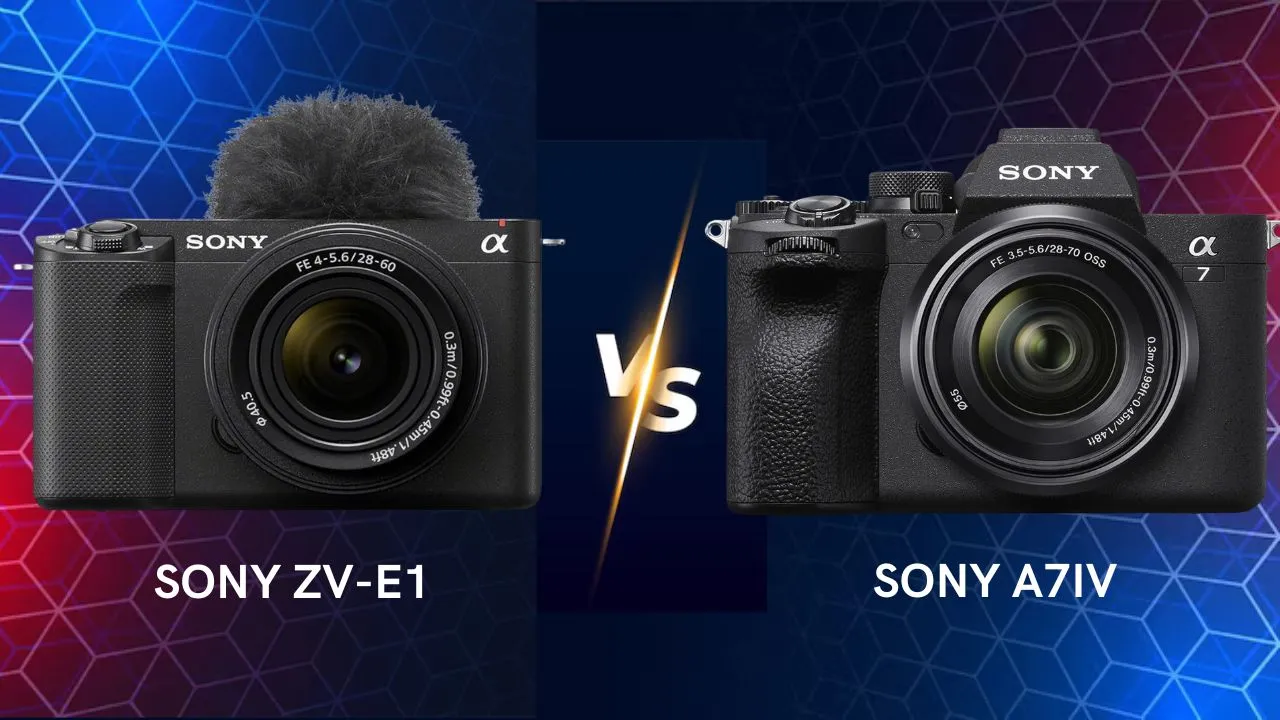
The Sony ZV-E1 and Sony A7 IV are two full-frame mirrorless cameras that target different types of creators — but share much of Sony’s latest imaging technology.
At first glance, they seem similar: both deliver 10-bit 4K video, advanced autofocus, and in-body image stabilization. However, their core design philosophies are quite different.
The ZV-E1 is a video-first camera optimized for content creators, vloggers, and filmmakers who value portability and automation. The A7 IV, meanwhile, is a true hybrid powerhouse built for professionals who need both high-quality stills and serious video performance.
So, which one should you buy? Let’s find out.
⚙️ Overview – Full-Frame Cinema vs Professional Hybrid
Sony ZV-E1:
Sony’s compact full-frame camera designed specifically for video creators. It features a 12 MP full-frame sensor (the same as the FX3), AI-assisted autofocus, excellent stabilization, and powerful 4K 120p recording — all in a small, lightweight body.
Sony A7 IV:
A more traditional mirrorless hybrid camera with a 33 MP full-frame sensor, 10-bit 4K 60p video, and advanced photo capabilities. It’s aimed at photographers and hybrid creators who want professional flexibility for both stills and video.
In short:
-
ZV-E1 = Full-frame cinematic video for content creators.
-
A7 IV = High-resolution hybrid performance for pros.
📸 Specifications Comparison
| Feature | Sony ZV-E1 | Sony A7 IV |
|---|---|---|
| Release Date | March 2023 | October 2021 |
| Camera Type | Full-Frame Mirrorless (Video-centric) | Full-Frame Mirrorless (Hybrid) |
| Sensor | 12.1 MP Full-Frame BSI CMOS (same as FX3) | 33 MP Full-Frame BSI CMOS |
| Processor | BIONZ XR + Dedicated AI Processor | BIONZ XR |
| Lens Mount | Sony E-Mount | Sony E-Mount |
| ISO Range | 80–102,400 (expandable to 409,600) | 100–51,200 (expandable to 204,800) |
| Dynamic Range | 15+ Stops | 15 Stops |
| In-Body Stabilization (IBIS) | 5-Axis, up to 5 Stops + Dynamic Active Mode | 5-Axis, up to 5.5 Stops |
| Autofocus System | 759 Phase-Detection Points + AI Tracking | 759 Phase-Detection Points + Real-Time Eye AF |
| Continuous Shooting | 10 fps | 10 fps |
| Video Recording | 4K 120p / 60p / 30p / 24p (10-bit 4:2:2) | 4K 60p (Super 35 crop) / 30p full-frame (10-bit 4:2:2) |
| Log Profiles | S-Cinetone, S-Log3, HLG | S-Cinetone, S-Log3, HLG |
| Slow Motion | Up to 240 fps (Full HD) | Up to 120 fps (Full HD) |
| Photo Resolution | 12 MP | 33 MP |
| Viewfinder | 2.36M-dot OLED | 3.69M-dot OLED |
| Screen | 3.0” Vari-Angle Touch LCD (1.04M dots) | 3.0” Vari-Angle Touch LCD (1.04M dots) |
| Battery Life (CIPA) | ~570 shots | ~610 shots |
| Card Slots | 1× SD UHS-II | Dual Slot (CFexpress Type A / SD UHS-II) |
| Connectivity | USB-C 3.2, Wi-Fi 5GHz, Bluetooth, Micro HDMI | USB-C 3.2, Wi-Fi 5GHz, Bluetooth, Full-Size HDMI |
| Body Material | Composite + Magnesium Alloy | Magnesium Alloy |
| Weight (Body Only) | 483 g | 658 g |
| Price (Body Only) | ~$2,199 (check on Amazon) | ~$2,499 (check on Amazon) |
🧱 Build and Handling
The ZV-E1 is designed for portability and ease of use. Its minimalist design is perfect for solo creators who need a lightweight setup and quick controls. It includes creator-focused features like auto framing, product showcase mode, and a dedicated bokeh switch for instant background blur.
The A7 IV is larger, sturdier, and more traditional — with dual control dials, customizable buttons, and weather sealing. It’s built for long sessions, external monitors, and more professional workflows.
👉 Verdict:
-
ZV-E1: Best for handheld vlogging and travel.
-
A7 IV: Best for professional hybrid use and studio setups.
🎯 Autofocus and Performance
Both cameras feature Sony’s powerful AI-driven autofocus system, capable of detecting eyes, faces, animals, birds, and vehicles.
The ZV-E1 goes a step further with real-time auto framing and AI subject recognition that automatically tracks and reframes the subject — a massive advantage for solo shooters.
The A7 IV, however, offers greater reliability for stills and more consistent focus control during photo sessions.
👉 Verdict:
-
ZV-E1: Best for intelligent video automation.
-
A7 IV: Best for hybrid creators and photographers.
🎥 Video Capabilities
Both cameras deliver outstanding 4K footage, but the ZV-E1 takes the lead for pure video power.
Sony ZV-E1
-
4K 120p (Full-Frame, no crop)
-
10-bit 4:2:2 internal recording
-
Dynamic Active Stabilization
-
S-Cinetone color science
-
AI Auto Framing and Subject Recognition
-
Best for cinematic solo production
Sony A7 IV
-
4K 60p (Super 35 crop) / 4K 30p full-frame
-
10-bit 4:2:2 internal recording
-
Dual card slots for redundancy
-
Better heat management for long sessions
-
Excellent hybrid workflow
👉 Verdict:
-
ZV-E1: Best for filmmakers, vloggers, and cinematic creators.
-
A7 IV: Best for professionals who need hybrid reliability.
🧠 Image Quality
The A7 IV’s 33 MP sensor gives it a clear edge in resolution for still photography — perfect for portraits, landscapes, and commercial work.
The ZV-E1, on the other hand, shines in low light and video — its 12 MP full-frame sensor (shared with the FX3 and A7S III) delivers outstanding noise performance, dynamic range, and color depth.
👉 Verdict:
-
ZV-E1: Superior low-light and video image quality.
-
A7 IV: Higher resolution and versatility for stills.
🔋 Battery Life and Workflow
Both use the NP-FZ100 battery, delivering strong endurance for long shoots.
The A7 IV has the edge for professional workflows with dual card slots, full-size HDMI, and faster data transfer — ideal for hybrid or event work.
The ZV-E1, while single-slot, offers a simpler creator-focused workflow with USB-C streaming, direct-to-social options, and lighter weight.
👉 Verdict:
-
ZV-E1: Better for portable content creation.
-
A7 IV: Better for pro workflows and redundancy.
💰 Price and Value
| Model | Approx. Price | Ideal For |
|---|---|---|
| Sony ZV-E1 | ~$2,199 | Video creators, vloggers, filmmakers |
| Sony A7 IV | ~$2,499 | Hybrid professionals, photographers, event shooters |
The ZV-E1 costs slightly less and offers more advanced video specs, while the A7 IV gives you a higher-resolution sensor and professional workflow features.
👉 Verdict:
-
ZV-E1: Best value for video creators.
-
A7 IV: Best all-around investment for hybrid users.
Check availability and price on Amazon 🛒
📷 Sony ZV-E1 — Amazon USA / Amazon Canada / Amazon UK / Amazon Australia
📷 Sony A7 IV — Amazon USA / Amazon Canada / Amazon UK / Amazon Australia
(As an Amazon Associate, I earn from qualifying purchases — at no extra cost to you.)
🏁 Final Verdict — Sony ZV-E1 vs A7 IV
| Type of User | Recommended Camera |
|---|---|
| Professional Videographer / YouTuber | ZV-E1 |
| Hybrid Creator (Photo + Video) | A7 IV |
| Travel / Solo Filmmaker | ZV-E1 |
| Event / Portrait Photographer | A7 IV |
| Low-Light Filmmaker | ZV-E1 |
| Studio / Corporate Shooter | A7 IV |
✅ In short:
Choose the Sony ZV-E1 if you prioritize video performance, portability, and AI-driven automation.
Choose the Sony A7 IV if you need a professional hybrid camera capable of capturing stunning stills and top-tier 4K video in any environment.
🧠 Final Thoughts
Both the ZV-E1 and A7 IV are phenomenal full-frame cameras — but they cater to different creative needs.
The ZV-E1 is the ultimate creator’s video camera, delivering cinematic image quality, powerful stabilization, and smart automation in a lightweight body.
The A7 IV, on the other hand, remains the most balanced hybrid camera in Sony’s lineup — blending professional photo performance with advanced video features.
If your goal is cinematic storytelling and solo video creation, the ZV-E1 is unbeatable.
If you want one camera to do it all — photo and video — with professional reliability, the A7 IV is the clear winner.