Sony ZV-E1 vs A6700 • Which one is better?
Sony ZV-E1 vs A6700 – Which One Is Better?
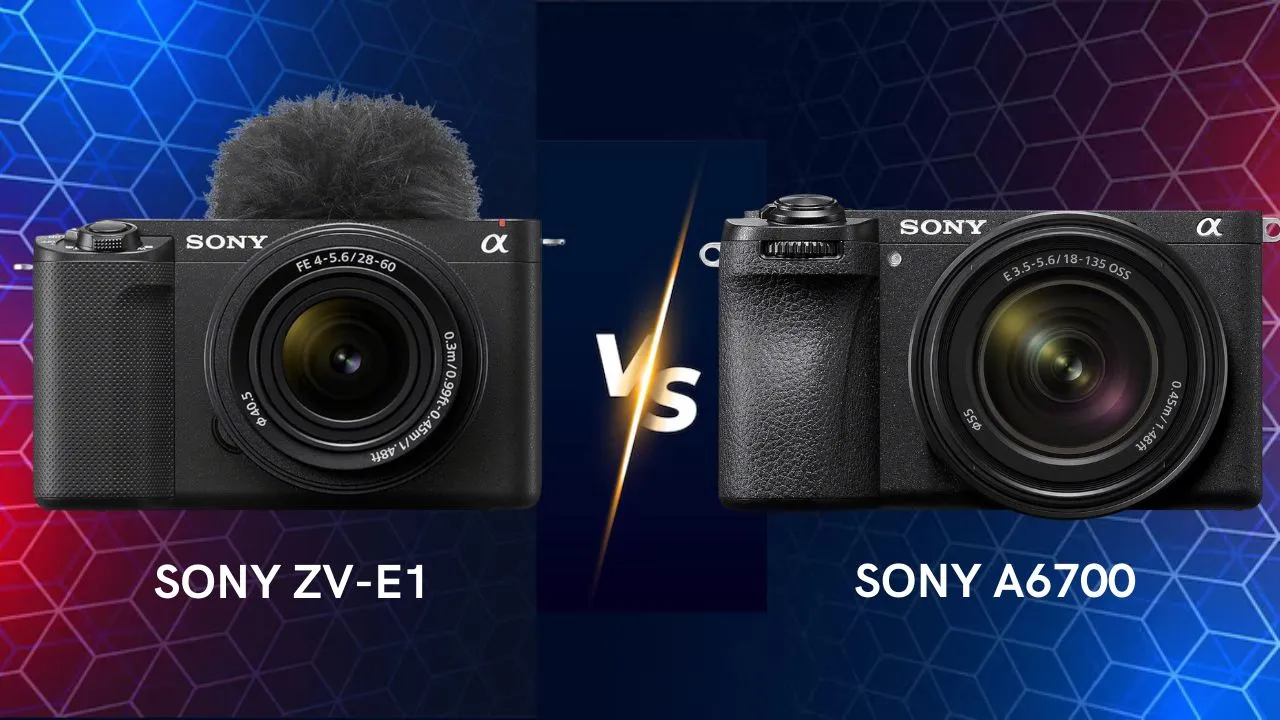
The Sony ZV-E1 and Sony A6700 are both high-performance mirrorless cameras, but they target somewhat different creators and usage scenarios.
The ZV-E1 is a full-frame camera built primarily for video creators and vloggers – compact yet powerful with a full-frame sensor and pro-video chops.
The A6700 is an APS-C sensor hybrid camera designed for stills and video creators who want flexibility, high resolution, and strong performance in a more compact APS-C form factor.
So which one is better? Let’s find out.
⚙️ Overview – Full-Frame Cinema vs APS-C Hybrid
Sony ZV-E1:
A full-frame interchangeable-lens camera with a 12-MP sensor (yes lower resolution stills) optimized for creators who want cinematic video quality, excellent low-light performance, and full-frame depth of field.
Sony A6700:
An APS-C mirrorless with 26 MP resolution, advanced autofocus (AI subject detection across humans, animals, etc.), high-frame-rate video, and strong stills performance.
In short:
-
ZV-E1 = Full-frame, video-centric, deep image quality.
-
A6700 = Higher resolution stills + hybrid shooting in APS-C, more affordable and flexible.
📸 Specifications Comparison
| Feature | Sony ZV-E1 | Sony A6700 |
|---|---|---|
| Release Date | April 2023 | July 2023 |
| Camera Type | Mirrorless (Video-focused) | Mirrorless (Hybrid APS-C) |
| Sensor | Full-Frame 12.1 MP BSI-CMOS | APS-C 26.0 MP BSI-CMOS |
| Image Processor | BIONZ XR + AI Processing Unit | BIONZ XR + AI Processing Unit |
| Lens Mount | Sony E-mount | Sony E-mount |
| ISO Range | 80–102,400 (expandable to 409,600 for video) | 100–32,000 (expandable to 102,400) |
| In-Body Image Stabilization (IBIS) | Yes, 5-axis (Active + Dynamic Active) | Yes, 5-axis |
| Autofocus System | Hybrid phase-detection AF (759 points) | Hybrid phase-detection AF (759 points) |
| AF Subject Recognition | Humans, animals, birds, insects, vehicles, aircraft | Humans, animals, birds, insects, vehicles, aircraft |
| Continuous Shooting Speed | Up to 10 fps (electronic) | Up to 11 fps |
| Video Recording | Up to 4K 120p | Up to 4K 120p |
| Video Bit Depth / Color | 10-bit 4:2:2 internal | 10-bit 4:2:2 internal |
| Color Profiles | S-Log3, S-Cinetone, HLG | S-Log3, S-Cinetone, HLG |
| RAW Video Output | Yes, 16-bit via HDMI | Yes, 16-bit via HDMI |
| Recording Limit | No recording limit (thermal dependent) | No recording limit (thermal dependent) |
| Viewfinder | None | 2.36M-dot OLED EVF |
| LCD Screen | 3.0″ fully articulating touchscreen (1.03M dots) | 3.0″ fully articulating touchscreen (1.03M dots) |
| Touch Functions | Yes (AF, tracking, menus) | Yes (AF, tracking, menus) |
| Product Showcase Mode | Yes | No |
| Background Defocus Button | Yes | No |
| Body Material | Magnesium alloy | Magnesium alloy |
| Weather Sealing | Yes (basic sealing) | Yes (basic sealing) |
| Audio Options | Mic input, headphone out, digital MI shoe | Mic input, headphone out, digital MI shoe |
| Connectivity | Wi-Fi, Bluetooth, USB-C, HDMI | Wi-Fi, Bluetooth, USB-C, HDMI |
| Battery Type | NP-FZ100 | NP-FZ100 |
| Battery Life (CIPA) | Approx. 570 shots | Approx. 570 shots |
| Dimensions (W × H × D) | 121 × 71.9 × 54.3 mm | 122 × 69 × 75.1 mm |
| Weight (Body Only) | Approx. 399 g | Approx. 409 g |
| Price (Body Only) | Approx. USD 2,199 (check on Amazon) | Approx. USD 1,399 |
🧱 Build and Handling
The ZV-E1 offers a full-frame sensor in a compactish body (for full-frame), weighing about 483 g and measuring approx 121 × 71.9 × 54.3 mm. Its design is optimized for video creators: good handling, video-centric controls, interchangeable lenses with full-frame depth.
The A6700, being APS-C, tends to be smaller, lighter, and more flexible for lens choices and everyday shooting. For hybrid shooters or stills/video creators who don’t require full-frame bokeh or ultra low-light, this is a major plus.
Verdict:
-
ZV-E1: Premium build, full-frame depth, optimal for video.
-
A6700: More compact, versatile, excellent for hybrid use.
🎯 Autofocus and Performance
Autofocus is a strength for both, but for slightly different reasons:
-
The ZV-E1 emphasizes video-centric subject detection and smooth transitions — excellent for vlogging, interviews, content creation.
-
The A6700 offers next-gen autofocus across many subject types (humans, birds, vehicles) in an APS-C body, which is impressive for stills and hybrid usage.
Verdict:
-
ZV-E1: Best for video creators who want smart tracking and simplified focusing.
-
A6700: Best for those who shoot stills + video and need broad AF subject coverage.
🎥 Video Capabilities
Video is where the ZV-E1 shines:
ZV-E1: Full-frame sensor, video-centric features, 10-bit 4:2:2, up to 4K/120p recording, excellent low-light and cinematic look.
A6700: Very capable video in APS-C, high frame rates, 10-bit/4:2:2 options, great for hybrid shooting.
Verdict:
-
ZV-E1: Best video-first choice, especially for creators prioritizing cinematic quality and full-frame look.
-
A6700: Excellent video capability plus stills performance — more “do it all” camera.
🧠 Image Quality
The ZV-E1’s full-frame sensor delivers superior depth of field control, low-light performance, and cinematic feel. For creators who use lenses for background separation, full-frame is meaningful.
The A6700’s APS-C sensor is still very good, especially with its high resolution and modern processing. It’s arguably “good enough” for many creators and photographers, and offers better value per euro in many scenarios.
Verdict:
-
ZV-E1: Best for ultra-premium look, cinematic depth, full-frame quality.
-
A6700: Best balancing image quality with cost, flexibility, stills + video.
🔋 Battery Life and Workflow
While exact battery numbers may vary, the APS-C A6700 often benefits from slightly better endurance relative to body size and lenses flexibility.
The ZV-E1, being full-frame and video-oriented, may require more attention to lens choice, lighting and power management for longer sessions.
Verdict:
-
ZV-E1: Must plan for power and workflow (especially for heavy video).
-
A6700: More forgiving for hybrid shooters and stills-focused usage.
💰 Price and Value
Because the ZV-E1 is full-frame and video-oriented, it carries a higher price tag. The A6700, being APS-C and hybrid, typically offers more performance per dollar/euro for many creators.
Verdict:
-
ZV-E1: Premium investment – worth it if you truly need full-frame video and depth.
-
A6700: Best value for creators who shoot stills + video and do not require full-frame.
Check availability and price on Amazon 🛒
📷 Sony ZV-E1 — Amazon USA / Amazon Canada / Amazon UK / Amazon Australia
📷 Sony A6700 — Amazon USA / Amazon Canada / Amazon UK / Amazon Australia
(As an Amazon Associate, I earn from qualifying purchases — at no extra cost to you.)
🏁 Final Verdict — Sony ZV-E1 vs A6700
| Type of User | Recommended Camera |
|---|---|
| Solo Video Creator / Vlogger (full-frame cinematic) | ZV-E1 |
| Hybrid Photographer + Videographer | A6700 |
| Travel Creator with mixed stills + video | A6700 |
| Cinematic Filmmaker wanting full-frame depth | ZV-E1 |
| Budget-conscious Creator | A6700 |
| Creator who prioritizes flexibility and lens system | A6700 |
_
✅ In short:
Choose the Sony ZV-E1 if your priority is video quality, cinematic full-frame look, and you’re a creator who focuses heavily on content creation and video production.
Choose the Sony A6700 if you want a balanced hybrid camera that performs excellently for photography and video, with strong autofocus and high resolution — and offers better value.
🧠 Final Thoughts
Both cameras are excellent tools in 2025, but they serve different creator needs:
If you make video content, vlogs, cinematic interviews, or want that full-frame depth of field — the ZV-E1 stands out.
If you shoot a mix of stills + video, want high resolution, flexibility, want to grow your lens kit, or want better value — the A6700 is likely the smarter overall pick.