Sony ZV-1 II vs RX100 VII | Which one is better?
Sony ZV-1 II vs RX100 VII – Which One Is Better?
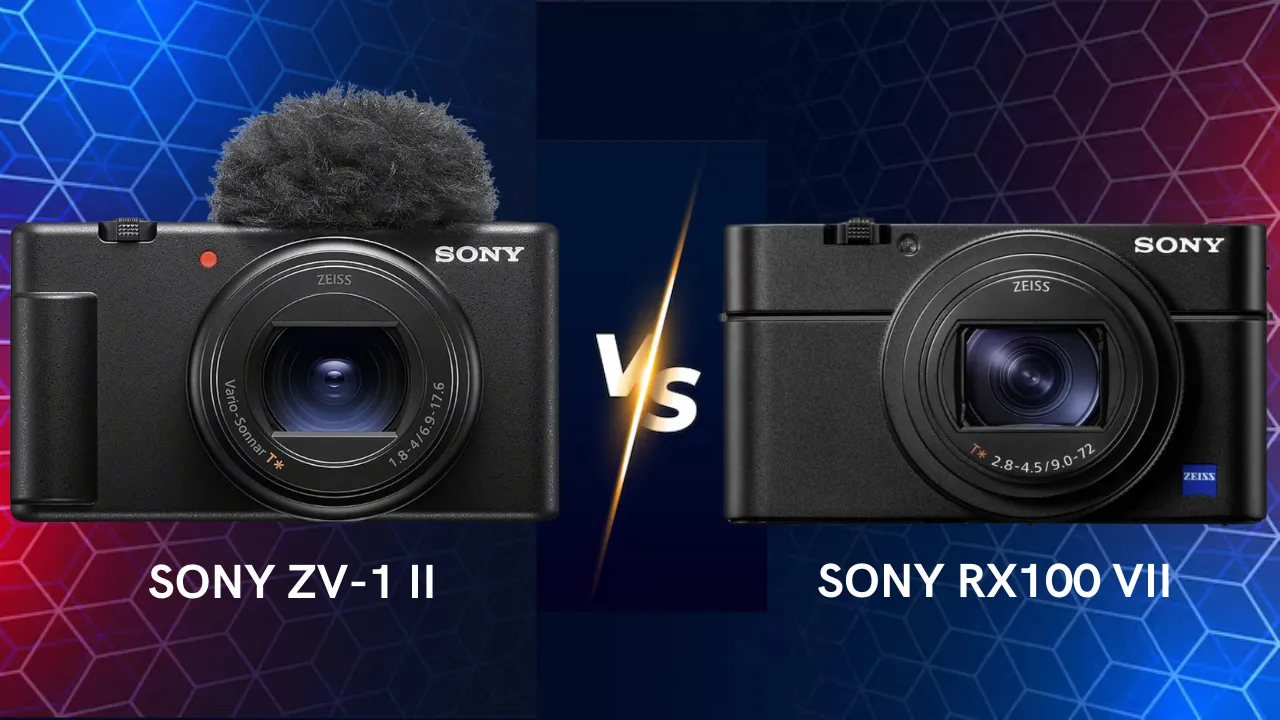
The Sony ZV-1 II and Sony RX100 VII are two of Sony’s top compact cameras, both aimed at creators who want professional image quality in a pocket-sized form.
They share many similarities — compact bodies, 1-inch sensors, and 4K video — but their priorities differ. The RX100 VII is a premium all-rounder built for photographers and travelers, while the ZV-1 II is a vlogging-focused camera optimized for creators and social media video.
So which one should you choose? Let’s find out.
⚙️ Overview – Creator Simplicity vs Premium Versatility
Sony ZV-1 II:
A compact camera designed specifically for vloggers and YouTubers. It builds on the original ZV-1 with a wider 18–50mm f/1.8–4 lens, better microphones, and a more user-friendly interface. Perfect for creators who want simplicity and wide-angle framing for self-recording.
Sony RX100 VII:
Sony’s most advanced compact camera for photographers and travelers. It offers a 24–200mm f/2.8–4.5 Zeiss lens, a pop-up viewfinder, and lightning-fast autofocus — making it one of the most capable pocket cameras ever made.
In short:
-
ZV-1 II = Optimized for vlogging and social media video.
-
RX100 VII = Best for travel, photography, and hybrid creators.
📸 Specifications Comparison
| Feature | Sony ZV-1 II | Sony RX100 VII |
|---|---|---|
| Release Date | May 2023 | July 2019 |
| Camera Type | Compact (Vlogging) | Compact (Premium All-Rounder) |
| Sensor Type | 1-inch Exmor RS CMOS (Stacked) | 1-inch Exmor RS CMOS (Stacked) |
| Resolution | 20.1 MP | 20.1 MP |
| Image Processor | BIONZ X | BIONZ X |
| Lens (35mm equivalent) | 18–50mm f/1.8–4 | 24–200mm f/2.8–4.5 Zeiss Vario-Sonnar T* |
| Optical Zoom Range | 2.8x | 8.3x |
| Autofocus System | 315 Phase-Detect + 425 Contrast Points | 357 Phase-Detect + 425 Contrast Points |
| Continuous Shooting Speed | 24 fps | 20 fps (blackout-free) |
| ISO Range | 125 – 12,800 | 100 – 12,800 |
| In-Body Stabilization | Optical + Electronic (Active Mode) | Optical + Electronic |
| Video Recording | 4K 30p / Full HD 120p | 4K 30p / Full HD 120p |
| Bit Depth / Color | 8-bit 4:2:0 | 8-bit 4:2:0 |
| Color Profiles | S-Log2, S-Log3, HLG | S-Log2, S-Log3, HLG |
| Recording Limit | ✅ Unlimited | 29 minutes (approx.) |
| Microphone Input | ✅ 3.5mm | ✅ 3.5mm |
| Headphone Output | ❌ No | ✅ Yes |
| Built-in Microphone | Directional 3-Capsule | Stereo Microphone |
| Screen | 3.0” Fully Articulating Touch LCD (921k dots) | 3.0” Tilting LCD (921k dots) |
| Viewfinder (EVF) | ❌ No | ✅ 2.36M-dot Pop-Up EVF |
| Touch Controls | Full Touch (focus + menu) | Touch for focus only |
| Product Showcase Mode | ✅ Yes | ❌ No |
| Background Defocus Button | ✅ Yes | ❌ No |
| Body Material | Polycarbonate | Magnesium Alloy |
| Weather Sealing | ❌ No | ❌ No |
| Battery Type | NP-BX1 | NP-BX1 |
| Battery Life (CIPA) | ~290 shots | ~260 shots |
| Connectivity | Wi-Fi, Bluetooth, USB-C | Wi-Fi, Bluetooth, Micro USB |
| Weight (Body Only) | 292 g | 302 g |
| Price (Body Only) | ~$899 (check on Amazon) | ~$1,299 (check on Amazon) |
🧱 Build and Handling
Both cameras are impressively compact, fitting easily in a pocket or small bag.
The ZV-1 II focuses on creator usability — lightweight, easy to hold at arm’s length, and equipped with a side-flipping screen for self-recording. The directional 3-capsule mic with included windscreen makes audio ready for upload.
The RX100 VII feels more premium, with a sturdier magnesium alloy body, retractable viewfinder, and longer zoom range — ideal for photographers who want flexibility in one device.
👉 Verdict:
-
ZV-1 II: Best for handheld vlogging and travel creators.
-
RX100 VII: Best for hybrid shooters who value build quality and a viewfinder.
🎯 Autofocus and Performance
Both use Sony’s world-class Real-Time Tracking and Eye AF, offering fast, accurate focusing for both photo and video.
The RX100 VII has a slight edge with more phase-detection points (357 vs 315) and blackout-free shooting at 20 fps, making it better for still photography and fast-moving subjects.
The ZV-1 II is tuned more for smooth focus transitions and face detection in video, including “Product Showcase Mode” for seamless focus shifts.
👉 Verdict:
-
ZV-1 II: Better optimized for vlogging and talking-head videos.
-
RX100 VII: Better for action, stills, and hybrid creators.
🎥 Video Capabilities
Both cameras deliver excellent 4K video, but the ZV-1 II is clearly optimized for creators:
Sony ZV-1 II
-
4K 30p / Full HD 120p
-
Unlimited recording time
-
Product Showcase Mode & Background Defocus
-
Directional 3-capsule mic with windscreen
-
Full touchscreen operation
Sony RX100 VII
-
4K 30p / Full HD 120p
-
29-minute recording limit
-
Superior rolling shutter control
-
Optional external mic and headphone monitoring
-
Clean HDMI output
👉 Verdict:
-
ZV-1 II: Better for vloggers and direct-to-camera creators.
-
RX100 VII: Better for advanced shooters and filmmakers who need monitoring and longer zoom.
🧠 Image Quality
Both cameras use a 1-inch stacked sensor and deliver excellent image quality for their size — crisp detail, great color, and solid dynamic range.
However, the RX100 VII’s longer lens (24–200mm) gives it a clear advantage for travel, wildlife, or events, while the ZV-1 II’s wider 18mm lens is perfect for vlogging and group shots.
👉 Verdict:
-
ZV-1 II: Better for wide-angle vlogs and creative handheld use.
-
RX100 VII: Better for photographers needing zoom flexibility.
🔋 Battery Life and Connectivity
Both use the same NP-BX1 battery, with similar endurance (~260–290 shots). The ZV-1 II gains a small advantage with its USB-C port, offering faster charging and power delivery.
👉 Verdict:
-
ZV-1 II: More modern USB-C convenience.
-
RX100 VII: Slightly shorter life but includes headphone jack for monitoring.
💰 Price and Value
| Model | Approx. Price | Ideal For |
|---|---|---|
| Sony ZV-1 II | ~$899 | Vloggers, YouTubers, travel creators |
| Sony RX100 VII | ~$1,299 | Hybrid shooters, travelers, photographers |
_
The ZV-1 II offers exceptional value for creators who focus mainly on video and ease of use, while the RX100 VII commands a premium for its versatility and professional features.
👉 Verdict:
-
ZV-1 II: Best choice for content creators and social media users.
-
RX100 VII: Best choice for travel photographers and all-around professionals.
Check availability and price on Amazon 🛒
📷 Sony ZV-1 II — Amazon USA / Amazon Canada / Amazon UK / Amazon Australia
📷 Sony RX100 VII — Amazon USA / Amazon Canada / Amazon UK / Amazon Australia
Note: camerafight.com participates in the Amazon Associates Program. As an Amazon Associate, we earn from qualifying purchases.
🏁 Final Verdict – Sony ZV-1 II vs RX100 VII
| Type of User | Recommended Camera |
|---|---|
| Beginner Vlogger | ZV-1 II |
| YouTuber / Content Creator | ZV-1 II |
| Travel Photographer | RX100 VII |
| Hybrid Photo + Video Creator | RX100 VII |
| Studio / Streaming Setup | ZV-1 II |
| Event / Action Shooter | RX100 VII |
| Compact Everyday Use | ZV-1 II |
| Budget Buyer | ZV-1 II |
_
✅ In short:
Choose the Sony ZV-1 II if you want an easy, creator-focused camera with a wide lens, simple controls, and great audio — perfect for vlogging and travel videos.
Choose the Sony RX100 VII if you want a premium compact powerhouse with advanced autofocus, a viewfinder, and a versatile zoom lens for both photo and video.
🧠 Final Thoughts
Both cameras share Sony’s excellent color science, autofocus, and video quality — but their goals are different.
The ZV-1 II is the ultimate vlogging tool: simple, wide, and optimized for quick creation and upload.
The RX100 VII is the compact camera for professionals, combining zoom versatility, superior build, and advanced features in a pocket-sized body.
If you’re a creator focused on vlogging and social content, go for the ZV-1 II.
If you’re a traveler, photographer, or hybrid user who wants the best all-around performance, the RX100 VII is still the king of compact cameras.