Sony Alpha ZV-E10 vs Canon EOS R50 | Which one is better?
Sony ZV-E10 vs Canon EOS R50 – Which One Is Better?
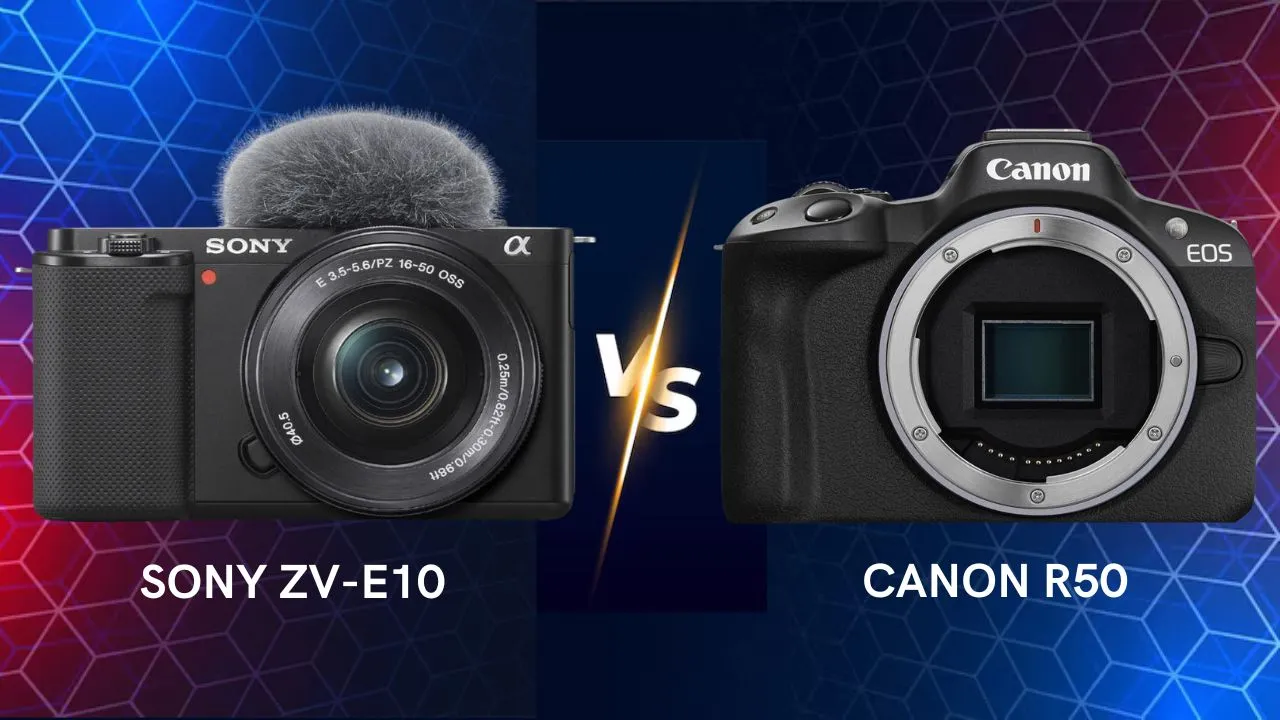
The Sony ZV-E10 and Canon EOS R50 are two compact, entry-level mirrorless cameras designed for content creators and vloggers.
Both are lightweight, easy to use, and deliver great image quality — but they differ in their approach.
The ZV-E10 is Sony’s creator-first camera built around a proven APS-C sensor, while the R50 is Canon’s budget-friendly RF-mount mirrorless camera that offers advanced video tools and beginner-friendly automation.
So, which one is the better buy? Let’s find out.
⚙️ Overview – Creator Classic vs Modern All-Rounder
Sony ZV-E10:
A compact mirrorless camera optimized for vloggers, YouTubers, and travel creators. It shares its 24.2 MP APS-C sensor with Sony’s Alpha lineup and offers great 4K video, a flip-out screen, and excellent autofocus — all in a lightweight body.
Canon EOS R50:
A new-generation entry-level RF camera with a 24.2 MP APS-C sensor, fast autofocus with subject detection, and 4K oversampled video. It’s beginner-friendly, reliable, and fits perfectly into Canon’s growing RF ecosystem.
In short:
-
ZV-E10 = Proven design for vloggers and hybrid creators.
-
R50 = Simplified mirrorless camera with strong AF and beginner features.
📸 Specifications Comparison
| Feature | Sony ZV-E10 | Canon EOS R50 |
|---|---|---|
| Release Date | July 2021 | February 2023 |
| Camera Type | APS-C Mirrorless | APS-C Mirrorless |
| Sensor Resolution | 24.2 MP APS-C CMOS | 24.2 MP APS-C CMOS (Dual Pixel CMOS AF II) |
| Image Processor | BIONZ X | DIGIC X |
| Lens Mount | Sony E-Mount | Canon RF Mount |
| ISO Range | 100 – 32,000 (expandable to 50 – 102,400) | 100 – 32,000 (expandable to 51,200) |
| In-Body Image Stabilization (IBIS) | ❌ No (electronic only) | ❌ No (digital only) |
| Autofocus System | 425 Phase + 425 Contrast Points | Dual Pixel CMOS AF II with AI Subject Detection |
| AF Subject Recognition | Humans / Animals (Eye AF) | Humans / Animals / Vehicles |
| Continuous Shooting Speed | 11 fps | 15 fps (electronic shutter) |
| Video Recording | 4K 30p (no crop) / 1080p 120p | 4K 30p (oversampled from 6K) / 1080p 120p |
| Bit Depth / Color | 8-bit 4:2:0 | 8-bit 4:2:0 |
| Color Profiles | S-Log2, S-Log3, HLG | Canon Log 3, HDR PQ |
| Recording Limit | ✅ Unlimited | ✅ Unlimited |
| LCD Screen | 3.0” Fully Articulating Touchscreen (920k dots) | 3.0” Fully Articulating Touchscreen (1.62M dots) |
| Viewfinder | ❌ No | ✅ 2.36M-dot OLED EVF |
| Touch Controls | Focus + Shutter | Full Menu Navigation + Focus |
| Product Showcase Mode | ✅ Yes | ❌ No |
| Background Defocus Button | ✅ Yes | ❌ No |
| Microphone Input | ✅ 3.5mm | ✅ 3.5mm |
| Headphone Output | ✅ Yes | ❌ No |
| Built-in Microphone | Directional 3-capsule mic | Stereo mic |
| Flash Mount / Hot Shoe | Standard Multi Interface | Canon Multi-Function Shoe |
| Body Material | Polycarbonate | Polycarbonate |
| Weather Sealing | ❌ No | ❌ No |
| Connectivity | Wi-Fi, Bluetooth, USB-C | Wi-Fi, Bluetooth, USB-C |
| Battery Type | NP-FW50 | LP-E17 |
| Battery Life (CIPA) | ~440 shots | ~370 shots |
| Dimensions (W x H x D) | 115 x 64 x 45 mm | 116 x 86 x 69 mm |
| Weight (Body Only) | 343 g | 375 g |
| Price (Body Only) | ~$699 (check on Amazon) | ~$679 (check on Amazon) |
🧱 Build and Handling
Both cameras are lightweight and compact, making them great for handheld shooting or travel.
The ZV-E10 is smaller and lighter, with a clean, minimalist interface optimized for creators. Its fully articulating touchscreen and large recording tally light make it ideal for solo vloggers.
The R50 offers a slightly more traditional DSLR-style grip and a built-in electronic viewfinder, which many photographers will appreciate. It feels more like a “real camera” for stills.
👉 Verdict:
-
ZV-E10: Best for vloggers who prioritize portability and simplicity.
-
R50: Best for photographers who want a small camera with a viewfinder.
🎯 Autofocus and Performance
The ZV-E10 uses Sony’s class-leading 425-point hybrid autofocus with Real-Time Eye AF for humans and animals — extremely reliable and fast.
The R50 introduces Canon’s Dual Pixel CMOS AF II, which adds AI-based subject detection, allowing it to recognize humans, animals, and vehicles. It’s slightly smarter in tracking moving subjects.
👉 Verdict:
-
ZV-E10: Excellent tracking and precision for vlogging and hybrid use.
-
R50: Smarter subject detection for stills and action.
🎥 Video Capabilities
Both cameras shoot great 4K footage, but they differ in their flexibility and design.
Sony ZV-E10
-
4K 30p (no crop) / 1080p 120p
-
Product Showcase Mode (instant focus shift)
-
Soft Skin Effect and Background Defocus
-
Directional 3-capsule microphone
-
Unlimited recording time
Canon EOS R50
-
4K 30p oversampled from 6K (super sharp detail)
-
Dual Pixel AF II in all modes
-
10-bit HDR PQ option (for grading)
-
UVC/UAC support for plug-and-play streaming
-
No headphone jack
👉 Verdict:
-
ZV-E10: Better for vlogging and creator workflows.
-
R50: Better for cinematic detail and clean oversampled 4K footage.
🧠 Image Quality
Both cameras feature 24 MP APS-C sensors and deliver excellent image quality for their class.
The ZV-E10 produces rich, natural colors with Sony’s neutral tone, while the R50 offers Canon’s warmer color science — particularly flattering for skin tones and portraits.
Thanks to its newer DIGIC X processor, the R50 provides slightly cleaner images at high ISO and better color depth in JPEGs straight out of camera.
👉 Verdict:
-
ZV-E10: Great image quality and flat color profiles for editing.
-
R50: Superior out-of-camera color and skin tone rendering.
🔋 Battery Life and Connectivity
The ZV-E10 lasts slightly longer, delivering around 440 shots per charge versus 370 on the R50.
Both support USB-C charging and Wi-Fi/Bluetooth connectivity. However, the R50 can act as a plug-and-play webcam (UVC/UAC) without additional software — a great feature for streamers.
👉 Verdict:
-
ZV-E10: Better endurance and audio options.
-
R50: Easier webcam and live-streaming integration.
💰 Price and Value
| Model | Approx. Price | Ideal For |
|---|---|---|
| Sony ZV-E10 | ~$699 | Vloggers, YouTubers, travel creators |
| Canon EOS R50 | ~$679 | Beginners, hybrid shooters, casual photographers |
_
Both cameras offer excellent value for under $700, but their strengths differ:
-
The ZV-E10 wins for content creation and flexible video tools.
-
The R50 wins for beginners who want great stills and Canon’s ease of use.
👉 Verdict:
-
ZV-E10: Best for vloggers and hybrid content creators.
-
R50: Best for photographers and casual video shooters.
Check availability and price on Amazon 🛒
📷 Canon EOS R50 — Amazon USA / Amazon Canada / Amazon UK / Amazon Australia
📷 Sony ZV-E10 — Amazon USA / Amazon Canada / Amazon UK / Amazon Australia
Note: camerafight.com participates in the Amazon Associates Program. As an Amazon Associate, we earn from qualifying purchases.
🏁 Final Verdict — Sony ZV-E10 vs Canon R50
| Type of User | Recommended Camera |
|---|---|
| Beginner Photographer | R50 |
| Vlogger / YouTuber | ZV-E10 |
| Hybrid Creator (Photo + Video) | ZV-E10 |
| Portrait Photographer | R50 |
| Travel Creator | ZV-E10 |
| Studio / Streamer | R50 |
| Social Media Content Creator | ZV-E10 |
| Budget Buyer | R50 (slightly cheaper) |
_
✅ In short:
Choose the Sony ZV-E10 if you’re a vlogger or creator who wants a lightweight setup with creator-friendly features like Product Showcase Mode and advanced autofocus.
Choose the Canon R50 if you’re a beginner photographer or hybrid shooter who values Canon’s color science, AI autofocus, and oversampled 4K quality.
🧠 Final Thoughts
Both the Sony ZV-E10 and Canon EOS R50 are fantastic entry-level cameras that deliver professional results in small, affordable packages.
The ZV-E10 remains a top choice for vloggers, streamers, and hybrid creators, offering the perfect balance of portability and creative control.
The R50, meanwhile, is ideal for beginners and hobbyist photographers who want Canon’s signature colors, simple menus, and impressive autofocus.
If your focus is content creation, go for the Sony ZV-E10.
If you lean more toward photography and ease of use, the Canon EOS R50 is the better match.