Sony Alpha 7R IV vs V – Which one is better?
Sony Alpha 7R IV vs Sony Alpha 7R V – Which One Is Better?
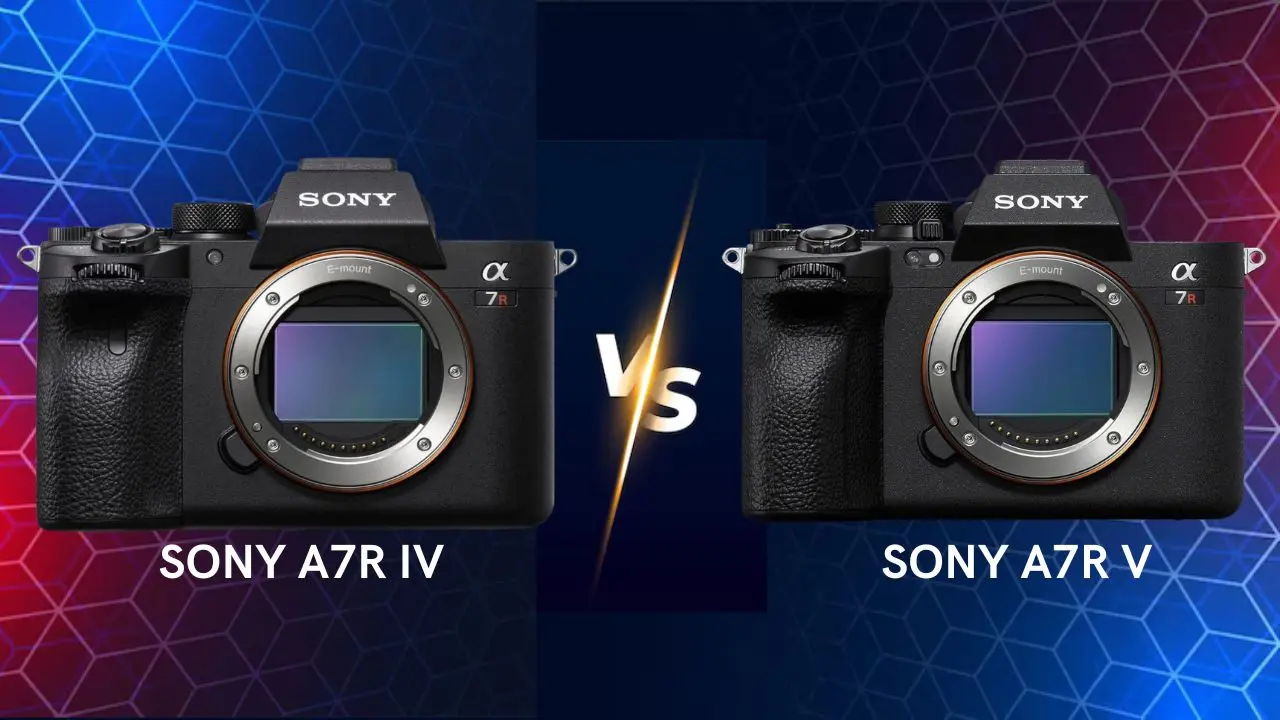
The Sony A7R IV and Sony A7R V are two high-end full-frame mirrorless cameras in Sony’s “R” series, both built around 61 MP sensors and designed for photographers demanding extreme resolution and image quality.
While externally they may look similar and share many strengths, the A7R V introduces a number of meaningful upgrades. So the real question is: are those upgrades worth the extra cost? Let’s find out.
⚙️ Overview – Proven High-Resolution vs Refined Flagship
Sony A7R IV:
A 61-megapixel full-frame powerhouse with excellent resolution, dynamic range, and still-image performance. For photographers who want detailed landscapes, commercial work, or print-large files, this remains a strong choice.
Sony A7R V:
Also housing a 61-megapixel sensor, but upgraded in many aspects: new BIONZ XR processor, AI subject recognition, improved IBIS, enhanced video features, and modern workflow enhancements. It is aimed at professionals who want the best in high resolution and modern hybrid capabilities.
In short:
-
A7R IV = Proven stills excellence, somewhat older tech.
-
A7R V = Next-step, refined flagship for those needing more features and future-proofing.
📸 Specifications Comparison
| Feature | Sony Alpha 7R IV | Sony Alpha 7R V |
|---|---|---|
| Release Date | July 2019 | October 2022 |
| Camera Type | Full-Frame Mirrorless | Full-Frame Mirrorless |
| Sensor Resolution | 61 MP Full-Frame BSI CMOS | 61 MP Full-Frame BSI CMOS |
| Image Processor | Dual BIONZ X | Dual BIONZ XR + Dedicated AI Processing Unit |
| Lens Mount | Sony E-Mount | Sony E-Mount |
| Native ISO Range | 100 – 32,000 (expandable 50 – 102,400) | 100 – 32,000 (expandable 50 – 102,400) |
| Dynamic Range (approx.) | 15 stops | 15 stops |
| In-Body Stabilization (IBIS) | ✅ 5-axis, up to 5.5 stops | ✅ 5-axis, up to 8 stops (new algorithm) |
| Autofocus System | 567 Phase-Detection Points | 693 Phase-Detection Points with AI Recognition |
| AF Subject Recognition | Humans / Animals (Eye AF) | Humans / Animals / Birds / Insects / Vehicles / Trains / Airplanes |
| Continuous Shooting Speed | 10 fps | 10 fps (with deeper buffer) |
| Shutter Type | Mechanical / Electronic | Mechanical / Electronic |
| Shutter Speed Range | 1/8000s to 30s | 1/8000s to 30s |
| Pre-Capture / Pre-Burst | ❌ No | ✅ Yes |
| Viewfinder | 5.76M-dot OLED EVF (0.78x) | 9.44M-dot OLED EVF (0.9x, 120Hz refresh rate) |
| LCD Screen | 3.0” Tilting LCD (1.44M dots) | 4-axis Fully Articulating LCD (2.1M dots) |
| Touchscreen Functions | Limited | Full Touch Menu Navigation & AF Control |
| Video Recording | 4K 30p (8-bit 4:2:0) | 8K 24p / 4K 60p / 10-bit 4:2:2 Internal |
| Video Bit Depth / Codec | 8-bit, S-Log2 / S-Log3 / HLG | 10-bit 4:2:2, S-Log3, S-Cinetone, HLG |
| RAW Video Output | ❌ No | ✅ 16-bit RAW via HDMI |
| Recording Limit | ~29 minutes | ✅ Unlimited (improved heat dissipation) |
| Storage Media | Dual SD UHS-II | Dual CFexpress Type A + SD UHS-II (combo slots) |
| Processor Speed | Slower (BIONZ X) | 8x faster (BIONZ XR) |
| Connectivity | Wi-Fi, Bluetooth, USB-C 3.1, Micro HDMI | Wi-Fi 5GHz, Bluetooth 5.1, USB-C 3.2, Full-Size HDMI |
| Flash Sync Speed | 1/250s | 1/250s |
| Battery Type | NP-FZ100 | NP-FZ100 |
| Battery Life (CIPA) | ~670 shots | ~530 shots |
| Body Material | Magnesium Alloy | Magnesium Alloy with Reinforced Cooling |
| Weather Sealing | ✅ Yes | ✅ Enhanced |
| Weight (Body Only) | 665 g | 723 g |
| Dimensions (W x H x D) | 129 x 96 x 78 mm | 131 x 97 x 82 mm |
| AI Processor / Machine Learning | ❌ No | ✅ Yes |
| Focus Breathing Compensation | ❌ No | ✅ Yes |
| Pixel Shift Multi Shooting | ✅ 16-image composite (240 MP) | ✅ 16-image composite (240 MP, improved alignment) |
| USB Power Delivery (PD) | ✅ Yes | ✅ Yes (faster charging) |
| Hot Shoe Type | Standard ISO | Multi Interface Shoe (digital audio compatible) |
| Price (Body Only) | ~$2,999 (check on Amazon) | ~$3,899 (check on Amazon) |
🧱 Build & Handling
The A7R IV has a more compact, slightly lighter body (~665g) and is very good for photographers who prioritise portability in high-resolution work.
The A7R V, while slightly larger and heavier (~723g), adds refinements: a fully articulating LCD, improved ergonomics, and more advanced controls for mixed photo/video/ hybrid workflows.
👉 Verdict:
-
A7R IV → Slight advantage in portability and simplicity.
-
A7R V → Better for photographers who also value video/modern workflows and can accept a slightly larger body.
🎯 Autofocus & Performance
Autofocus is a key difference. The A7R IV offers excellent stills AF performance for its time, but the A7R V brings in the newer AI-based system, allowing recognition of a much broader range of subjects (insects, vehicles, etc.).
In practice, for studio or landscape work where subject motion is minimal, the difference may be less impactful. For dynamic shooting, the A7R V’s tracking may give a meaningful edge.
👉 Verdict:
-
A7R IV → Still very strong for static subject photography.
-
A7R V → Better for action, complex tracking or hybrid use where AF matters a lot.
🎥 Video & Hybrid Capabilities
While both cameras are primarily stills-oriented, the A7R V pulls ahead in hybrid features: improved stabilization, better integration of video modes, faster data handling and improved workflow options.
If your focus is purely high-resolution stills, then the video/hybrid benefits may be less relevant.
👉 Verdict:
-
A7R IV → Good for stills with occasional video.
-
A7R V → More future-proof if you also shoot video or need advanced workflow features.
🧠 Image Quality
Since both share the same 61 MP sensor, stills image quality (resolution, dynamic range) is very close. Some tests suggest the A7R V slightly edges out the IV in processing, stabilization, and real-world results thanks to the newer processor.
👉 Verdict:
If your workflow is centred on high resolution stills, both will deliver superb image quality. The A7R V offers incremental improvement; the A7R IV remains excellent value.
🔋 Battery Life & Workflow
The older A7R IV slightly wins on battery life and simplicity, while the A7R V offers more modern connectivity, card slot options (CFexpress Type A + SD in some markets) and enhanced workflow features.
👉 Verdict:
-
A7R IV → Advantage in pure battery/endurance for stills.
-
A7R V → Advantage in workflow flexibility and future-proofing.
💰 Price & Value
Given its older status, the A7R IV tends to cost less (for body only) than the newer A7R V. For those who need high resolution but can accept fewer modern features, this is excellent value.
The A7R V commands a premium for its extra features and future-proofing.
👉 Verdict:
-
A7R IV → Better value if you focus on stills and don’t need the absolute latest features.
-
A7R V → Worth the extra if budget allows and you’ll benefit from the newer tech.
Check availability and price on Amazon 🛒
📷 Sony A7R IV — Amazon USA / Amazon Canada / Amazon UK / Amazon Australia
📷 Sony A7R V — Amazon USA / Amazon Canada / Amazon UK / Amazon Australia
Note: camerafight.com participates in the Amazon Associates Program. As an Amazon Associate, we earn from qualifying purchases.
🏁 Final Verdict – Sony A7R IV vs A7R V
| Type of User | Recommended Camera |
|---|---|
| Landscape / studio photographer focused on high resolution | A7R IV |
| Commercial photographer needing maximum detail with proven workflows | A7R IV (or A7R V if budget allows) |
| Hybrid creator (photo + video) or action photographer tracking complex subjects | A7R V |
| Photographer who values newest features/workflows and will keep body longer term | A7R V |
| Budget-conscious high resolution shooter | A7R IV |
–
✅ In short:
If you’re primarily about stills and want outstanding resolution while managing budget, the A7R IV remains a top choice.
If you want more modern AF, improved stabilization, better video/hybrid workflow and plan to keep the body many years, the A7R V is the clear upgrade.