Sony Alpha 7C II vs Canon R8 – Which one is better?
Sony A7C II vs Canon R8 – Which One Is Better?
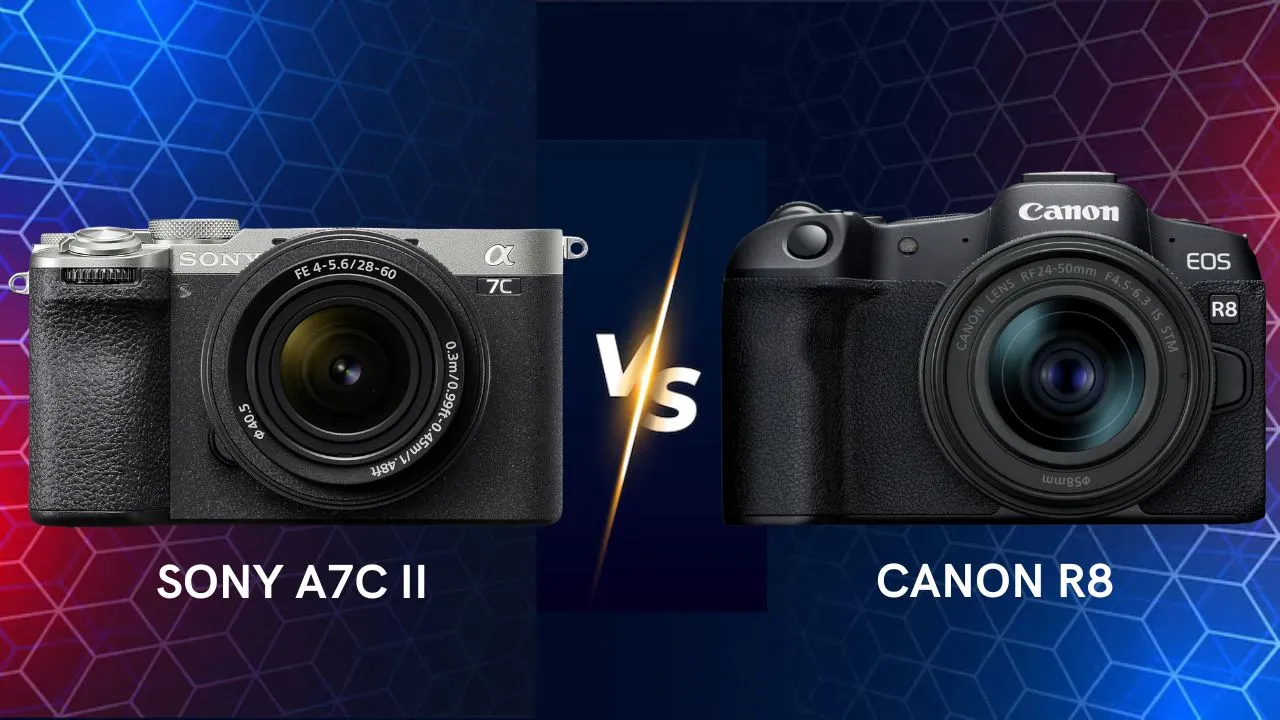
The Sony A7C II and Canon EOS R8 are two of the most compact and capable full-frame mirrorless cameras on the market today.
Both are designed for hybrid creators who want high-quality photo and video performance in lightweight bodies, but they take different approaches. The A7C II focuses on versatility and stabilization, while the R8 prioritizes speed, simplicity, and value.
So, which one gives you the best value for your needs? Let’s find out.
⚙️ Overview – Compact Hybrid Power vs Lightweight Speed
Sony A7C II:
A premium compact hybrid camera featuring a 33 MP full-frame sensor, AI-powered autofocus, and 5-axis in-body stabilization. It’s ideal for creators who shoot both photos and videos and need professional quality in a portable form.
Canon R8:
A lightweight full-frame camera that delivers 24 MP resolution, 6K oversampled 4K video, and Canon’s cutting-edge Dual Pixel CMOS AF II. It’s built for creators who want top-tier image quality without the weight or cost of higher-end models.
In short:
-
A7C II = Compact, stabilized, and advanced hybrid performance.
-
R8 = Fast, affordable, and lightweight full-frame power.
📸 Specifications Comparison
| Feature | Sony A7C II | Canon EOS R8 |
|---|---|---|
| Release Date | August 2023 | February 2023 |
| Sensor | 33 MP Full-Frame BSI CMOS | 24.2 MP Full-Frame CMOS (same as R6 II) |
| Processor | BIONZ XR + AI Processor | DIGIC X |
| Lens Mount | Sony E-Mount | Canon RF Mount |
| In-Body Stabilization (IBIS) | ✅ Yes (5-axis, up to 7 stops) | ❌ No (digital IS only) |
| Video Recording | 4K 60p (10-bit 4:2:2, Super 35 crop) | 4K 60p (10-bit 4:2:2, full sensor, oversampled from 6K) |
| Autofocus System | AI Real-Time Tracking (humans, animals, birds, vehicles, insects) | Dual Pixel CMOS AF II (humans, animals, vehicles) |
| Continuous Shooting | 10 fps | 40 fps (electronic) / 6 fps (mechanical) |
| Viewfinder | 2.36M-dot OLED EVF | 2.36M-dot OLED EVF |
| Screen | 3.0” Fully Articulating Touch LCD | 3.0” Fully Articulating Touch LCD |
| Dual Card Slots | ❌ No (Single SD UHS-II) | ❌ No (Single SD UHS-II) |
| Weather Sealing | ✅ Yes | ✅ Yes |
| Battery Life (CIPA) | ~540 shots | ~290 shots |
| Connectivity | Wi-Fi, Bluetooth, USB-C, HDMI | Wi-Fi, Bluetooth, USB-C, HDMI |
| Weight (Body Only) | 514 g | 461 g |
| Price (Body Only) | ~$2,099 (check on Amazon) | ~$1,499 (check on Amazon) |
🧱 Build and Handling
Both cameras are impressively compact for full-frame systems.
The Sony A7C II has a rangefinder-style body with the viewfinder positioned to the left, a fully articulating screen, and a refined grip over its predecessor. It feels solid and professional despite its small size.
The Canon R8 uses a DSLR-style layout with a central EVF and minimal physical controls, making it lightweight and easy to carry, though slightly less ergonomic for larger lenses.
👉 Verdict:
-
A7C II: More premium feel, better balance, and stronger stabilization.
-
R8: Smaller, lighter, and simpler to operate.
🎯 Autofocus and Performance
Both cameras feature cutting-edge autofocus systems, but with different philosophies.
The A7C II uses Sony’s AI-powered Real-Time Tracking, capable of recognizing humans, animals, birds, cars, and insects — both in stills and video. It’s consistent, sticky, and highly reliable in all lighting conditions.
The Canon R8 employs Canon’s Dual Pixel CMOS AF II, also powered by deep-learning AI. It locks onto subjects instantly and tracks them smoothly, especially in video. Its 40 fps electronic shutter speed makes it faster for action shooting.
👉 Verdict:
-
A7C II: Slightly smarter overall with broader subject recognition.
-
R8: Faster burst shooting and excellent real-time tracking.
🎥 Video Capabilities
Both cameras are fantastic video tools, but their strengths differ.
Sony A7C II
-
4K 60p (10-bit 4:2:2, Super 35 crop)
-
4K 30p oversampled from 7K (full-frame)
-
S-Cinetone, S-Log3, HLG color profiles
-
Focus breathing compensation
-
Active stabilization and unlimited recording
Canon R8
-
4K 60p (10-bit 4:2:2, full-frame, oversampled from 6K)
-
Canon Log 3 and HDR PQ profiles
-
180 fps Full HD slow motion
-
Excellent color science and heat management
-
No in-body stabilization (relying on digital IS and lens IS)
👉 Verdict:
-
A7C II: Better stabilization and advanced color flexibility.
-
R8: Sharper full-frame 4K and superior value for video creators.
🧠 Image Quality
Both cameras produce beautiful images, but their sensors offer different strengths.
The A7C II’s 33 MP sensor captures higher detail and dynamic range, ideal for landscape and portrait photographers who like to crop or print large.
The R8’s 24 MP sensor, borrowed from the R6 II, delivers cleaner images at high ISOs and smoother tones, making it excellent for events, weddings, and general photography.
👉 Verdict:
-
A7C II: Higher resolution and slightly greater dynamic range.
-
R8: Better low-light performance and natural color rendering.
🔋 Battery Life and Connectivity
Battery life is one of the biggest differences between these two cameras.
The A7C II uses Sony’s long-lasting NP-FZ100 battery, delivering around 540 shots per charge and far superior endurance for video.
The R8, with its smaller LP-E17 battery, manages only about 290 shots, though it supports USB-C PD charging and external power delivery for video use.
Both offer Wi-Fi, Bluetooth, and USB-C for easy transfers and remote operation.
👉 Verdict:
-
A7C II: Much longer battery life and professional workflow support.
-
R8: Convenient charging but shorter endurance.
💰 Price and Value
| Model | Approx. Price | Ideal For |
|---|---|---|
| Sony A7C II | ~$2,099 | Hybrid creators, vloggers, professionals |
| Canon R8 | ~$1,499 | Beginners, enthusiasts, content creators |
The Canon R8 offers unbeatable value for its performance — full-frame 4K 60p, advanced autofocus, and superb image quality at a very accessible price.
The Sony A7C II, while more expensive, adds in-body stabilization, better battery life, higher resolution, and deeper hybrid functionality — making it a better long-term investment for serious creators.
👉 Verdict:
-
A7C II: Best all-around hybrid for professionals and frequent shooters.
-
R8: Best value full-frame for budget-conscious creators.
Check availability and price on Amazon 🛒
📷 Canon R8 — Amazon USA / Amazon Canada / Amazon UK / Amazon Australia
📷 Sony A7C II — Amazon USA / Amazon Canada / Amazon UK / Amazon Australia
Note: camerafight.com participates in the Amazon Associates Program. As an Amazon Associate, we earn from qualifying purchases.
🏁 Final Verdict — Sony A7C II vs Canon R8
| Type of User | Recommended Camera |
|---|---|
| Beginner Photographer | Canon R8 |
| Enthusiast Photographer | A7C II |
| Professional Photographer | A7C II |
| Vlogger / YouTuber | Canon R8 |
| Travel Photographer | A7C II |
| Event / Wedding Shooter | Canon R8 |
| Studio Photographer | A7C II |
| Hybrid Creator | A7C II |
| Budget Buyer | Canon R8 |
✅ In short:
Choose the Sony A7C II if you want a modern, stabilized full-frame hybrid camera with higher resolution, AI autofocus, and better endurance.
Choose the Canon R8 if you want incredible full-frame performance, beautiful colors, and professional-grade 4K video — all at a very affordable price.
🧠 Final Thoughts
Both the Sony A7C II and Canon R8 prove that full-frame performance no longer requires a big, heavy camera.
The A7C II shines as a premium hybrid system — compact, stabilized, and perfect for creators who shoot both stills and high-end video.
The Canon R8, meanwhile, is one of the best-value full-frame cameras ever made, delivering superb image quality, advanced autofocus, and professional 4K video in one of the lightest bodies available.
If you value IBIS, resolution, and long-term versatility, go for the A7C II.
If you want speed, simplicity, and unbeatable value, the Canon R8 is the clear winner.