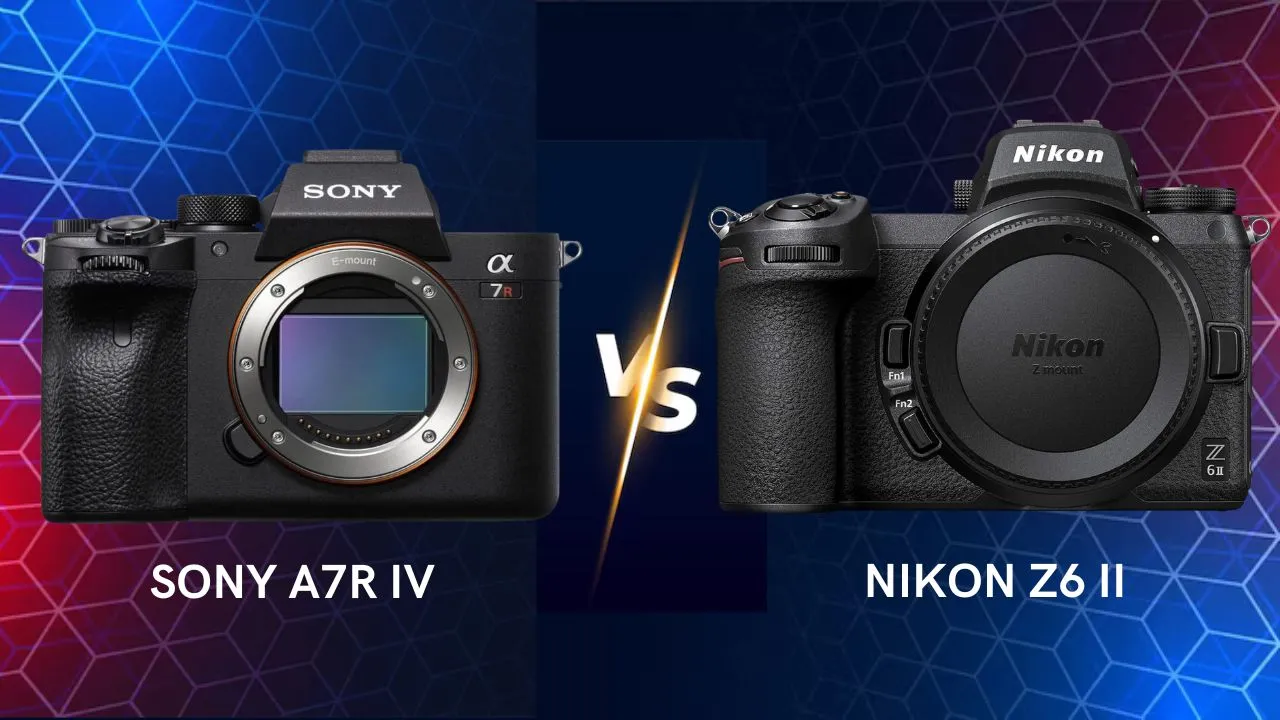
Sony A7R IV vs Nikon Z6 II | Which one is better?
Sony Alpha 7R IV vs Nikon Z6 II – Which One Is Better?
The Sony Alpha 7R IV and Nikon Z6 II are two excellent full-frame mirrorless cameras, but they serve very different audiences.
The A7R IV is a resolution powerhouse, designed for professional photographers who demand maximum image detail and dynamic range. The Z6 II, on the other hand, is a versatile hybrid performer, balancing strong image quality, fast performance, and affordability.
So which one gives you the best value today? Let’s find out.
⚙️ Overview – Resolution King vs Balanced Hybrid
Sony Alpha 7R IV:
A professional-grade mirrorless camera with a 61 MP full-frame BSI sensor, delivering extraordinary detail and cropping flexibility. Ideal for studio, commercial, and landscape photographers who want maximum resolution and clarity.
Nikon Z6 II:
A second-generation hybrid camera with a 24.5 MP BSI sensor, improved autofocus, dual processors, and dual card slots. It’s built for creators who need speed, versatility, and reliability for both photo and video.
In short:
-
A7R IV = Extreme resolution and detail for still photography.
-
Z6 II = Fast, capable hybrid performance for all-around use.
📸 Specifications Comparison
| Feature | Sony Alpha 7R IV | Nikon Z6 II |
|---|---|---|
| Release Date | July 2019 | October 2020 |
| Sensor | 61 MP Full-Frame BSI CMOS | 24.5 MP Full-Frame BSI CMOS |
| Processor | Dual BIONZ X | Dual EXPEED 6 |
| Lens Mount | Sony E-Mount | Nikon Z-Mount |
| In-Body Stabilization (IBIS) | ✅ Yes (5-axis, up to 5.5 stops) | ✅ Yes (5-axis, up to 5 stops) |
| Video Recording | 4K 30p (8-bit 4:2:0) | 4K 60p (10-bit 4:2:2 external) |
| Autofocus System | 567 Phase-Detect Points | 273 Phase-Detect Points |
| Continuous Shooting | 10 fps | 14 fps |
| Viewfinder | 5.76M-dot OLED EVF | 3.69M-dot OLED EVF |
| Screen | 3.0” Tilting LCD | 3.2” Tilting Touch LCD |
| Dual Card Slots | ✅ Dual UHS-II SD | ✅ CFexpress Type B + SD UHS-II |
| Weather Sealing | ✅ Yes | ✅ Yes |
| Battery Life (CIPA) | ~670 shots | ~410 shots |
| Connectivity | Wi-Fi, Bluetooth, USB-C | Wi-Fi, Bluetooth, USB-C |
| Weight (Body Only) | 665 g | 705 g |
| Price (Body Only) | ~$2,999 (check on Amazon) | ~$1,999 (check on Amazon) |
🧱 Build and Handling
Both cameras feature durable magnesium alloy bodies and weather sealing, but their designs reflect different priorities.
The Sony A7R IV is compact and lightweight for its class, yet feels premium and solid. Its high-resolution EVF (5.76M dots) is excellent for critical focusing, especially in studio or landscape environments.
The Nikon Z6 II has a slightly larger grip, a more traditional layout, and one of the most comfortable ergonomics in the full-frame segment. It’s intuitive and ideal for long shooting sessions or video work.
👉 Verdict:
-
A7R IV: Sleeker, lighter, and more premium in design.
-
Z6 II: More comfortable handling and intuitive control layout.
🎯 Autofocus and Performance
The A7R IV features a 567-point phase-detection autofocus system covering 74% of the frame, with Real-Time Eye AF for humans and animals. It’s highly accurate, though not as fast as Sony’s newer AI-based systems.
The Z6 II, powered by dual EXPEED 6 processors, offers faster autofocus and improved subject tracking over the original Z6. While it doesn’t match Sony’s subject recognition intelligence, it performs reliably for action, portraits, and video.
In continuous shooting, the Z6 II’s 14 fps burst rate outpaces the A7R IV’s 10 fps, giving it the edge for fast-paced shooting.
👉 Verdict:
-
A7R IV: Better precision for static or studio work.
-
Z6 II: Faster, more responsive autofocus for action and hybrid shooting.
🎥 Video Capabilities
The Nikon Z6 II is clearly designed with hybrid creators in mind.
Sony A7R IV
-
4K 30p (full sensor readout, 8-bit 4:2:0)
-
S-Log2 / S-Log3 / HLG profiles
-
Clean HDMI output
-
In-body stabilization for handheld shooting
Nikon Z6 II
-
4K 60p (firmware update, 10-bit 4:2:2 external)
-
N-Log and HLG color profiles
-
Full pixel readout for sharp 4K footage
-
Optional 12-bit ProRes RAW output
-
Excellent rolling shutter control
The A7R IV can produce great results for short clips, but the Z6 II is far superior for serious videography, offering more codecs, frame rates, and better heat management.
👉 Verdict:
-
A7R IV: Good for occasional video projects.
-
Z6 II: Excellent for hybrid creators and filmmakers.
🧠 Image Quality
This is where the A7R IV reigns supreme.
Its 61 MP sensor captures extraordinary detail, dynamic range, and color depth — ideal for large prints, studio portraits, or fine-art photography. Even at low ISO, the files are stunningly clean and flexible for post-processing.
The Z6 II’s 24.5 MP sensor, while less detailed, offers better low-light performance due to larger pixels and smoother tonal transitions. Its images are sharp, natural, and versatile — perfect for everyday shooting and event photography.
👉 Verdict:
-
A7R IV: Unmatched resolution and dynamic range for stills.
-
Z6 II: Better low-light performance and tonal smoothness.
🔋 Battery Life and Connectivity
The A7R IV provides up to 670 shots per charge with the NP-FZ100 battery — one of the best in mirrorless performance. It also supports USB-C power delivery and Wi-Fi/Bluetooth connectivity.
The Z6 II lasts for about 410 shots, but features dual card slots (CFexpress + SD), USB-C charging, and a strong SnapBridge app for easy transfers.
👉 Verdict:
-
A7R IV: Longer endurance for photo-heavy sessions.
-
Z6 II: Slightly shorter battery life but more flexible workflow options.
💰 Price and Value
| Model | Approx. Price | Ideal For |
|---|---|---|
| Sony A7R IV | ~$2,999 (check on Amazon) | Landscape, studio, and commercial photographers |
| Nikon Z6 II | ~$1,999 (check on Amazon) | Hybrid creators, videographers, and event shooters |
The A7R IV commands a higher price due to its incredible resolution and detail.
The Z6 II offers outstanding value for money — excellent photo quality, strong video features, and professional performance at a significantly lower cost.
👉 Verdict:
-
A7R IV: Best for professionals who need ultra-high resolution.
-
Z6 II: Best value hybrid camera for most creators.
(As an Amazon Associate, I earn from qualifying purchases — at no extra cost to you.)
🏁 Final Verdict — Sony A7R IV vs Nikon Z6 II
| Type of User | Recommended Camera |
|---|---|
| Landscape Photographer | A7R IV |
| Studio / Commercial Photographer | A7R IV |
| Portrait Photographer | A7R IV |
| Event / Wedding Shooter | Z6 II |
| Travel Photographer | Z6 II |
| Vlogger / YouTuber | Z6 II |
| Hybrid Creator (Photo + Video) | Z6 II |
| Fine-Art Photographer | A7R IV |
| Budget-Conscious Buyer | Z6 II |
✅ In short:
Choose the Sony A7R IV if you prioritize ultimate resolution, detail, and dynamic range for professional still photography.
Choose the Nikon Z6 II if you want a more balanced, affordable, and faster hybrid camera that performs brilliantly across both photo and video.
🧠 Final Thoughts
The Sony Alpha 7R IV remains one of the best high-resolution cameras ever made — a true professional’s tool for demanding photographers who value precision and fine detail.
The Nikon Z6 II, on the other hand, is a perfectly balanced hybrid camera — powerful, intuitive, and more affordable — making it an excellent choice for creators who shoot both stills and video.
If you’re a pure photographer, go for the A7R IV.
If you’re a hybrid creator or all-around shooter, the Z6 II is the smarter, more versatile choice.