Sony A7C vs Lumix S9 – Which one is better?
Sony A7C vs Lumix S9 – Which One Is Better?
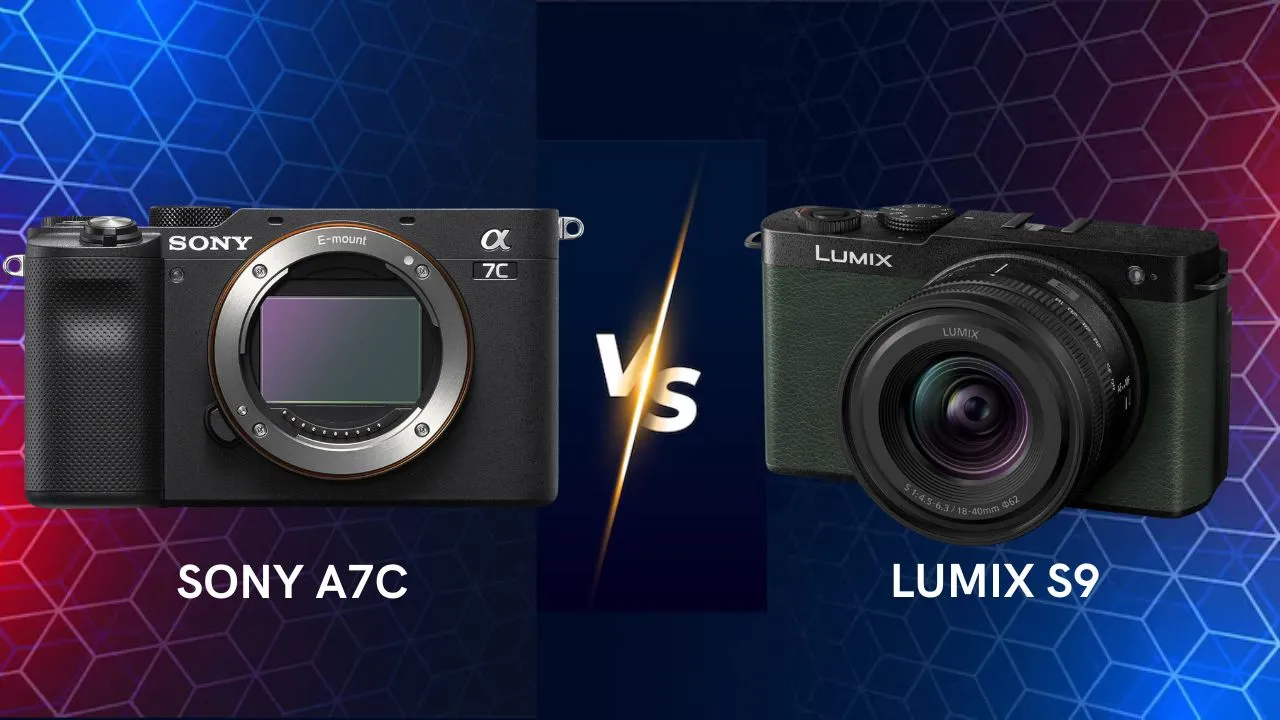
The Sony A7C and Panasonic Lumix S9 are two full-frame mirrorless cameras designed with compactness and creativity in mind.
Both aim to serve hybrid shooters, vloggers, and photographers wanting high quality in a relatively small body – but they approach their tasks from different angles.
So which one is the better value and fit for you today? Let’s dive in.
⚙️ Overview – Established Compact Full-Frame vs Newer Content-Creator Hybrid
Sony A7C:
A full-frame camera that prioritises portability without sacrificing much in image quality or usability. It’s essentially a full-frame photographer’s tool in a travel-friendly body — ideal for everyday shooters, street work, travel and casual video.
Panasonic Lumix S9:
A more recent release targeting creators and content makers. With a 24.2 MP sensor, compact design, and strong video features (6K/4K), it leans into modern workflows, social media, and hybrid photo-video use in a lightweight package.
In short:
-
A7C = Proven full-frame portability, reliable stills, solid video.
-
Lumix S9 = Newer tech, creator-centric features, excellent for hybrid photo + video + content sharing.
📸 Specifications Comparison
| Specification | Sony A7C | Panasonic Lumix S9 |
|---|---|---|
| Release Date | October 2020 | May 2024 |
| Camera Type | Full-frame mirrorless | Full-frame mirrorless |
| Sensor | 24.2 MP full-frame CMOS | 24.2 MP full-frame CMOS |
| Image Processor | BIONZ X | Venus Engine (latest) |
| Lens Mount | Sony E-mount | Leica L-Mount |
| ISO Range | 100–51 200 (expandable to 50–204 800) | 100–51 200 (expandable to 50–204 800) |
| In-Body Image Stabilization (IBIS) | Yes (5-axis) | Yes (5-axis) |
| Autofocus System | Hybrid AF w/ phase & contrast | Hybrid AF w/ on-sensor phase detection (~779 points) |
| AF Subject Recognition | People & animal detection | People & animal detection |
| Continuous Shooting Speed | Up to ~10 fps | ~9 fps |
| Video Recording | 4K UHD up to 30p; FHD up to 120p | 6K up to 30p, 4K up to 60p |
| Video Bit Depth / Color | 8-bit 4:2:0 | 10-bit internal options |
| Color Profiles | Standard Sony profiles | V-Log / cinematic profiles |
| RAW Video Output | Yes (via HDMI) | Yes (via HDMI) |
| Recording Limit | Standard 30 min cap typical | Varies by resolution/codec (~15–20 min in high res) |
| Viewfinder | Built-in EVF (~2.36 M dots) | None (LCD-only) |
| LCD Screen | 3.0″ articulating touchscreen | 3.0″ fully articulating touchscreen (~1.84 M dots) |
| Touch Functions | Full touch control | Full touch control |
| Product Showcase Mode | No dedicated mode | No dedicated mode |
| Background Defocus Button | No | No |
| Body Material | Magnesium/aluminum composite | Composite/lightweight build |
| Weather Sealing | Yes (dust & moisture resistant) | Yes (dust & splash resistant) |
| Audio Options | 3.5 mm mic input & headphone jack | 3.5 mm mic input only |
| Connectivity | Wi-Fi, Bluetooth, USB-C, micro-HDMI | Wi-Fi, Bluetooth, USB-C, micro-HDMI |
| Battery Type | Sony NP-FZ100 | Panasonic DMW-BLK22 |
| Battery Life (CIPA) | ~600+ shots | ~470 shots |
| Dimensions (W × H × D) | ~124 × 71 × 60 mm | ~126 × 74 × 47 mm |
| Weight (Body Only) | ~424 g | ~486 g |
| Approx. Price (Body Only) | ~€1 500–€1 700 (check on Amazon) | ~€1 099–€1 499 (check on Amazon) |
🧱 Build and Handling
The Sony A7C offers a familiar Sony E-mount full-frame experience in a much more compact body than traditional full-frame hybrids. It has a decent grip for its size, IBIS built in, and performs well for handheld and travel use.
The Lumix S9 further pushes the compact agenda: it’s very lightweight, has a simplified control layout aimed at creators, and emphasises portability and ease-of-use in hybrid workflows.
👉 Verdict:
-
A7C: Best for those who want full-frame quality in a compact body with a bit more “traditional” stills-camera feel.
-
Lumix S9: Better for creators prioritising lightweight carry, video workflow, and content-first design.
🎯 Autofocus and Performance
The Sony A7C packs Sony’s well-respected autofocus tech: hybrid AF with 693 phase + 425 contrast points, real-time tracking and eye-AF for humans and animals.
The Lumix S9 brings modern AF with phase-detection across the sensor, subject detection (humans, animals, cars) and modern video-centric features.
👉 Verdict:
-
A7C: Very dependable autofocus for stills and decent for video in its class.
-
Lumix S9: Slight edge if you prioritise latest AF features and video-centric subject detection — especially for hybrid content.
🎥 Video Capabilities
For video, the Lumix S9 pulls ahead thanks to more advanced specs: 6K recording, 10-bit colour depth, strong support for content workflows. It’s clearly aimed at creators.
The A7C, while capable (4K, full-frame sensor, IBIS), doesn’t reach the same margin for high-end video features. But it remains very useful for travel video, vlogging and hybrid photo/video.
👉 Verdict:
-
A7C: Great for photo-heavy workflows with video as support.
-
Lumix S9: Better tailored for serious hybrid shooter or video-first creator.
🧠 Image Quality
Both use full-frame sensors of 24.2 MP, which means they deliver excellent image quality for most uses. The Sony A7C has the advantage of a mature ecosystem, E-mount lenses, and proven full-frame results.
The Lumix S9 with its newer sensor and video-focused design may offer advantages in certain workflow scenarios, especially for video creators needing 10-bit footage and modern colour profiles.
👉 Verdict:
-
A7C: Excellent image quality for stills; proven results.
-
Lumix S9: Tends to excel for hybrid workflows and newer content demands.
🔋 Battery Life and Connectivity
The A7C shines in battery life for its size — roughly ~740 shots using the LCD. Imaging Resource
The Lumix S9 emphasises compactness and creator-friendly features like streamlined connectivity and LUT workflows (not always about raw battery life).
👉 Verdict:
-
A7C: Better for full-day shoots and travel with fewer interruptions.
-
Lumix S9: Great for content creators prioritising workflow, though you may want to keep a spare battery.
💰 Price and Value
| Model | Approx. Price | Ideal For |
|---|---|---|
| Sony A7C | ~$1,799 (at launch) | Travel photographers, hybrid shooters, full-frame novices |
| Panasonic Lumix S9 | ~$1,499 (MSRP) | Content creators, vloggers, hybrid photo-video users seeking modern features |
–
The Lumix S9 offers strong value for its price especially given its video-friendly spec and modern approach. The A7C offers excellent value too, especially if you prioritize stills, full-frame build and a mature lens ecosystem.
👉 Verdict:
-
A7C: Best value when stills or hybrid leaning toward photography.
-
Lumix S9: Best value when you lean toward content creation, video, modern workflow.
Check availability and price on Amazon 🛒
📷 Sony A7C — Amazon USA / Amazon Canada / Amazon UK / Amazon Australia
📷 Panasonic Lumix S9 — Amazon USA / Amazon Canada / Amazon UK / Amazon Australia
Note: camerafight.com participates in the Amazon Associates Program. As an Amazon Associate, we earn from qualifying purchases.
🏁 Final Verdict — Sony A7C vs Lumix S9
| Type of User | Recommended Camera |
|---|---|
| Beginner Photographer | A7C |
| Travel Photographer | A7C |
| Vlogger / YouTuber | Lumix S9 |
| Hybrid Creator (Photo + Video) | Lumix S9 |
| Still-First Photographer | A7C |
| Compact Full-Frame Daily Carry | Lumix S9 |
| Budget Conscious Full-Frame | Lumix S9 or A7C (depending on deals) |
✅ In short:
Choose the Sony A7C if you want a compact full-frame camera with excellent image quality, longer battery life, and a strong stills + hybrid performance.
Choose the Panasonic Lumix S9 if you prioritise modern video features, content creation workflows, lightweight design and value for a hybrid photo/video creator.
🧠 Final Thoughts
The Sony A7C remains a strong contender for anyone entering full-frame or wanting a reliable, travel-friendly camera with great full-frame results.
The Panasonic Lumix S9, meanwhile, is a smart pick for creators who demand up-to-date video, lightweight portability, and modern content-creation friendly features.
If your priority is still photography, full-frame feel, battery endurance, then go with the A7C.
If your priority is video, content creation, lightweight carry, modern workflow, then the Lumix S9 is the better match.