Sony A7 V Review Roundup: : Is It the Best Hybrid Camera?
Sony A7 V Review Roundup: Should You Upgrade from the A7 IV?
The Sony A7 V arrives as one of the most anticipated full-frame mirrorless launches in recent years. As the successor to the hugely successful A7 IV—one of the world’s top-selling hybrid cameras since 2021—the A7 V enters a far tougher, more competitive landscape. Canon, Nikon, Panasonic and Sony itself have all dramatically raised the bar.
So, does the A7 V reclaim its place as the ultimate all-rounder? We’ve gathered impressions from major reviewers-Phototrend, Digital Camera World, PetaPixel, TechRadar, and Gerald Undone—to see where this new hybrid body shines… and where it still compromises.
A Major Update, Even If It Looks Familiar
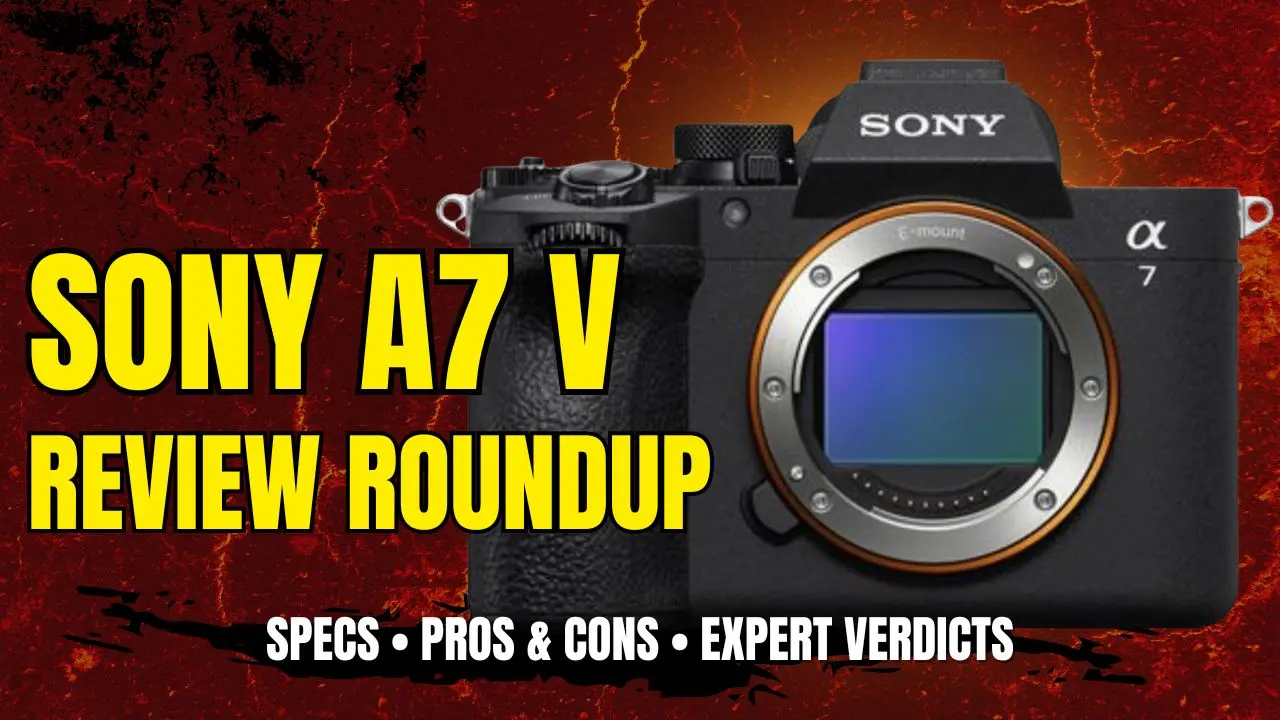
Unveiled in December 2025, the A7 V might look nearly identical to the A7 IV, but the internals make it a genuine next-generation upgrade:
-
New 33 MP semi-stacked full-frame sensor
-
30 fps electronic burst shooting
-
AI-powered autofocus with advanced subject detection
-
Improved IBIS rated at 7.5 stops
-
4K 60p without crop (and 4K 120p in APS-C)
-
Dual CFexpress Type A / SD card slot
-
New articulating/tilting LCD borrowed from the A7R V
Phototrend summed it up: “A major update to Sony’s most versatile full-frame mirrorless camera.” They awarded it 8.9/10, one of the highest scores in the lineup.
Design & Handling: Familiar but Refined
Multiple reviewers note that the A7 V remains visually and ergonomically close to the A7 IV. This continuity is either comforting—or slightly disappointing depending on how much you hoped for a redesign.
Still, key usability upgrades include:
-
The new 4-way tilt-and-flip LCD, considered by Gerald Undone and Phototrend as the best screen in the industry.
-
A slightly refined grip, though the change is subtle.
-
Weather-sealing, dual USB-C ports, and Sony’s typical robust control layout.
TechRadar praises the user experience, calling the A7 V “my favorite Sony camera ever”.
Autofocus & Performance: A Major Leap Forward
Autofocus is the star of the show. Every reviewer—French or English—calls the A7 V’s AF outstanding.
AF Highlights
-
AI-driven autofocus with enhanced subject recognition
-
Excellent tracking for humans, animals, birds, vehicles
-
Highly reliable even in difficult lighting
Digital Camera World calls it a “big AF upgrade”, while Phototrend labels it “formidable” in real-world use.
Burst Shooting
-
30 fps electronic (blackout-free)
-
10 fps mechanical
-
Pre-capture up to 1 second
-
“Unlimited” buffer at 10 fps in some compressed modes
However, the 30 fps mode has a limited buffer—PetaPixel and Gerald Undone stress this. It’s blisteringly fast, but not designed for long sustained bursts.
Image Quality: Excellent Across the Board
Despite keeping the same 33 MP resolution as the A7 IV, every reviewer notes meaningful improvements:
-
Cleaner shadows and more natural noise handling
-
Better detail retention at high ISO
-
More neutral color science, closer to Sony’s cinema line
-
Superb dynamic range (Gerald Undone measured ~14.2 stops in S-Log3)
TechRadar praises it as “exceptional image quality with great low-light performance.”
Phototrend calls it simply: “excellent.”
Video: Improved, But Still Conservative
Sony clearly enhanced video performance:
-
Full-frame 4K 60p oversampled from 7K
-
4K 120p in APS-C mode
-
Advanced autofocus, improved IBIS, better thermal efficiency
-
Dual USB-C ports, webcam 4K30, new video UI, user LUTs
But reviewers agree: video specs lag behind the competition in certain areas.
Main criticisms
-
No 6K, 7K, or Open Gate
-
No internal RAW
-
Noise reduction options tied to crop modes
-
Rival hybrid cameras offer more “cinema-leaning” formats
Digital Camera World calls video “a little underwhelming versus competitors,” and Phototrend says Sony remains “too cautious” in the video department.
Thermals: A Shockingly Big Win
Gerald Undone demonstrated that the A7 V can record:
-
Over 6 hours of full-frame 4K60
-
Without overheating
-
At room temperature
This is industry-leading and beats some cameras with built-in fans.
Battery Life & Workflow
Reviewers unanimously praise:
-
Significantly improved battery life thanks to the new BIONZ XR2
-
Dual card format flexibility (CFexpress A + SD)
-
Fast tethering & transfer with dual USB-C ports
TechRadar calls the endurance “impressive”, and PetaPixel highlights how Sony has finally optimized thermal and battery performance to a remarkable level.
Pros & Cons Overview
Pros (from all reviews combined)
-
Outstanding AI autofocus
-
Semi-stacked sensor = faster readout & lower rolling shutter
-
Up to 30 fps burst
-
Excellent image quality, especially in low light
-
Superb IBIS (up to 7.5 stops)
-
Brilliant new articulating/tilting LCD
-
Huge improvement in video overheating resistance
-
Long battery life
-
Flexible dual card slots
Cons
− Video specs feel conservative vs Canon, Panasonic, Nikon
− No Open Gate / No internal RAW
− Same EVF as A7 IV
− Buffer limits at 30 fps
− CFexpress Type A is still expensive
− Heavy-handed JPEG noise reduction (TechRadar)
− Not a big enough upgrade for current A7 IV owners
How Reviewers Compare It to the Competition
PetaPixel even calls it a serious contender for best all-round camera of the year, rivaling Canon’s R6 III.
“A smarter, faster all-rounder, but with compromises.”
“My favorite Sony camera ever.”
Gerald Undone:
“If I were starting from scratch, I’d pick this one.”
Should You Buy the Sony A7 V?
Buy it if:
-
You want the best hybrid full-frame camera Sony has ever made
-
You need elite autofocus and reliable burst performance
-
You record long 4K takes and need exceptional thermal stability
-
You want a do-everything camera for travel, weddings, sports, events, or documentary work
Don’t buy it if:
-
You shoot primarily high-end video and need Open Gate, 6K/8K, or RAW
-
You’re a beginner overwhelmed by pro features
-
You already own an A7 IV and don’t need the faster sensor, improved AF, or better 4K60
Final Verdict
The Sony A7 V is one of the most capable hybrid cameras ever released, offering:
-
A huge leap in autofocus
-
Faster readout and shooting performance
-
Stronger IBIS
-
Better workflow and battery life
-
Class-leading thermal management
-
Excellent all-round stills and video quality
Its video features aren’t as forward-leaning as some rivals, but for most photographers and hybrid creators, the A7 V is an exceptionally balanced tool—and arguably the best general-purpose full-frame camera you can buy today.
A true return to form for the A7 line—and a worthy challenger in the fiercely competitive mid-range full-frame market.