Sony A7 IV vs Sony A7 V • Which one is better?
Sony A7 IV vs Sony A7 V • Which One Is Better?
Sony’s full-frame mirrorless lineup just took a major leap forward with the arrival of the Sony A7 V, a long-awaited upgrade to the massively popular Sony A7 IV – the hybrid camera that dominated the market since 2021.
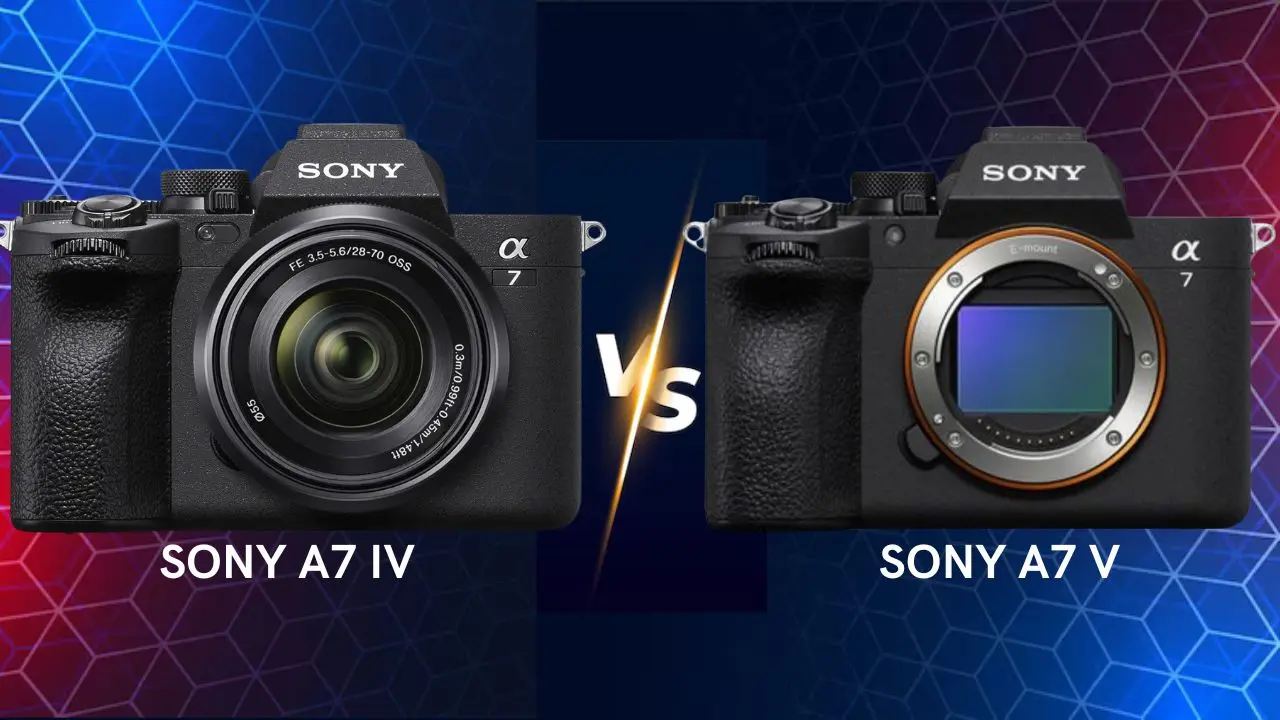
At first glance, the two bodies look nearly identical. They share the same 33 MP resolution, Sony’s familiar ergonomics, a strong hybrid philosophy, and broad feature sets aimed at creators.
But under the hood? Huge differences: a new partially-stacked sensor, a next-gen Bionz XR2 processor, a vastly improved autofocus engine, and major upgrades for burst speed, rolling shutter control, stabilization, and overall responsiveness.
The Sony A7 IV remains an excellent hybrid camera at a more affordable price – but the A7 V pushes the series into a new class of performance, edging closer to Sony’s high-end bodies like the A9 III and A1 II.
So… which one is the better choice for you?
Let’s break it down.
⚙️ Overview – The Trusted Hybrid vs The Next-Gen All-Rounder
Sony A7 IV
A proven hybrid full-frame camera with a 33 MP sensor, 10 fps burst, solid AF, and strong 4K video performance. Ideal for enthusiasts and professionals on a budget who want excellent all-around capabilities without chasing bleeding-edge specs.
Sony A7 V
A major generational leap: new 33 MP partially stacked sensor, blackout-free 30 fps burst, advanced AI autofocus, radically improved thermal performance, and 4K60 full-frame video. Built for hybrid creators who want a faster, smarter, more robust tool.
In short:
A7 IV = The value hybrid for creators.
A7 V = The new performance king of Sony’s mid-range lineup.
📸 Specifications Comparison
| Feature | Sony A7 IV | Sony A7 V |
|---|---|---|
| Release Date | 2021 | 2025 |
| Camera Type | Full-Frame Hybrid | Full-Frame Hybrid (Next-Gen) |
| Sensor | 33 MP BSI CMOS | 33 MP Partially Stacked BSI CMOS |
| Processor | Dual Bionz XR | Bionz XR2 (integrated AI) |
| ISO Range | 100–204,800 expanded | 100–51,200 (50–204,800 expanded) |
| Dynamic Range | ~15 stops | Up to 16 stops |
| In-Body Stabilization | 5.5 stops | 7.5 stops |
| Autofocus System | Real-time AF & Tracking | Next-Gen AI AF (Human, Animal, Bird, Vehicle) |
| AF Points | 759 | 759 |
| Burst Shooting | 10 fps | 30 fps blackout-free + Pre-Capture |
| Shutter | Mech + Electronic | Mech (improved durability) + Electronic (much faster readout) |
| Rolling Shutter | Noticeable | Dramatically improved |
| Video | 4K60 (1.5× crop) | 4K60 full-frame + 4K120 (APS-C) |
| LCD Screen | 1.04M-dot vari-angle | 2.1M-dot vari-angle + tilt (A7R V style) |
| Viewfinder | 3.69M dots | 3.69M dots |
| Storage | 1× SD UHS-II + 1× CFexpress Type A/SD | Same |
| Ports | 1× USB-C | 2× USB-C (power + data simultaneously) |
| Battery Life | Good | Excellent (+23%) |
| Weather Sealing | Yes | Yes (Improved thermals) |
| Launch Price | Check on Amazon | Check on Amazon |
🧱 Build and Handling
Both bodies look almost identical, but the A7 V refines the formula.
Sony A7 IV
-
Comfortable grip
-
Classic Sony control layout
-
Fully articulating LCD (but low resolution)
-
Solid for hybrid work
Sony A7 V
-
Same ergonomics, but with improved LCD quality (2.1M dots)
-
Dual-axis tilt + flip screen (A7R V style)
-
Better thermal management
-
Stronger mechanical shutter durability (500,000 cycles)
-
Two USB-C ports for simultaneous charging and data transfer
-
Slightly heavier, slightly deeper grip
Verdict:
A7 IV: Tried-and-true ergonomics for most creators.
A7 V: More refined, better screen, better cooling, more flexible workflow.
🎯 Autofocus and Performance
This is where the A7 V crushes the A7 IV.
Sony A7 IV
-
Excellent AF for its time
-
Strong eye detection
-
Good for portrait, events, and basic action
-
Struggles with fast subjects compared to newer models
Sony A7 V
-
New AI processor + subject detection module
-
Faster readout = far better tracking + less lag
-
Reliable for wildlife, sports, motorsports
-
Pre-Capture mode (up to 1 second before shutter press!)
-
Blackout-free 30 fps shooting
Pierre T. Lambert called pre-capture a “real game changer for wildlife photographers” and said the A7 V could replace his Sony A1 in some situations — that says a lot.
Verdict:
A7 V wins easily — it’s dramatically faster, smarter, and more versatile.
🎥 Video Capabilities
Sony A7 IV
-
4K 60p but with a 1.5× crop
-
Good oversampled 4K30
-
Decent rolling shutter but not class-leading
-
Occasional overheating in warm environments
-
Limited stabilization options
Sony A7 V
-
4K60 full-frame (no crop)
-
4K120 APS-C
-
Better color science (closer to FX line)
-
Much better rolling shutter (nearly 2× faster readout)
-
7.5-stop IBIS + Active + Dynamic Active stabilization
-
AI Auto Framing (auto-tracking for solo creators)
-
Massively improved thermal performance
-
Gerald Undone measured over 6 hours of 4K60 without overheating (!!)
-
According to Pierre T. Lambert, the stabilization upgrades and smart framing “open new creative possibilities for solo shooters.”
Verdict:
A7 V all the way — huge gains across stability, heat, AF, rolling shutter, and frame rates.
🧠 Image Quality
Both use 33 MP sensors, but:
A7 IV
-
Good dynamic range
-
Good low-light performance
-
More aggressive noise reduction
-
Slower readout = less ideal for action
-
Great colors but older processing pipeline
A7 V
-
16 stops of DR (vs ~15 on A7 IV)
-
More natural noise structure
-
Better color (closer to FX2)
-
Cleaner shadows
-
Less rolling shutter distortion
Pierre notes that Sony encourages users to shoot electronic shutter almost all the time due to the vastly improved readout — a huge shift for action and silent shooting.
Verdict:
A7 V offers better dynamic range, cleaner details, and more consistency.
🔋 Battery Life and Workflow
A7 IV
-
Already strong battery life
-
Limited to one USB-C port
-
Older thermal design
A7 V
-
23% better efficiency thanks to XR2 processor
-
Dual USB-C ports for powering + tethering
-
Significantly cooler operation
-
Improved long-format recording options
Verdict:
A7 V is more reliable for long shoots and professional workflows.
💰 Price and Value
| Model | Approx. Price | Ideal For |
|---|---|---|
| Sony A7 IV | ~€2799 | Beginners, enthusiasts, budget-conscious pros |
| Sony A7 V | ~€2999 | Hybrid creators, event shooters, wildlife, action, and video professionals |
–
The A7 IV remains a great deal — but the performance leap of the A7 V for only ~€200 more makes it extremely compelling.
Verdict:
A7 IV: Best for budget-minded creators.
A7 V: Best performance-per-euro in Sony’s lineup today.
🏁 Final Verdict – Sony A7 IV vs Sony A7 V
| Type of User | Recommended Camera |
|---|---|
| Hybrid Creator | Sony A7 V |
| Professional Videographer | Sony A7 V |
| Wildlife / Sports | Sony A7 V |
| Travel Photographer | A7 IV (budget) or A7 V (performance) |
| Event / Wedding | Sony A7 V |
| Studio / Product | A7 V (better DR + color) |
| Budget Buyer | A7 IV |
✅ In short:
Choose the Sony A7 IV if…
-
You want the best price-to-performance ratio
-
You don’t need high-speed bursts
-
You shoot mostly portraits, travel, or casual video
Choose the Sony A7 V if…
-
You want major autofocus improvements
-
You shoot wildlife, sports, events, or fast action
-
You need 4K60 full-frame and better rolling shutter
-
You want top-tier stabilization and thermals
-
You want a camera that feels modern and future-proof
Both are excellent — but the Sony A7 V is the biggest generational leap in the A7 lineup since the A7 III.