Sony A7 IV vs Nikon Z6 III – Which one is better?
Sony A7 IV vs Nikon Z6 III – Which one is better?
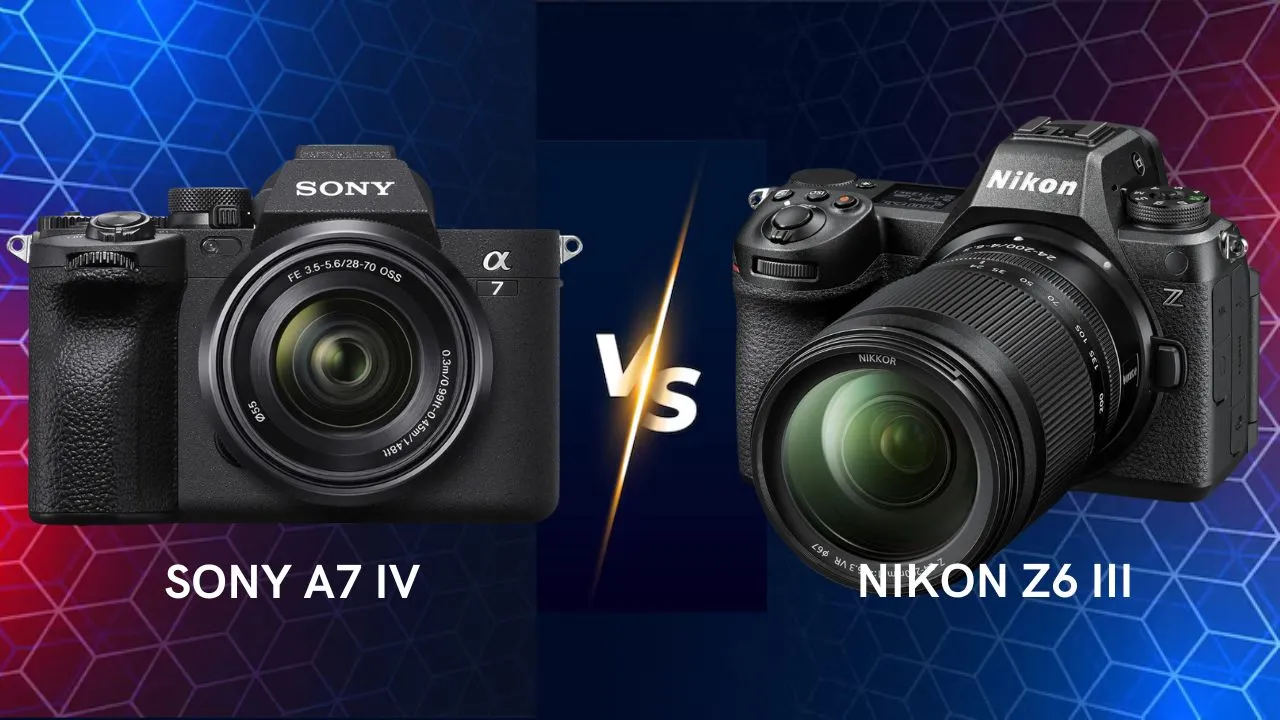
The Sony A7 IV and Nikon Z6 III are two excellent full-frame mirrorless cameras aimed at hybrid photographers and videographers — each bringing unique strengths to the table.
If you’re deciding between them, the best choice depends on what you shoot and how you shoot. Let’s dive in.
⚙️ Overview – Resolution & All-round Hybrid vs Speed & Modern Video Hybrid
Sony A7 IV:
A broadly capable hybrid camera with a 33 MP sensor, strong stills and video features, advanced autofocus, and a well-rounded body design. It’s ideal for someone who needs one camera for both high-quality photography and serious video.
Nikon Z6 III:
A more recent model that emphasises speed, video flexibility, and improved sensor design. With a 24.5 MP (approx.) partially-stacked sensor and advanced video specs, it aims to be a versatile all-rounder for stills and video, leaning slightly more into motion work.
In short:
-
A7 IV = Higher resolution stills, very capable video, excellent all-rounder.
-
Z6 III = Faster sensor read-out, modern video features, strong for hybrid and motion tech.
📸 Specifications Comparison
Here’s a distilled comparison of major spec details:
| Specification | Sony A7 IV | Nikon Z6 III |
|---|---|---|
| Release Date | October 2021 | June 2024 |
| Camera Type | Full-Frame Mirrorless | Full-Frame Mirrorless |
| Sensor | 33 MP BSI-CMOS full-frame | 24.5 MP partially stacked CMOS full-frame |
| Image Processor | BIONZ XR | EXPEED 7 |
| Lens Mount | Sony E-mount | Nikon Z-mount |
| ISO Range | Approx. 100–51,200 (expandable) | Approx. 100–64,000 (expandable) |
| In-Body Image Stabilization (IBIS) | Yes (5-axis) | Yes (5-axis) |
| Autofocus System | Hybrid AF with advanced subject detection | Hybrid AF with enhanced tracking |
| AF Subject Recognition | People, Animals, Vehicles | People, Animals, Vehicles |
| Continuous Shooting Speed | Up to ~10 fps | Up to ~20 fps (RAW) / 120 fps (JPG crop) |
| Video Recording | 4K up to 60p | 6K up to 60p, 4K up to 120p |
| Video Bit Depth / Color | 10-bit color (via S-Log3) | 10-bit with N-Log / ProRes options |
| Color Profiles | S-Log3, S-Cinetone | N-Log, Flat, Standard |
| RAW Video Output | Yes (external) | Yes (internal + external support) |
| Recording Limit | Standard limits (varies by settings) | Extended record times |
| Viewfinder | Built-in EVF (~3.69M dots) | Built-in EVF (~5.76M dots) |
| LCD Screen | 3.0″ fully articulating touchscreen | 3.2″ fully articulating touchscreen |
| Touch Functions | Full touch support | Full touch support |
| Product Showcase Mode | No specific mode (photo/video profiles) | No dedicated showcase |
| Background Defocus Button | No dedicated button | No dedicated button |
| Body Material | Magnesium alloy framework | Magnesium alloy framework |
| Weather Sealing | Yes (robust sealing) | Yes (pro-grade sealing) |
| Audio Options | Mic input, headphone jack | Mic input, headphone jack |
| Connectivity | Wi-Fi, Bluetooth, USB-C, HDMI | Wi-Fi, Bluetooth, USB-C, HDMI |
| Battery Type | NP-FZ100 | EN-EL15c |
| Battery Life (CIPA) | ~580–600 shots | ~380–450 shots |
| Dimensions (W × H × D) | ~131 × 96 × 80 mm | ~138 × 101 × 74 mm |
| Weight (Body Only) | ~658 g | ~750 g |
| Approx. Price (Body Only) | ~€1,838 – €1,999 | ~€2,341 – €2,494 |
🧱 Build and Handling
The Sony A7 IV offers a familiar A7-series body with a deep grip, good weather-sealing, fully articulated screen, and plenty of customisation for both stills and video shooters.
The Nikon Z6 III builds on Nikon’s Z-mount system with improved ergonomics, perhaps slightly more modern build, and the benefit of its fast sensor and read-out design. The newer sensor allows for smoother performance and faster data handling, which can translate into better usability especially for video or action work.
👉 Verdict:
-
If you prioritise a mature, well-proven body with excellent stills + video balance → A7 IV.
-
If you prioritise speed, modern sensor tech, and perhaps slightly more future-proof video capabilities → Z6 III.
🎯 Autofocus and Performance
Sony has long been a leader in autofocus, and the A7 IV continues that tradition: strong real-time tracking, Eye-AF for humans/animals, good performance across photo and video.
The Nikon Z6 III, thanks to its partially-stacked sensor and updated processing, brings impressive AF and fast read-out, which helps reduce rolling shutter and improve performance in both stills and video.
👉 Verdict:
-
A7 IV: Top tier AF for hybrid work.
-
Z6 III: Slight edge for speed and modern performance, especially in demanding situations.
🎥 Video Capabilities
Here’s where differences become more significant.
Sony A7 IV:
-
Offers 4K up to 60p in many modes, 10-bit 4:2:2 internal recording.
-
Excellent hybrid shooter video wise, very strong for content creators.
-
Some limitations may include crop factors (e.g., at certain 4K 60p modes) and older video features compared to the very newest models.
Nikon Z6 III:
-
Offers 6K/60p, oversampled 4K, 4K up to 120p in some modes.
-
Sensor read-out and design reduce rolling shutter and improve video quality in motion.
-
Strong pick if your workflow leans heavily into video or hybrid with serious video features.
👉 Verdict:
-
If your workflow is majorly video or hybrid with advanced video demands → Z6 III has the edge.
-
If the video is important but still combined with high-quality stills, and you want one camera that does it all well → A7 IV remains extremely competitive.
🧠 Image Quality
The A7 IV’s 33 MP sensor gives very good resolution for stills, good dynamic range, and flexibility for cropping or detailed work.
The Z6 III’s ~24.5 MP sensor means slightly lower nominal resolution, but the partially-stacked design offers benefits in read-out speed, video performance, and responsiveness. The trade-off is resolution for speed in certain respects.
👉 Verdict:
-
For high-resolution stills where detail and cropping matter → A7 IV.
-
For everyday stills + video where speed, responsiveness, modern features matter more than ultra-high resolution → Z6 III.
🔋 Battery Life and Connectivity
Both cameras come with modern connectivity: Wi-Fi, Bluetooth, USB-C, etc.
The Sony A7 IV benefits from the mature ecosystem of Sony and solid hybrid capabilities. The Nikon Z6 III benefits from its modern sensor and read-out speeds for better responsiveness.
Battery life in real-world use will depend a lot on what you’re doing (video vs stills), but if you shoot lots of video or long sessions, the Nikon’s modern sensor efficiency might help.
👉 Verdict:
-
Both very capable. If you prioritise smooth workflow, modern features, and faster performance → Z6 III slightly ahead.
-
If you prioritise a robust ecosystem, established body design and balance between stills + video → A7 IV very strong.
💰 Price and Value
Given similar price brackets, the choice becomes what features you value more.
-
If cost is a major factor and you want best all-round hybrid value → A7 IV gives you tremendous capabilities for what you pay.
-
If you can afford the slightly newer tech and want the speed, video flexibility, and responsiveness → Z6 III offers very compelling value in that space.
👉 Verdict:
-
A7 IV: Best value for a hybrid shooter who wants excellent stills + video.
-
Z6 III: Best value if you prioritise speed, modern sensor tech, and heavy video/hybrid use.
Check availability and price on Amazon 🛒
📷 Sony A7 IV — Amazon USA / Amazon Canada / Amazon UK / Amazon Australia
📷 Nikon Z6 III — Amazon USA / Amazon Canada / Amazon UK / Amazon Australia
Note: camerafight.com participates in the Amazon Associates Program. As an Amazon Associate, we earn from qualifying purchases.
🏁 Final Verdict — Sony A7 IV vs Nikon Z6 III
| Type of User | Recommended Camera |
|---|---|
| Photographer focused on stills and detail | Sony A7 IV |
| Hybrid creator (photos + video) where video is important | Nikon Z6 III |
| Travel / event shooter needing one camera for everything | Sony A7 IV |
| Videographer or hybrid with serious motion/fast action needs | Nikon Z6 III |
| Budget-conscious buyer wanting maximum features | Sony A7 IV |
| Someone wanting latest tech, fastest read-out, future-proof features | Nikon Z6 III |
✅ In short:
Choose the Sony A7 IV if you want a well-rounded hybrid that excels in stills, offers great video, and has excellent value.
Choose the Nikon Z6 III if you prioritise modern sensor technology, faster performance, advanced video features, and are willing to lean into the newer system.
🧠 Final Thoughts
The Sony A7 IV remains one of the best hybrid full-frame cameras around. It gives full-frame quality, excellent autofocus, great video features, and superb value.
The Nikon Z6 III, however, represents a newer wave: with a partially-stacked sensor, modern video features (6K, oversampled 4K, high frame-rates), and very strong hybrid capacity. If you are looking ahead, it’s a terrific option.
If your priority is stills (high resolution, cropping, classic photography) with strong video on the side → A7 IV is a brilliant choice.
If your workflow is heavy on video or you want a camera built for speed, responsiveness and future-proof hybrid work → Z6 III is excellent.
Happy shooting — and if you like, I can pull in lens ecosystem comparisons (Sony vs Nikon Z-mount) too, since that’s often a major practical deciding factor.