Sony A7 IV vs Canon R6 Mark II – Which one is better?
Sony A7 IV vs Canon R6 Mark II – Which One Is Better?
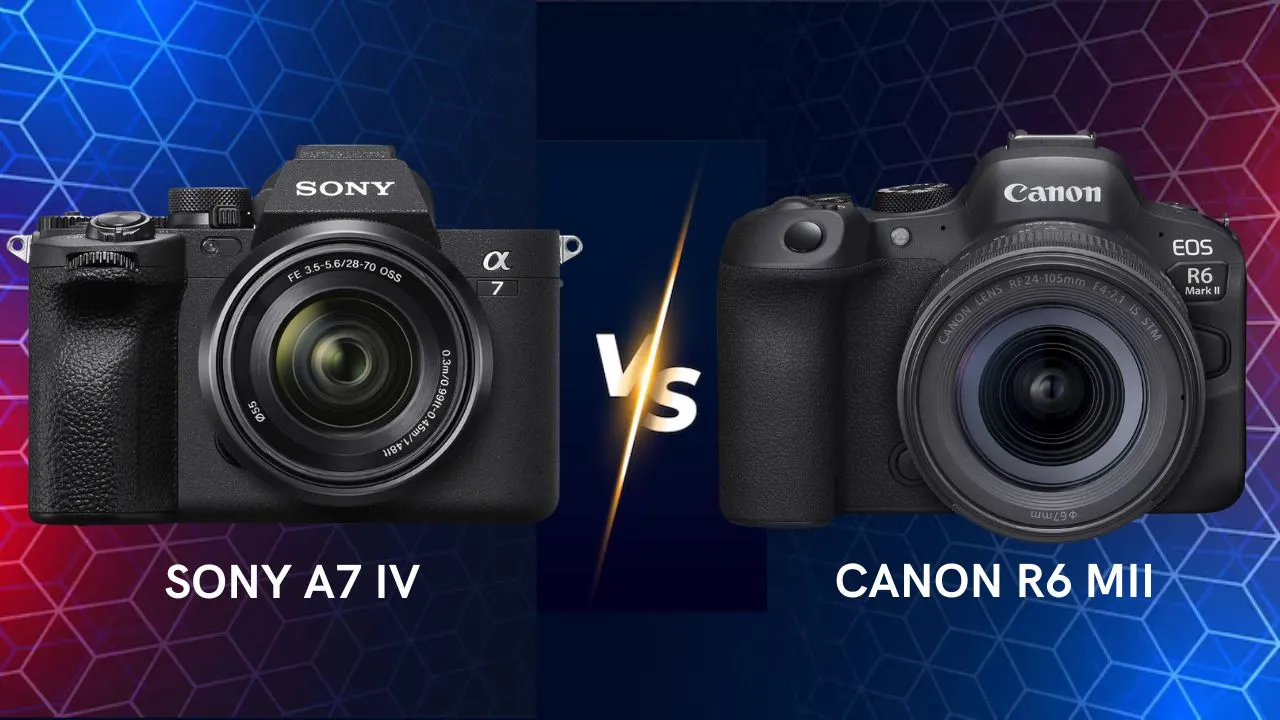
The Sony A7 IV and Canon EOS R6 Mark II are two of the best hybrid full-frame mirrorless cameras in the mid-to-high-end range.
Both target creators who shoot both photos and videos, offering professional performance, excellent image quality, and reliable autofocus systems.
But which one gives you the best balance between performance, features, and value? Let’s find out.
⚙️ Overview – Balanced All-Rounder vs Speedy Hybrid Performer
Sony A7 IV:
A refined hybrid camera with a 33 MP full-frame sensor, 10-bit 4K 60p video, and class-leading autofocus. It’s built for creators who want professional results in both stills and video, with strong color science and long battery life.
Canon EOS R6 Mark II:
A fast and responsive full-frame camera with a 24 MP sensor, powerful subject-tracking autofocus, and 6K oversampled 4K 60p video. It’s designed for hybrid shooters who value speed, low-light performance, and intuitive handling.
In short:
-
A7 IV = High-resolution, feature-packed hybrid camera.
-
R6 Mark II = Fast, intuitive, and excellent in low light.
📸 Specifications Comparison
| Feature | Sony A7 IV | Canon R6 Mark II |
|---|---|---|
| Release Date | October 2021 | November 2022 |
| Sensor | 33 MP Full-Frame Exmor R CMOS | 24.2 MP Full-Frame CMOS |
| Processor | BIONZ XR | DIGIC X |
| Mount | Sony E-Mount | Canon RF Mount |
| In-Body Stabilization (IBIS) | ✅ Yes (up to 5.5 stops) | ✅ Yes (up to 8 stops) |
| Video Recording | 4K 60p (10-bit 4:2:2, Super 35 crop) / 4K 30p full sensor | 6K oversampled 4K 60p (10-bit 4:2:2, full sensor) |
| Autofocus System | 759 Phase-Detection Points with Real-Time Tracking | Dual Pixel CMOS AF II (1053 AF zones with subject detection) |
| Continuous Shooting | 10 fps | 12 fps (mechanical) / 40 fps (electronic) |
| Viewfinder | 3.68M-dot OLED EVF | 3.69M-dot OLED EVF |
| Screen | 3.0” Fully Articulating Touch LCD (1.03M dots) | 3.0” Fully Articulating Touch LCD (1.62M dots) |
| Dual Card Slots | ✅ Yes (CFexpress Type A + SD UHS-II) | ✅ Yes (Dual SD UHS-II) |
| Weather Sealing | ✅ Yes | ✅ Yes |
| Battery Life (CIPA) | ~580 shots | ~450 shots |
| Connectivity | Wi-Fi, Bluetooth, USB-C, HDMI | Wi-Fi, Bluetooth, USB-C, HDMI |
| Weight (Body Only) | 659 g | 588 g |
| Price (Body Only) | ~$2,499 (check on Amazon) | ~$2,499 (check on Amazon) |
🧱 Build and Handling
Both cameras offer excellent ergonomics and solid weather-sealed bodies.
The Sony A7 IV has a slightly more angular, compact design with a deep grip and extensive customization options. Sony’s menus have greatly improved, making it easier to navigate between photo and video modes.
The Canon R6 Mark II feels a bit more rounded and ergonomic, with larger buttons and Canon’s signature control wheel layout. It’s extremely intuitive, even for first-time users.
👉 Verdict:
-
A7 IV: More customizable and refined for hybrid shooters.
-
R6 Mark II: More comfortable and user-friendly, especially for handheld shooting.
🎯 Autofocus and Performance
Both cameras have exceptional autofocus systems — among the best in the world.
The A7 IV uses Sony’s Real-Time Tracking AF with 759 phase-detection points and reliable Eye AF for humans, animals, and birds in both photo and video.
The R6 Mark II pushes even further with Canon’s Dual Pixel CMOS AF II, which uses deep-learning algorithms to detect not just eyes and animals but also vehicles, horses, and airplanes.
Performance-wise, the Canon is faster — capable of up to 40 fps with its electronic shutter, compared to Sony’s 10 fps.
👉 Verdict:
-
A7 IV: Excellent all-round AF performance.
-
R6 Mark II: Faster burst rate and more intelligent subject tracking.
🎥 Video Capabilities
This is where the comparison gets really close.
Sony A7 IV:
-
4K 60p (10-bit 4:2:2, Super 35 crop)
-
4K 30p (full sensor readout)
-
S-Cinetone, S-Log3, and HLG profiles
-
No overheating in typical conditions
-
Focus breathing compensation and full-size HDMI
Canon R6 Mark II:
-
6K oversampled 4K 60p (no crop)
-
4K 120p (with slight crop)
-
10-bit 4:2:2 internal recording (Canon Log 3, HDR PQ)
-
No overheating issues (massive improvement over the original R6)
-
False color and pre-recording options for filmmakers
👉 Verdict:
-
A7 IV: Perfect for consistent hybrid use and longer recording sessions.
-
R6 Mark II: More advanced video features and faster frame rates.
🧠 Image Quality
The Sony A7 IV’s 33 MP sensor provides higher resolution and slightly better dynamic range, offering more flexibility for cropping and post-processing.
The Canon R6 Mark II’s 24 MP sensor performs better in low light, delivering cleaner results at higher ISOs thanks to larger pixel size and Canon’s color science.
Both deliver stunning color accuracy and natural skin tones, with Sony leaning toward cinematic neutrality and Canon toward warmer, more vivid rendering.
👉 Verdict:
-
A7 IV: Sharper, higher-resolution images with great dynamic range.
-
R6 Mark II: Better low-light performance and color rendering.
🔋 Battery Life and Connectivity
The A7 IV leads in battery endurance, offering about 580 shots per charge, compared to roughly 450 for the R6 Mark II.
Both use USB-C for charging and data, and support Wi-Fi and Bluetooth for remote control and image transfer.
The A7 IV has the edge for creators who shoot long events or travel often, while the R6 Mark II remains efficient for its class.
👉 Verdict:
-
A7 IV: Better battery life and endurance.
-
R6 Mark II: Slightly shorter life but faster performance overall.
💰 Price and Value
| Model | Approx. Price | Ideal For |
|---|---|---|
| Sony A7 IV | ~$2,499 | Hybrid creators, travel shooters, and professionals |
| Canon R6 Mark II | ~$2,499 | Event, sports, and low-light photographers; hybrid shooters |
At the same price, both cameras deliver exceptional value.
The A7 IV offers slightly more flexibility for photo and video professionals, while the R6 Mark II provides faster performance and better handling for action or run-and-gun creators.
👉 Verdict:
-
A7 IV: Best for resolution, dynamic range, and long sessions.
-
R6 Mark II: Best for speed, usability, and low-light shooting.
🏁 Final Verdict — Sony A7 IV vs Canon R6 Mark II
| Type of User | Recommended Camera |
|---|---|
| Beginner Photographer | R6 Mark II |
| Enthusiast / Hybrid Shooter | A7 IV |
| Event / Wedding Photographer | R6 Mark II |
| Travel Photographer | A7 IV |
| Vlogger / YouTuber | R6 Mark II |
| Studio Photographer | A7 IV |
| Sports / Action Shooter | R6 Mark II |
| Low-Light Shooter | R6 Mark II |
| All-Around Creator | A7 IV |
✅ In short:
Choose the Sony A7 IV if you want higher resolution, longer battery life, and professional-level flexibility for both stills and video.
Choose the Canon R6 Mark II if you value speed, intuitive handling, and superior autofocus tracking — especially for action, wildlife, or low-light shooting.
🧠 Final Thoughts
The Sony A7 IV remains one of the most complete hybrid cameras ever made, offering incredible versatility, top-tier autofocus, and unmatched reliability for the price.
The Canon R6 Mark II takes everything great about the original R6 and makes it faster, smarter, and more filmmaker-friendly — a real step forward for Canon’s hybrid shooters.
If you prioritize dynamic range, resolution, and all-day battery life, the A7 IV is your best bet.
If you prefer speed, simplicity, and low-light excellence, the R6 Mark II might just be the perfect camera for you.
Check availability and price on Amazon 🛒
📷 Canon R6 M2 — Amazon USA / Amazon Canada / Amazon UK / Amazon Australia
📷 Sony A7 IV — Amazon USA / Amazon Canada / Amazon UK / Amazon Australia
Note: camerafight.com participates in the Amazon Associates Program. As an Amazon Associate, we earn from qualifying purchases.