Sony A7 III vs Panasonic Lumix S5 II – Which one is better?
Sony A7 III vs Panasonic Lumix S5 II – Which One Is Better?
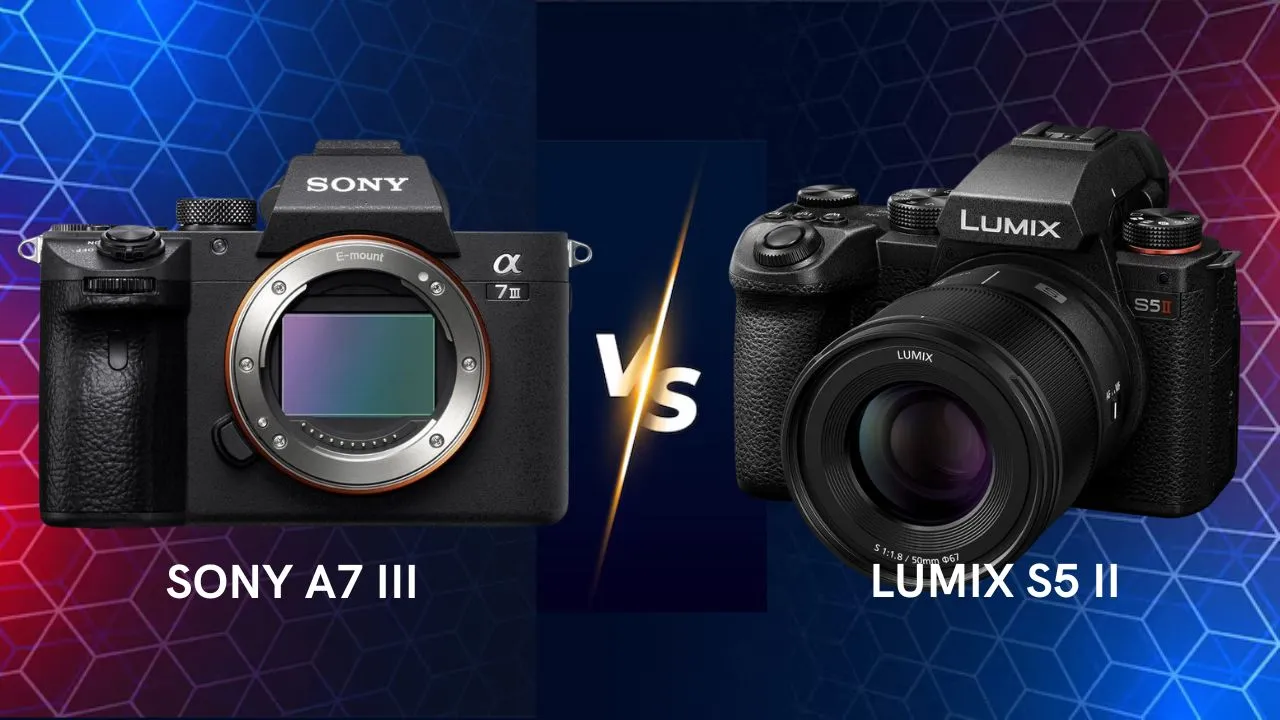
Choosing between the Sony A7 III and the Panasonic Lumix S5 II means comparing two strong full-frame mirrorless cameras—both excellent in their own right—yet tailored for slightly different workflows.
Below is a breakdown to help you see which one might suit you better.
⚙️ Overview – Proven Hybrid Full-Frame vs Modern Full-Frame Hybrid
Sony A7 III – Released in April 2018.
A full-frame mirrorless camera that has earned a reputation as a reliable all-rounder: strong stills and video performance, mature lens ecosystem, excellent value.
Panasonic Lumix S5 II – Announced January 2023.
A more recent full-frame mirrorless camera designed to deliver modern features, hybrid performance (photo + video) and appeal to creators looking for up-to-date capability.
In short:
-
A7 III = A trusted full-frame workhorse that many creators use today.
-
S5 II = A newer full-frame body with fresh features, aimed at creators who want modern flexibility.
📸 Key Specifications Comparison
| Specification | Sony A7 III | Panasonic Lumix S5 II |
|---|---|---|
| Release date | April 2018 | January 2023 |
| Camera type | Mirrorless | Mirrorless |
| Sensor format | Full Frame (35.6 × 23.8 mm) | Full Frame (35.6 × 23.8 mm) |
| Sensor type | BSI-CMOS | CMOS |
| Resolution | 24.2 MP | 24.2 MP |
| Image processor | BIONZ X | Venus Engine |
| ISO range | 100–51,200 (expandable to 204,800) | 100–51,200 (expandable to 204,800) |
| Autofocus system | 693-point phase-detection AF | Phase Hybrid AF (779-point) |
| Continuous shooting | Up to 10 fps | Up to 9 fps (mechanical), 30 fps (electronic) |
| Video recording | 4K up to 30p (8-bit, 4:2:0 internal) | 6K up to 30p, 4K up to 60p (10-bit, 4:2:2 internal) |
| Viewfinder | 2.36M-dot OLED EVF | 3.68M-dot OLED EVF |
| LCD screen | 3.0″ tilting screen, 922k dots | 3.0″ fully articulating touchscreen, 1.84M dots |
| In-body image stabilization (IBIS) | Yes, 5-axis | Yes, 5-axis (up to 6.5 stops with Dual I.S. 2) |
| Memory card slots | 2× SD (1× UHS-II, 1× UHS-I) | 2× SD (UHS-II) |
| Battery life (CIPA) | Approx. 710 shots | Approx. 370 shots |
| Weight (with battery & card) | Approx. 650 g | Approx. 740 g |
| Launch price (body only) | Approx. USD 2,000 (check on Amazon) | Approx. USD 2,000 (check on Amazon) |
🧱 Build, Handling & Portability
The Sony A7 III offers a body that’s been tried and tested—robust, full-frame ergonomics, excellent handling for both photo and video. Because it’s older, there’s wealth of accessories, user experience and lens compatibility.
The Panasonic S5 II brings more recent design elements, potentially newer interface, and is optimized for hybrid creators. If you value the latest features and can build into the L-Mount ecosystem, it gives a modern feel.
Verdict:
-
Choose A7 III if you want a proven, reliable full-frame system with many lenses and years of community support.
-
Choose S5 II if you prioritise the newest features, modern hybrid workflows and are okay investing in a newer ecosystem.
🎯 Autofocus & Performance
The A7 III has strong autofocus, especially for stills and hybrid use, backed by years of firmware refinement. The S5 II’s newer generation hardware gives it an edge in terms of freshness and possibly improved processing, especially in hybrid/hands-on workflows.
Verdict:
-
For rock-solid stills + video performance using a mature system, A7 III is very reliable.
-
For latest generation AF, hybrid workflows and newer technology, S5 II is very compelling.
🎥 Video Capabilities
If you shoot video as well as stills:
-
The A7 III offers a solid full-frame video experience, depth of field advantages and broad lens support.
-
The S5 II brings modern video features (higher bit-rates, newer codec support, better hybrid emphasis). If you’re heavily into video, the newer body may give extra value.
Verdict:
-
If you do video + stills and rely on a broad lens library, A7 III is a safe bet.
-
If video is a major part of your workflow and you want newer tech, S5 II might be the smarter choice.
🧠 Image Quality (Stills)
With both being full-frame ~24 MP camera bodies, you’ll get excellent image quality from either: good dynamic range, full-frame depth of field, strong performance in low light. The difference comes down less to raw resolution and more to system, lenses, workflow and processing.
Verdict:
-
Both deliver very good still image quality.
-
If you already own Sony full-frame lenses or prefer that system, stick with A7 III.
-
If you choose to build new and want fresh full-frame capability, S5 II works extremely well.
🔋 Ecosystem & Future-Proofing
Sony’s E-Mount full-frame ecosystem is extremely mature—lots of lenses, many third-party options, years of accessories and tutorials. That gives A7 III a strong advantage in system depth.
Panasonic’s L-Mount for the S5 II is good, offers full-frame lenses, and is growing (with partners like Sigma, Leica). But if you already have a Sony lens investment, that may tilt you toward A7 III.
Verdict:
-
If you want maximum lens choices, long-term system growth and compatibility, choose A7 III.
-
If you’re building fresh, are okay with fewer but good full-frame lenses and value modern features, go with S5 II.
💰 Price & Value
Because the A7 III has been on the market longer, you may find very good deals on used/discounted bodies and lenses—making it excellent value for full-frame. The S5 II, being newer, may carry a higher price but offers modern features.
Verdict:
For best value and full-frame performance, A7 III is hard to beat.
For value in modern hybrid full-frame version with up-to-date features, S5 II is very worthy.
Check availability and price on Amazon 🛒
📷 Panasonic Lumix S5 II — Amazon USA / Amazon Canada / Amazon UK / Amazon Australia
📷 Sony A7 III — Amazon USA / Amazon Canada / Amazon UK / Amazon Australia
🏁 Final Verdict — Sony A7 III vs Panasonic Lumix S5 II
| Type of User | Recommended Camera |
|---|---|
| Photographer/hybrid creator wanting broad lens support and full-frame investment | Sony A7 III |
| Creator wanting newer full-frame hybrid features, modern video and starting a new system | Panasonic Lumix S5 II |
| Video + stills user with existing Sony lens investment | A7 III |
| Travel/hybrid content creator building fresh system | S5 II |
✅ In Short:
Choose Sony A7 III if you want a proven full-frame body, excellent value, extensive lens ecosystem and dependable performance.
Choose Panasonic Lumix S5 II if you want full-frame performance with modern specs, new hybrid features and are okay with building or moving into a newer system.
🧠 Final Thoughts
Both cameras are excellent—there is no “one size fits all” answer. The “better” camera depends on your workflow, what lenses you already own or plan to buy, your budget, and which features you prioritise.
-
If you have Sony lenses or want to benefit from a deep, mature system → A7 III is an outstanding choice.
-
If you are starting fresh, value modern video + photo hybrid features and are okay with a newer ecosystem → S5 II is a compelling option.
Think about how you shoot, what gear you carry, and where you plan to go — then pick the camera that aligns best with you.