Sony A6700 vs Sony A7C – Which one is better?
Sony A6700 vs Sony A7C – Which One Is Better?
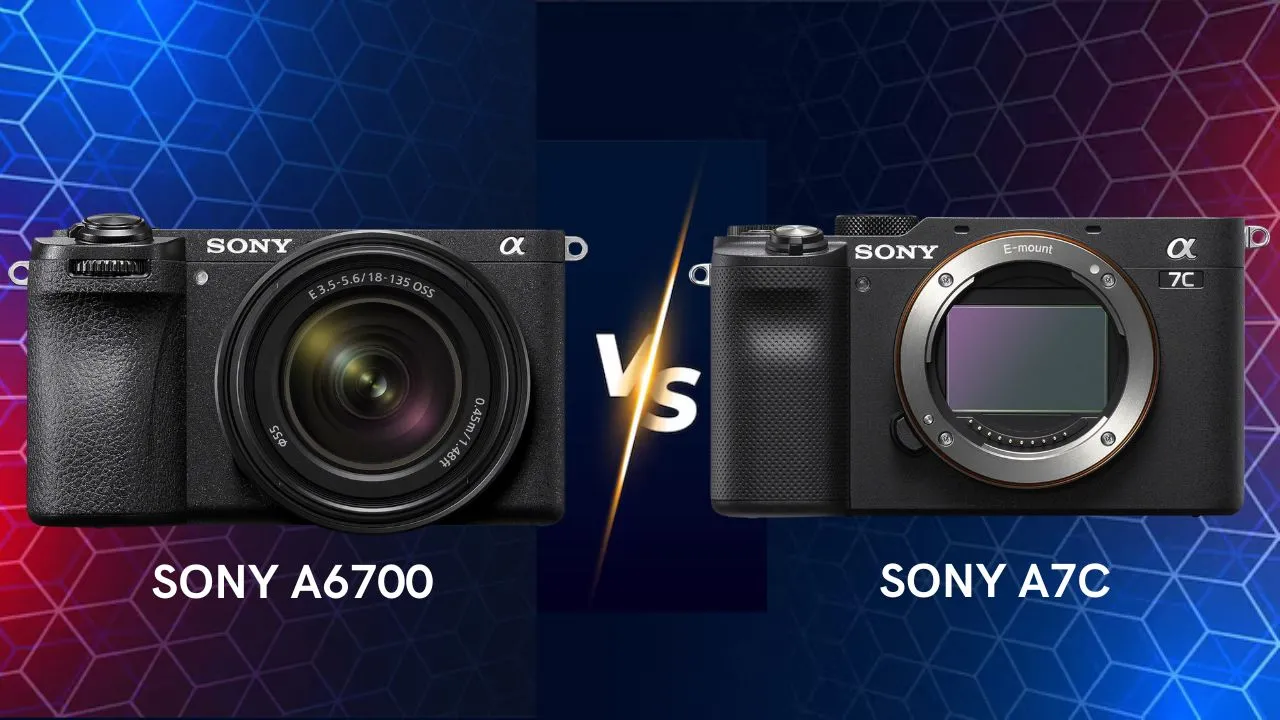
Choosing between the Sony A6700 and the Sony A7C means comparing a newer APS-C camera with modern hybrid features against a compact full-frame body that prioritizes portability and system flexibility.
Each has distinct strengths, so the best one for you depends on your priorities and workflow.
⚙️ Overview – APS-C Performance vs Compact Full-Frame
Sony A6700
An advanced APS-C mirrorless camera designed for creators who want strong hybrid (stills + video) performance in a compact form factor. It features modern autofocus, video capabilities, and lighter gear.
Sony A7C
A compact full-frame mirrorless camera that offers full-frame image quality in a travel-friendly body, combining portability with premium full-frame advantages. It appeals to creators who want full-frame benefits without oversized gear.
In short:
-
A6700 = Best for creators prioritizing modern features, hybrid shooting, lighter gear, APS-C size.
-
A7C = Best for those wanting full-frame image quality, portability, and system growth with a full-frame sensor.
📸 Detailed Specifications Comparison
| Feature | Sony A6700 | Sony A7C |
|---|---|---|
| Release Date | July 2023 | October 2020 |
| Camera Type | Mirrorless (Hybrid APS-C) | Mirrorless (Compact Full Frame) |
| Sensor | APS-C 26.0 MP BSI-CMOS | Full-Frame 24.2 MP BSI-CMOS |
| Image Processor | BIONZ XR + AI Processing Unit | BIONZ X |
| Lens Mount | Sony E-mount | Sony E-mount |
| ISO Range | 100–32,000 (expandable to 102,400) | 100–51,200 (expandable to 204,800) |
| In-Body Image Stabilization (IBIS) | Yes, 5-axis | Yes, 5-axis |
| Autofocus System | Hybrid phase-detection AF (759 points) | Hybrid phase-detection AF (693 points) |
| AF Subject Recognition | Humans, animals, birds, insects, vehicles, aircraft | Humans, animals (Eye AF), birds (limited via firmware) |
| Continuous Shooting Speed | Up to 11 fps | Up to 10 fps |
| Video Recording | Up to 4K 120p | Up to 4K 30p |
| Video Bit Depth / Color | 10-bit 4:2:2 internal | 8-bit 4:2:0 internal |
| Color Profiles | S-Log3, S-Cinetone, HLG | S-Log2, S-Log3, HLG |
| RAW Video Output | Yes, 16-bit via HDMI | No |
| Recording Limit | No recording limit (thermal dependent) | No recording limit |
| Viewfinder | 2.36M-dot OLED EVF | 2.36M-dot OLED EVF (rangefinder-style) |
| LCD Screen | 3.0″ fully articulating touchscreen (1.03M dots) | 3.0″ fully articulating touchscreen (921k dots) |
| Touch Functions | Yes (AF, tracking, menus) | Limited (AF, basic controls) |
| Product Showcase Mode | No | No |
| Background Defocus Button | No | No |
| Body Material | Magnesium alloy | Magnesium alloy |
| Weather Sealing | Yes (basic sealing) | Yes (basic sealing) |
| Audio Options | Mic input, headphone out, digital MI shoe | Mic input only |
| Connectivity | Wi-Fi, Bluetooth, USB-C, HDMI | Wi-Fi, Bluetooth, USB-C, HDMI |
| Battery Type | NP-FZ100 | NP-FZ100 |
| Battery Life (CIPA) | Approx. 570 shots | Approx. 740 shots |
| Dimensions (W × H × D) | 122 × 69 × 75.1 mm | 124 × 71.1 × 59.7 mm |
| Weight (Body Only) | Approx. 409 g | Approx. 424 g |
| Price (Body Only) | Approx. USD 1,399 (check on Amazon) | Approx. USD 1,800 (check on Amazon) |
🧱 Build & Handling
The A6700 excels in portability: smaller body, lighter lens combinations, and versatile for handheld and travel setups. It’s optimized for creators who carry gear often and value lighter load.
The A7C, while still compact for a full-frame, is slightly larger than APS-C bodies. It offers full-frame ergonomics, a deeper grip and the benefits of full-frame image quality—still maintaining a travel-friendly footprint.
👉 Verdict:
-
Choose A6700 if you want the smallest, lightest gear with modern hybrid features.
-
Choose A7C if you want full-frame image quality in a compact body and are comfortable with slightly more size/weight.
🎯 Autofocus & Performance
Both cameras deliver strong autofocus, but in slightly different contexts:
-
The A7C benefits from a full-frame sensor and advanced AF system, offering excellent subject detection, tracking and performance in low-light scenarios.
-
The A6700 offers the same mount but in an APS-C format with very strong AF and hybrid performance—especially suited for video and stills combined.
👉 Verdict:
-
For professional stills, low-light and full-frame advantage → A7C.
-
For hybrid creation, lighter rig and modern features → A6700.
🎥 Video Capabilities
For video creators:
-
A6700 is optimized for the hybrid creator: APS-C size, solid video specs, flexible rig setups and portability.
-
A7C brings full-frame sensor benefits to video: shallower depth-of-field, better low-light performance, full-frame framing—but with slightly larger gear.
👉 Verdict:
-
If video is your strong priority and you carry gear lightly → A6700 is great.
-
If you want full-frame video quality with portability and can handle slightly larger gear → A7C is preferable.
🧠 Image Quality (Stills)
Full-frame sensors generally provide better low-light performance, more flexibility, more depth-of-field control. The A7C has the clear advantage here. The A6700, while smaller sensor, still delivers excellent quality and may suffice for many creators.
👉 Verdict:
-
For maximum image quality and full-frame look → A7C.
-
For very good quality with lighter gear and APS-C size → A6700.
🔋 Ecosystem & Future-Proofing
Both cameras share the Sony E-Mount system, giving access to a wide range of lenses and accessories. However:
-
The A7C gives immediate full-frame system capability, meaning any full-frame lens is usable.
-
The A6700 offers flexibility and partially a more compact, cost-effective system if staying APS-C or later upgrading.
👉 Verdict:
-
If you plan long-term, full-frame system building → A7C is more future-proof.
-
If you value compact kit now and may upgrade later, A6700 is very strong value.
💰 Price & Value
The A6700 offers strong value for creators wanting performance in APS-C size without full-frame cost. The A7C costs more (body + full-frame lenses) but brings full-frame benefits.
👉 Verdict:
-
For value and size-conscious creators → A6700.
-
For full-frame investment and image quality → A7C.
Check availability and price on Amazon 🛒
📷 Sony A7C — Amazon USA / Amazon Canada / Amazon UK / Amazon Australia
📷 Sony A6700 — Amazon USA / Amazon Canada / Amazon UK / Amazon Australia
(As an Amazon Associate, I earn from qualifying purchases — at no extra cost to you.)
🏁 Final Verdict — Sony A6700 vs Sony A7C
| Type of User | Recommended Camera |
|---|---|
| Travel/hybrid content creator who prioritizes portability and flexibility | Sony A6700 |
| Still-image shooter, full-frame enthusiast, system builder | Sony A7C |
| Video creator wanting lightweight hybrid kit | A6700 |
| Photographer who wants full-frame look in compact body | A7C |
✅ In Short:
Choose Sony A6700 if you want a high-performance APS-C body with excellent hybrid features, modern autofocus, and lighter gear.
Choose Sony A7C if you want full-frame image quality in a compact package, and are willing to invest in lenses/system.
🧠 Final Thoughts
Both cameras are excellent—but the “better” one depends on how you shoot, what gear you carry, and what features you value most.
-
If you’re always on the move, shoot stills + video, favour portability → go A6700.
-
If you want full-frame quality, system growth, maximum still image performance → go A7C.
Think about your workflow, what lenses you already have or plan to get, and how you carry gear—then pick the camera that matches you.