Sony A6700 vs Fujifilm X-S20 – Which one is better?
Sony A6700 vs Fujifilm X‑S20 – Which One Is Better?
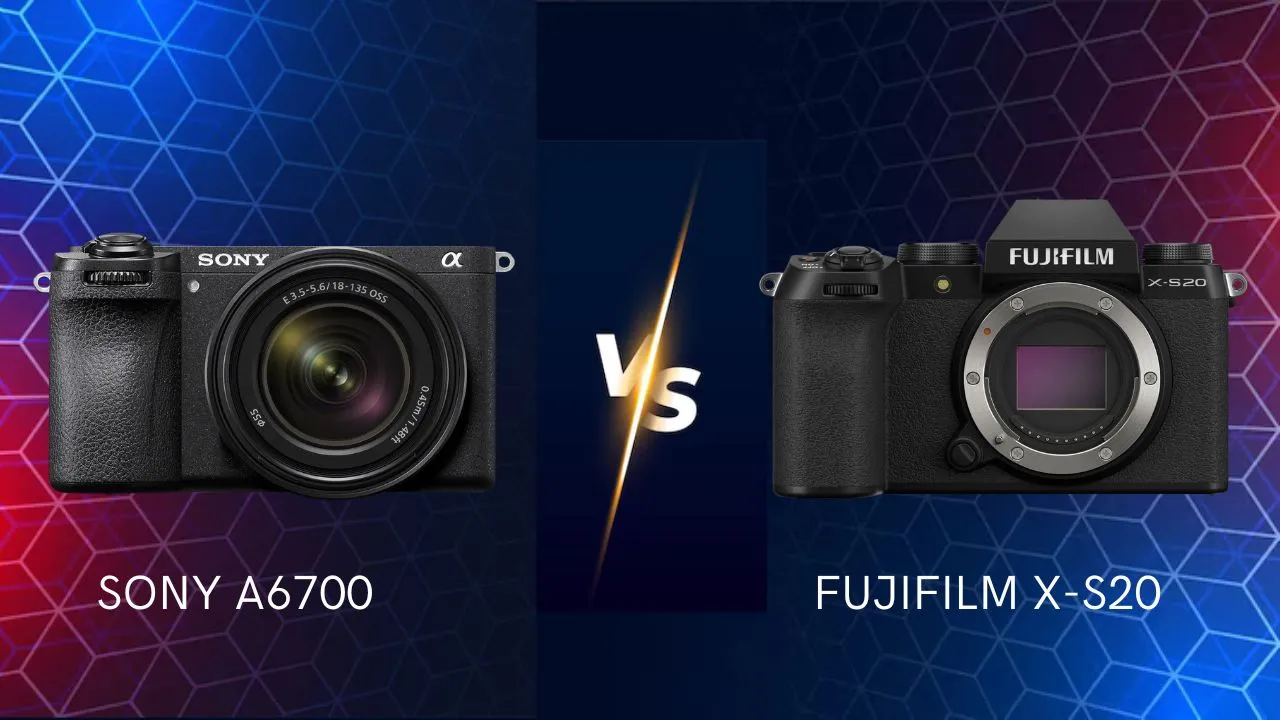
When you’re comparing the Sony A6700 and Fujifilm X-S20, you’re looking at two very capable APS-C mirrorless cameras that cater to creators, but with different priorities.
One leans toward modern hybrid performance (the Sony), the other balances still-photography excellence with hybrid capability (the Fujifilm).
Let’s dive into how they stack up — and which one might be the better fit for you.
⚙️ Overview – Speed & Hybrid Power vs Photography-First Hybrid
Sony A6700
An advanced APS-C mirrorless camera designed for creators who want cutting-edge autofocus, hybrid photo + video capability, strong stills performance, and a lighter gear load.
Fujifilm X-S20
Also an APS-C mirrorless model, but with a stronger emphasis on photographic experience, tactile controls, Fujifilm’s color science, while still offering very good hybrid capability (video + stills) and IBIS.
In short:
-
A6700 = Best if hybrid workflow (photo + video), speed, modern AF, portability dominate your decision.
-
X-S20 = Best if stills quality, camera feel, Fujifilm ecosystem, and a balanced hybrid need are your priorities.
📸 Detailed Specifications Comparison
| Feature | Sony A6700 | Fujifilm X-S20 |
|---|---|---|
| Release Date | July 2023 | May 2023 |
| Camera Type | Mirrorless (Hybrid APS-C) | Mirrorless (Hybrid APS-C) |
| Sensor | APS-C 26.0 MP BSI-CMOS | APS-C 26.1 MP X-Trans CMOS 4 |
| Image Processor | BIONZ XR + AI Processing Unit | X-Processor 5 |
| Lens Mount | Sony E-mount | Fujifilm X-mount |
| ISO Range | 100–32,000 (expandable to 102,400) | 160–12,800 (expandable to 80–51,200) |
| In-Body Image Stabilization (IBIS) | Yes, 5-axis | Yes, 5-axis (up to 7 stops) |
| Autofocus System | Hybrid phase-detection AF (759 points) | Hybrid phase-detection AF (425 points) |
| AF Subject Recognition | Humans, animals, birds, insects, vehicles, aircraft | Humans, animals, birds, vehicles |
| Continuous Shooting Speed | Up to 11 fps | 8 fps (mechanical), 20 fps (electronic, crop) |
| Video Recording | Up to 4K 120p | Up to 6.2K 30p, 4K 60p |
| Video Bit Depth / Color | 10-bit 4:2:2 internal | 10-bit 4:2:2 internal |
| Color Profiles | S-Log3, S-Cinetone, HLG | F-Log2, Film Simulations |
| RAW Video Output | Yes, 16-bit via HDMI | Yes, 12-bit via HDMI |
| Recording Limit | No recording limit (thermal dependent) | No recording limit (thermal dependent) |
| Viewfinder | 2.36M-dot OLED EVF | None |
| LCD Screen | 3.0″ fully articulating touchscreen (1.03M dots) | 3.0″ fully articulating touchscreen (1.84M dots) |
| Touch Functions | Yes (AF, tracking, menus) | Yes (AF, tracking, menus) |
| Product Showcase Mode | No | No |
| Background Defocus Button | No | No |
| Body Material | Magnesium alloy | Magnesium alloy |
| Weather Sealing | Yes (basic sealing) | No |
| Audio Options | Mic input, headphone out, digital MI shoe | Mic input, headphone via USB-C |
| Connectivity | Wi-Fi, Bluetooth, USB-C, HDMI | Wi-Fi, Bluetooth, USB-C, HDMI |
| Battery Type | NP-FZ100 | NP-W235 |
| Battery Life (CIPA) | Approx. 570 shots | Approx. 750 shots |
| Dimensions (W × H × D) | 122 × 69 × 75.1 mm | 127.7 × 85.1 × 65.4 mm |
| Weight (Body Only) | Approx. 409 g | Approx. 491 g |
| Price (Body Only) | Approx. USD 1,399 (check on Amazon) | Approx. USD 1,300 |
🧱 Build, Handling & Portability
The Sony A6700 wins on pure performance and flexibility. It’s built to be efficient for creators who move fast, shoot both stills and video, and want modern autofocus and functionality. Because it leans that way, it may feel slightly more “feature-packed”.
The Fujifilm X-S20 gives you an excellent balance — stills-friendly controls, Fujifilm’s aesthetic and color science, plus hybrid video capability. If you’re a photographer first and video second, the handling and gear experience may feel more tailored.
👉 Verdict:
-
Choose A6700 if you prioritise performance and hybrid capability.
-
Choose X-S20 if you prioritise stills, camera feel, and enjoy the photographic experience.
🎯 Autofocus & Performance
Here’s where the A6700 shines: its autofocus system is cutting-edge for APS-C, excellent for both moving subjects and video workflows. On the other hand, the X-S20 offers very capable AF and hybrid features, but with slightly more emphasis on stills and general use rather than pushing the bleeding edge.
👉 Verdict:
-
If you shoot a lot of action, video, moving subjects → A6700 likely gives you the edge.
-
If you shoot more stills, portrait, travel, and want reliability in simpler scenarios → X-S20 is strong.
🎥 Video Capabilities
For video creation:
-
A6700: Strong option for creators who need a compact rig, flexibility, and modern features (strong video specs in an APS-C body).
-
X-S20: Very good video support, including high-end features (e.g., 6.2 K, 4K/60) for its class, making it a strong hybrid choice, especially if video is important but stills dominate.
👉 Verdict:
-
If video is a major part of your workflow: A6700 may give more margin.
-
If stills are primary but you do video too: X-S20 might offer the better balance.
🧠 Image Quality (Stills)
Both cameras deliver excellent APS-C image quality. The distinctions will come more from lenses, sensor tuning, color science, and workflow rather than mega difference in raw detail. The X-S20’s Fujifilm color science is often praised by photographers; the A6700 will deliver very high quality but maybe more neutral in character.
👉 Verdict:
-
For stills quality + photographic experience → X-S20 slightly favored.
-
For versatility and hybrid stills/video high performance → A6700 very strong.
🔋 Ecosystem, Lenses & Future-Proofing
If you already own lenses or plan extensive lens investment:
-
E-Mount (Sony) offers enormous flexibility, many lenses (APS-C and full-frame) and third-party support.
-
X-Mount (Fujifilm) has a strong APS-C lens set, excellence in primes and compact lenses, very good support — especially if you stay APS-C.
👉 Verdict:
-
If you want broad lens flexibility and future upgrades (including maybe full frame) → A6700 is stronger.
-
If you commit to APS-C and love compact primes and photographic lenses, X-S20 works extremely well.
💰 Price & Value
Given its hybrid focus and specs, the A6700 might offer “more camera” for certain use-cases, though lens/gear costs remain. The X-S20, while still excellent value, might cost more (especially with lens + features) but offers premium stills experience.
👉 Verdict:
-
If budget is tight and you need high flex & hybrid use → A6700.
-
If your budget allows and stills + experience matter most → X-S20 is a worthy investment.
Check availability and price on Amazon 🛒
📷 Fuji X-S20 — Amazon USA / Amazon Canada / Amazon UK / Amazon Australia
📷 Sony A6700 — Amazon USA / Amazon Canada / Amazon UK / Amazon Australia
(As an Amazon Associate, I earn from qualifying purchases — at no extra cost to you.)
🏁 Final Verdict — Sony A6700 vs Fujifilm X-S20
| Type of User | Recommended Camera |
|---|---|
| Hybrid creator doing stills + video, valuing modern specs & lens flexibility | Sony A6700 |
| Photographer who shoots primarily stills, enjoys camera feel & color science, but also does video | Fujifilm X-S20 |
| Travel or carry-everyday shooter wanting strong all-round APS-C performance | A6700 |
| Photography-enthusiast wanting high-quality images with hybrid capability in a refined body | X-S20 |
✅ In short:
Choose the Sony A6700 if you want a high-performance APS-C body, excellent hybrid capability, modern AF, and strong flexibility.
Choose the Fujifilm X-S20 if you want a more photography-first experience, stills excellence, Fujifilm’s look and feel, while still having solid video and hybrid performance.
🧠 Final Thoughts
Both cameras are outstanding — the “better” one comes down to how you shoot, what you carry, and what features matter most.
-
If you carry your camera often, shoot both stills and video, want modern performance and flexibility → go Sony A6700.
-
If you are photographer-first (with some video), love the camera experience, and want strong image quality and style → go Fujifilm X-S20.
Think about your workflow, gear habits and future plans — then pick the camera that aligns best with you.