Sony A6700 vs Fuji X-T50 – Which one is better?
Sony A6700 vs Fujifilm X-T50 – Which One Is Better?
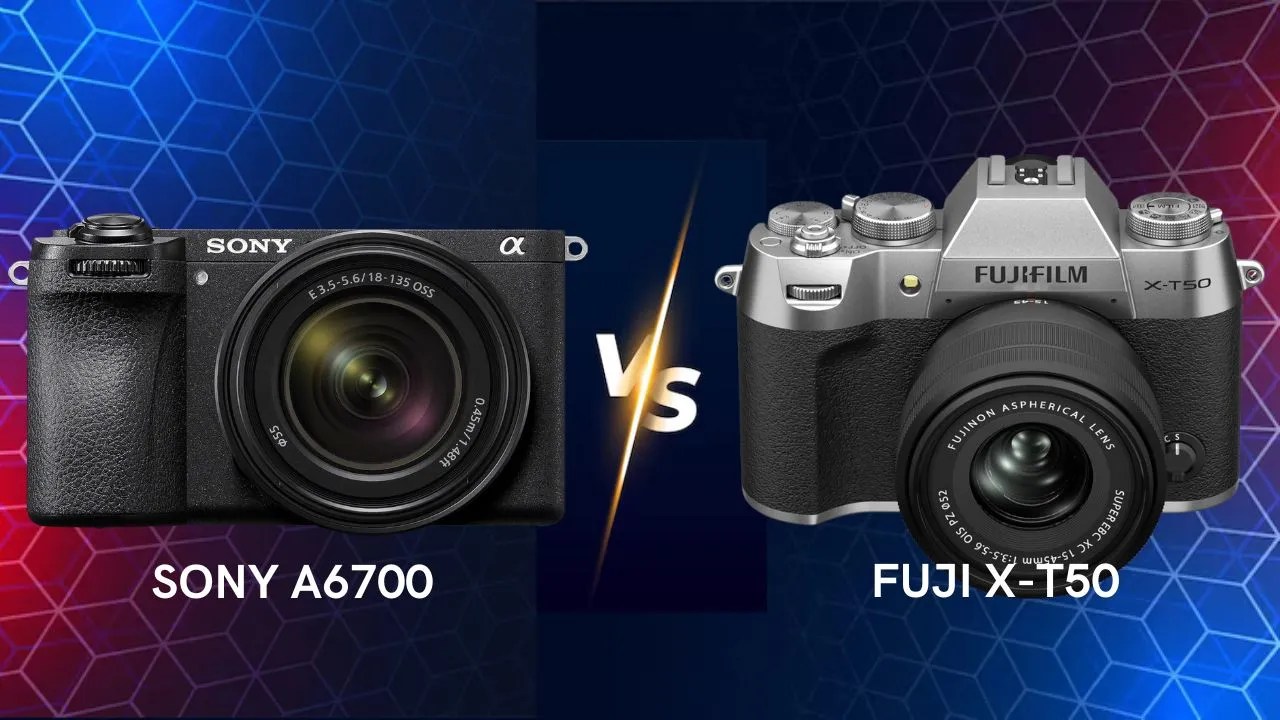
The Sony A6700 and Fujifilm X-T50 are both excellent mirrorless cameras—but for very different kinds of creators.
The A6700 is a high-performance APS-C model with cutting-edge features, while the X-T50 emphasizes style, photographic experience, and portability.
Below is a detailed comparison to help you decide which one fits you best.
⚙️ Overview – High-End APS-C vs Style-And-Photography-Focused APS-C
Sony A6700:
An APS-C mirrorless camera designed for creators who want top specs, advanced autofocus, hybrid photo + video capability and a strong all-round performer.
Fujifilm X-T50:
An APS-C mirrorless camera built for photographers who value image quality, tactile controls, Fujifilm’s film simulation color science and a stylish, intuitive camera body.
In short:
-
A6700 = Best for speed, hybrid performance, modern specs and creators who want high-end in an APS-C body.
-
X-T50 = Best for photographers who focus on stills (with some video) and want an enjoyable camera experience, less gear weight and refined look.
📸 Detailed Specifications Comparison
| Feature | Sony A6700 | Fujifilm X-T50 |
|---|---|---|
| Release Date | July 2023 | June 2024 |
| Camera Type | Mirrorless (Hybrid APS-C) | Mirrorless (Compact APS-C) |
| Sensor | APS-C 26.0 MP BSI-CMOS | APS-C 40.2 MP X-Trans CMOS 5 HR |
| Image Processor | BIONZ XR + AI Processing Unit | X-Processor 5 |
| Lens Mount | Sony E-mount | Fujifilm X-mount |
| ISO Range | 100–32,000 (expandable to 102,400) | 125–12,800 (expandable to 64–51,200) |
| In-Body Image Stabilization (IBIS) | Yes, 5-axis | No |
| Autofocus System | Hybrid phase-detection AF (759 points) | Hybrid phase-detection AF (425 points) |
| AF Subject Recognition | Humans, animals, birds, insects, vehicles, aircraft | Humans, animals, birds, vehicles |
| Continuous Shooting Speed | Up to 11 fps | Up to 8 fps (mechanical), 20 fps (electronic, crop) |
| Video Recording | Up to 4K 120p | Up to 6.2K 30p, 4K 60p |
| Video Bit Depth / Color | 10-bit 4:2:2 internal | 10-bit 4:2:2 internal |
| Color Profiles | S-Log3, S-Cinetone, HLG | F-Log2, Film Simulations |
| RAW Video Output | Yes, 16-bit via HDMI | Yes, 12-bit via HDMI |
| Recording Limit | No recording limit (thermal dependent) | No recording limit (thermal dependent) |
| Viewfinder | 2.36M-dot OLED EVF | 2.36M-dot OLED EVF |
| LCD Screen | 3.0″ fully articulating touchscreen (1.03M dots) | 3.0″ tilting touchscreen (1.62M dots) |
| Touch Functions | Yes (AF, tracking, menus) | Yes (AF, menus) |
| Product Showcase Mode | No | No |
| Background Defocus Button | No | No |
| Body Material | Magnesium alloy | Magnesium alloy |
| Weather Sealing | Yes (basic sealing) | No |
| Audio Options | Mic input, headphone out, digital MI shoe | Mic input, headphone via USB-C |
| Connectivity | Wi-Fi, Bluetooth, USB-C, HDMI | Wi-Fi, Bluetooth, USB-C, HDMI |
| Battery Type | NP-FZ100 | NP-W126S |
| Battery Life (CIPA) | Approx. 570 shots | Approx. 305 shots |
| Dimensions (W × H × D) | 122 × 69 × 75.1 mm | 123.8 × 84 × 48.8 mm |
| Weight (Body Only) | Approx. 409 g | Approx. 329 g |
| Price (Body Only) | Approx. USD 1,399 (check on Amazon) | Approx. USD 999 |
🧱 Build, Handling & Portability
The Sony A6700 offers performance-packed specs in a compact APS-C body but may still carry the weight and size necessary for advanced features. It is well suited for creators who want serious capability and are comfortable carrying a moderately sized kit.
The Fujifilm X-T50 emphasizes portability, lightweight build, comfortable handling with tactile controls, and a stylish look. It’s ideal for people who prefer to carry less gear, want a camera you enjoy using for still photography, and perhaps less frequent heavy video work.
👉 Verdict:
-
Choose A6700 if you want performance and versatility, and are comfortable with slightly larger gear.
-
Choose X-T50 if you prioritize portability, photography experience, style, and lighter gear.
🎯 Autofocus & Performance
Both cameras offer very capable autofocus systems, but with subtle differences:
-
The A6700 is likely to have superior tracking and video-oriented AF, making it more flexible for hybrid workflows and action.
-
The X-T50 focuses on stills, and while its AF is strong for photography, it may not match the hybrid speed and tracking of Sony’s high-end APS-C models.
👉 Verdict:
-
For fast moving subjects, video or hybrid shooting: A6700.
-
For stills, comfortable handling, and photography-centric use: X-T50.
🎥 Video Capabilities
For video:
-
Sony A6700 shines with higher-end video specs, making it more capable for creators who do both stills and video and may require advanced workflows.
-
Fujifilm X-T50 is excellent for photography with some video capabilities—but if video is a major part of your workflow, it may not be as strong as the A6700.
👉 Verdict:
-
Choose A6700 if video is important alongside stills.
-
Choose X-T50 if stills are your primary focus and video is secondary.
🧠 Image Quality (Stills)
Both cameras share APS-C sensors of very similar resolution, so image quality will be excellent on both. However:
-
The Fujifilm X-T50 brings Fujifilm’s distinctive color science, film simulation modes, and a user experience that maximizes still photography enjoyment.
-
The Sony A6700 offers more flexibility and hybrid use, which may appeal to creators who do both stills and video or want more future-proof features.
👉 Verdict:
-
For photography-first composers who enjoy the camera experience: X-T50.
-
For image quality plus flexibility and hybrid use: A6700.
🔋 Ecosystem, Lenses & Future-Proofing
-
Sony E-Mount gives the A6700 access to a massive lens ecosystem (APS-C and full-frame), strong third-party support, and future system flexibility.
-
Fujifilm X-Mount gives the X-T50 access to many excellent compact primes, a system designed around photographers, and great value in APS-C lenses.
👉 Verdict:
-
If system growth, lens variety and future-proofing matter: A6700 has the edge.
-
If you choose a compact photography system now and want minimal gear with excellent lenses already: X-T50 works very well.
💰 Price & Value
Since the X-T50 emphasizes photography and lighter gear, it likely offers better value if video isn’t a major component of your work. The A6700 costs more but offers more flexibility and performance.
👉 Verdict:
-
If budget and photography focus matter: X-T50.
-
If you value performance and hybrid capability: A6700.
Check availability and price on Amazon 🛒
📷 Fuji X-T50 — Amazon USA / Amazon Canada / Amazon UK / Amazon Australia
📷 Sony A6700 — Amazon USA / Amazon Canada / Amazon UK / Amazon Australia
Note: camerafight.com participates in the Amazon Associates Program. As an Amazon Associate, we earn from qualifying purchases.
🏁 Final Verdict — Sony A6700 vs Fujifilm X-T50
| Type of User | Recommended Camera |
|---|---|
| Hybrid creator who shoots both stills + video and wants high performance | Sony A6700 |
| Photographer wanting compact, stylish, photography-first setup | Fujifilm X-T50 |
| Travel/street shooter prioritising portability and enjoyment | X-T50 |
| Creator who needs performance, video capabilities, and lens ecosystem | A6700 |
✅ In Short:
-
Choose Sony A6700 if you want a high-performance APS-C body, excellent hybrid capability, and future-proof system flexibility.
-
Choose Fujifilm X-T50 if you focus on stills, want a lighter, more intuitive photographic experience, and don’t need every video-centric feature.
🧠 Final Thoughts
Both cameras are excellent—but the “better” one really depends on how you shoot, what you carry, and what features you value most.
-
If you carry your camera often, shoot video + stills and pursue flexibility → go A6700.
-
If you prioritise photograph-feels, portability, minimal gear and stills-centric shooting → go X-T50.
Think about your shooting style, gear habits and long-term system plans — then choose the camera that fits you best.