Sony A6700 vs A7 IV – Which one is better?
Sony A6700 vs Sony A7 IV – Which one is better?
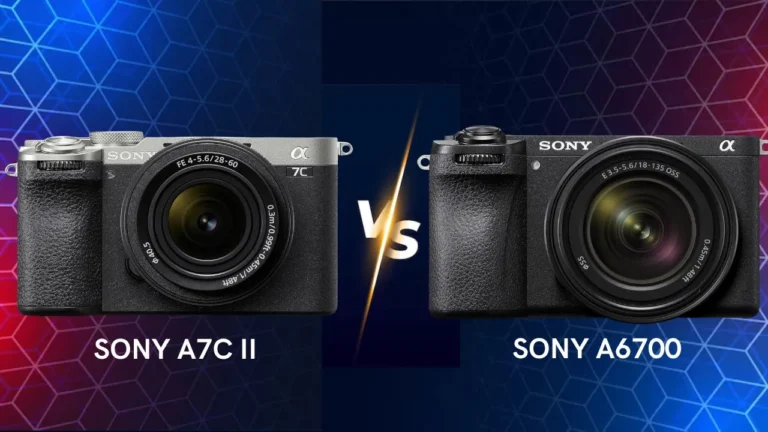
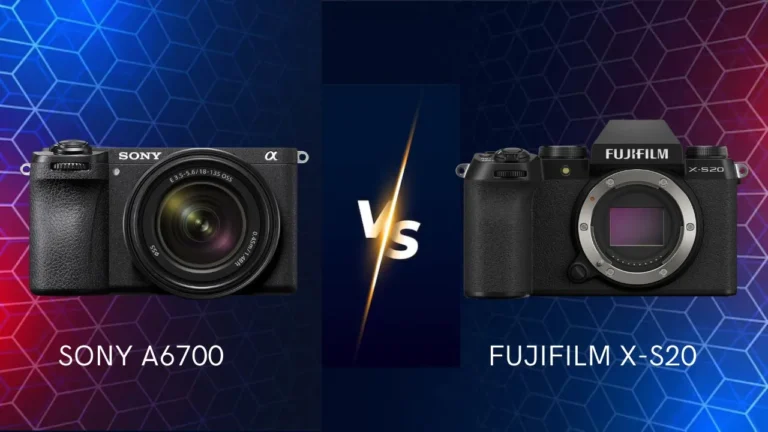
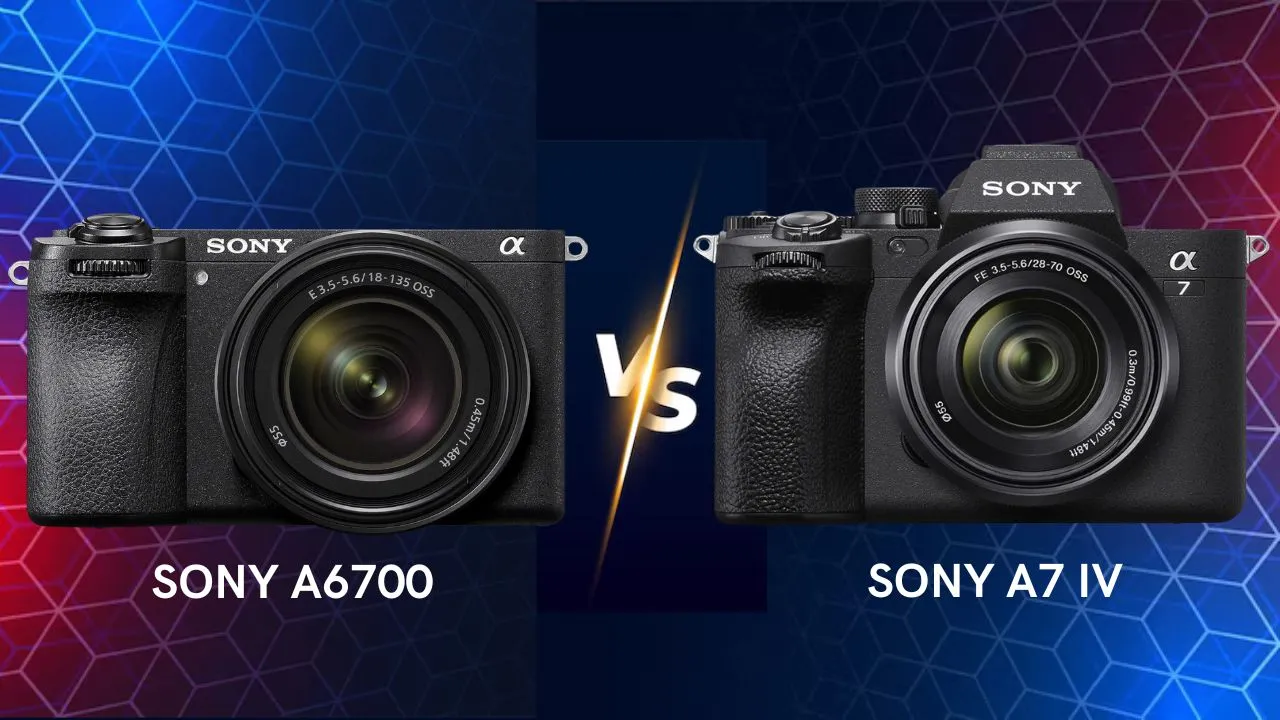
Choosing between the Sony A6700 and the Sony A7 IV means deciding not just between camera models, but between sensor sizes, workflows, and future system investment.
The A6700 is a high-spec APS-C camera with excellent features in a more compact form, while the A7 IV is a full-frame powerhouse designed for creators who want room to grow.
This comparison will help you determine which one is better for your needs.
⚙️ Overview — High-End APS-C vs Versatile Full-Frame Hybrid
Sony A6700:
A next-generation APS-C mirrorless camera designed for creators who want top performance, great autofocus, and strong video features without the full size or cost of full-frame gear.
Sony A7 IV:
A full-frame mirrorless camera aimed at hybrid stills + video creators who want full-frame image quality, advanced features, and system-level investability.
In short:
-
A6700 = Optimised APS-C for speed, affordability, and portability.
-
A7 IV = Full-frame quality, major system depth, long-term value.
📸 Detailed Specifications Comparison
| Feature | Sony A6700 | Sony A7 IV |
|---|---|---|
| Release Date | July 2023 | December 2021 |
| Camera Type | Mirrorless (Hybrid APS-C) | Mirrorless (Hybrid Full Frame) |
| Sensor | APS-C 26.0 MP BSI-CMOS | Full-Frame 33.0 MP BSI-CMOS |
| Image Processor | BIONZ XR + AI Processing Unit | BIONZ XR |
| Lens Mount | Sony E-mount | Sony E-mount |
| ISO Range | 100–32,000 (expandable to 102,400) | 100–51,200 (expandable to 204,800) |
| In-Body Image Stabilization (IBIS) | Yes, 5-axis | Yes, 5-axis |
| Autofocus System | Hybrid phase-detection AF (759 points) | Hybrid phase-detection AF (759 points) |
| AF Subject Recognition | Humans, animals, birds, insects, vehicles, aircraft | Humans, animals, birds (AI-based) |
| Continuous Shooting Speed | Up to 11 fps | Up to 10 fps |
| Video Recording | Up to 4K 120p | Up to 4K 60p |
| Video Bit Depth / Color | 10-bit 4:2:2 internal | 10-bit 4:2:2 internal |
| Color Profiles | S-Log3, S-Cinetone, HLG | S-Log3, S-Cinetone, HLG |
| RAW Video Output | Yes, 16-bit via HDMI | Yes, 16-bit via HDMI |
| Recording Limit | No recording limit (thermal dependent) | No recording limit (thermal dependent) |
| Viewfinder | 2.36M-dot OLED EVF | 3.69M-dot OLED EVF |
| LCD Screen | 3.0″ fully articulating touchscreen (1.03M dots) | 3.0″ fully articulating touchscreen (1.03M dots) |
| Touch Functions | Yes (AF, tracking, menus) | Yes (AF, tracking, menus) |
| Product Showcase Mode | No | No |
| Background Defocus Button | No | No |
| Body Material | Magnesium alloy | Magnesium alloy |
| Weather Sealing | Yes (basic sealing) | Yes (advanced sealing) |
| Audio Options | Mic input, headphone out, digital MI shoe | Mic input, headphone out, digital MI shoe |
| Connectivity | Wi-Fi, Bluetooth, USB-C, HDMI | Wi-Fi, Bluetooth, USB-C, HDMI |
| Battery Type | NP-FZ100 | NP-FZ100 |
| Battery Life (CIPA) | Approx. 570 shots | Approx. 580 shots |
| Dimensions (W × H × D) | 122 × 69 × 75.1 mm | 131.3 × 96.4 × 79.8 mm |
| Weight (Body Only) | Approx. 409 g | Approx. 659 g |
| Price (Body Only) | Approx. USD 1,399 (check on Amazon) | Approx. USD 2,500 |
🧱 Build & Handling
The A6700’s compact size makes it ideal for creators who travel, shoot handheld, or want minimal gear weight—while still getting excellent features. The body is lighter and easier to carry daily.
The A7 IV, as a full-frame body, is a bit larger and heavier, but still very manageable. It offers deeper grip, more robust build, more display/evf real-estate and feels more like a professional workhorse.
👉 Verdict:
-
Choose A6700 if portability and compactness matter most.
-
Choose A7 IV if you want a full-frame body built for extended use and system growth.
🎯 Autofocus & Performance
Both cameras offer excellent autofocus systems, but the A7 IV has the edge due to full-frame sensor coverage, larger focusing area, and more mature tracking algorithms. The A6700 is extremely capable and may suffice for most users, especially in APS-C territory, but for demanding action, hybrid shoots, or professional subjects, the A7 IV is stronger.
👉 Verdict:
-
A7 IV: Better for fast action, complex hybrid work, and future-proofing.
-
A6700: Very strong for creators not needing full-frame and prioritising size/cost.
🎥 Video Capabilities
For video creators:
-
The A7 IV offers full-frame depth, better low-light performance, larger field of view, and advanced video features suited for hybrid professionals, while still being relatively compact.
-
The A6700 delivers high quality video for APS-C size: excellent codec options, great autofocus, portable rig capability. If you shoot video but carry gear a lot, this is compelling.
👉 Verdict:
-
If video is same importance as stills and you build a system, choose A7 IV.
-
If portability, hybrid content, smaller setup matter more and you can live with APS-C, choose A6700.
🧠 Image Quality (Stills)
A full-frame sensor (A7 IV) gives advantages in depth of field control, low-light performance and cropping flexibility. The APS-C sensor (A6700) still produces excellent image quality, but there’s a performance gap especially in demanding situations.
👉 Verdict:
-
Choose A7 IV if you prioritise still image quality and full-frame look.
-
Choose A6700 if you’re satisfied with APS-C and want lighter gear.
🔋 Ecosystem, Lenses & Future-Proofing
Since both are E-Mount, lens compatibility is good; but full-frame lenses are larger and more expensive. If you expect to build a serious system, full-frame gives you more options long-term. APS-C may limit you somewhat, but many excellent options exist.
👉 Verdict:
-
A7 IV: Better for long-term investment and lens upgrade path.
-
A6700: Better for moderate budget and smaller setup.
💰 Price & Value
The APS-C A6700 offers strong value in a high-end body for creators. The full-frame A7 IV costs more (body + lenses) but gives more headroom and flexibility.
👉 Verdict:
-
If budget and size matter most → A6700.
-
If quality and system capability matter more → A7 IV.
Check availability and price on Amazon 🛒
📷 Sony A7 IV — Amazon USA / Amazon Canada / Amazon UK / Amazon Australia
📷 Sony A6700 — Amazon USA / Amazon Canada / Amazon UK / Amazon Australia
Note: camerafight.com participates in the Amazon Associates Program. As an Amazon Associate, we earn from qualifying purchases.
🏁 Final Verdict — Sony A6700 vs Sony A7 IV
| Type of User | Recommended Camera |
|---|---|
| Creator who carries camera often and values compact gear | Sony A6700 |
| Hybrid creator/stills+video shooter who wants full-frame quality and upgrade path | Sony A7 IV |
| Travel/Street photographer prioritising portability | A6700 |
| Professional or enthusiast wanting full-frame system and image quality | A7 IV |
✅ In Short:
Choose Sony A6700 if you want a high-performance APS-C body with excellent features, lighter size and better value.
Choose Sony A7 IV if you want a full-frame body with more headroom, better image quality, and system versatility for the future.
🧠 Final Thoughts
Both cameras are excellent — the “better” one depends on how you shoot, what you carry, and what you prioritise.
-
If you move fast, shoot hybrid content, travel often, and carry gear lightly → go A6700.
-
If you shoot stills + video seriously, want full-frame look, and plan to build a camera system → go A7 IV.
Reflect on your workflow, gear habits and future plans — then pick the camera that aligns best with you.