Sony A6400 vs Sony A7 III – Which one is better?
Sony A6400 vs Sony A7 III – Which One Is Better?
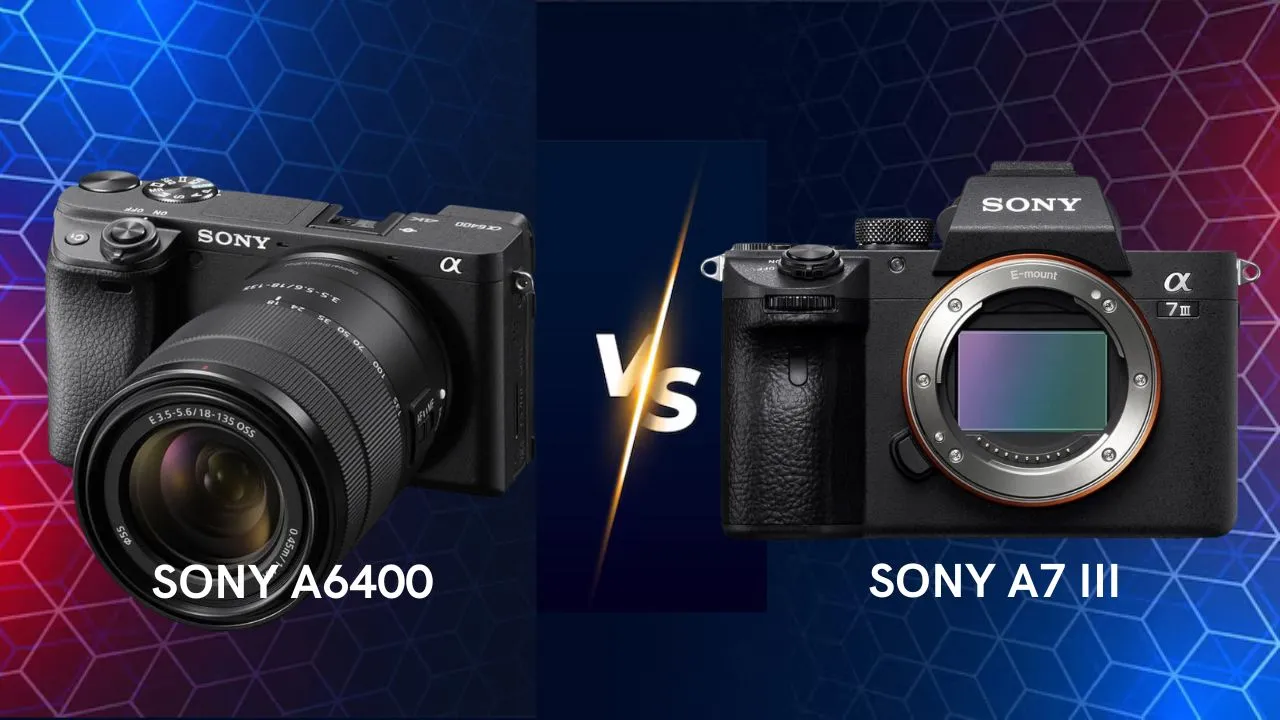
Comparing the Sony Alpha A6400 and Sony Alpha A7 III means looking at two capable mirrorless cameras aimed at different levels of the creator market.
The A6400 is an APS-C machine offering excellent autofocus and value, while the A7 III is a full-frame powerhouse with broader system potential.
Let’s break down the key differences and see which might be the better fit for you.
⚙️ Overview — Value APS-C vs Full-Frame Performer
Sony A6400:
An APS-C mirrorless camera designed for creators who want modern autofocus, strong stills + video quality in a compact package. It’s especially attractive for those on a budget or carrying gear often.
Sony A7 III:
A full-frame mirrorless camera with high-end stills and hybrid credentials. It features full-frame sensor benefits, a more advanced image-system, stronger low-light performance, and a mature lens ecosystem.
In short:
-
A6400 = Great value, APS-C size, excellent autofocus.
-
A7 III = Full-frame quality, system depth, longer horizon.
📸 Detailed Specifications Comparison
| Specification | Sony A6400 | Sony A7 III |
|---|---|---|
| Release date | January 2019 | April 2018 |
| Camera type | Mirrorless | Mirrorless |
| Sensor format | APS-C (23.5 × 15.6 mm) | Full Frame (35.6 × 23.8 mm) |
| Sensor type | CMOS | BSI-CMOS |
| Resolution | 24.2 MP | 24.2 MP |
| Image processor | BIONZ X | BIONZ X |
| ISO range | 100–32,000 (expandable to 102,400) | 100–51,200 (expandable to 204,800) |
| Autofocus system | 425-point phase-detection AF with Real-time Tracking & Eye AF | 693-point phase-detection AF |
| Continuous shooting | Up to 11 fps | Up to 10 fps |
| Video recording | 4K up to 30p (oversampled from 6K, 8-bit 4:2:0) | 4K up to 30p (8-bit, 4:2:0 internal) |
| Viewfinder | 2.36M-dot OLED EVF | 2.36M-dot OLED EVF |
| LCD screen | 3.0″ flip-up touchscreen, 921k dots | 3.0″ tilting screen, 922k dots |
| In-body image stabilization (IBIS) | No | Yes, 5-axis |
| Memory card slots | 1× SD (UHS-I) | 2× SD (1× UHS-II, 1× UHS-I) |
| Battery life (CIPA) | Approx. 410 shots | Approx. 710 shots |
| Weight (with battery & card) | Approx. 403 g | Approx. 650 g |
| Launch price (body only) | Approx. USD 900 (check on Amazon) | Approx. USD 2,000 (check on Amazon) |
🧱 Build, Handling & Portability
The A6400 is lighter and more compact — ideal if you carry your camera all day, travel often, or want a smaller footprint. The smaller sensor and body size mean less gear weight overall.
The A7 III, being full-frame, is somewhat larger and heavier than an APS-C body, but delivers full-frame ergonomics, deeper grip, dual card slots, and the “big camera” feel for serious work.
👉 Verdict:
-
If you prioritise lightweight gear and portability, the A6400 has the advantage.
-
If you prioritise system feel, full-frame handling and upgrade path, the A7 III is more suitable.
🎯 Autofocus & Performance
Both cameras perform very well, but there’s a clear difference in scale and system maturity:
-
The A6400 offers excellent autofocus for its class and size, especially for APS-C stills and hybrid work.
-
The A7 III’s autofocus system is more advanced (phase-detect across a much broader area, better subject tracking), making it stronger for challenging conditions, fast action, event work, and more demanding hybrid environments.
👉 Verdict:
-
For daily, travel, vlog, shooting with predictable subjects: A6400 delivers very strong AF.
-
For fast action, hybrid stills + video, professional shoots: A7 III is the better choice.
🎥 Video Capabilities
Both handle video well, but the full-frame sensor and feature set of the A7 III provide more headroom in low-light and depth of field. The A6400 gives excellent value for video but may have more limitations compared to full-frame tools.
👉 Verdict:
-
If you do a lot of video, handheld, in controlled rig, the A7 III gives more flexibility.
-
If you shoot travel, vlog, hybrid stills/video in lighter setups, the A6400 handles very well.
🧠 Image Quality (Stills)
Full-frame generally offers shallower depth of field, better low-light performance, and more “luxury” image quality. APS-C still offers fantastic quality—especially in the hands of good lenses—but full-frame gives an edge.
👉 Verdict:
-
If image quality is your top priority and you print large or do studio work → A7 III.
-
If you shoot mostly online/social/street and value lighter gear → A6400 is very good.
🔋 Ecosystem & Future-Proofing
Both use the same Sony E-Mount, which means lens compatibility is excellent for both bodies. However, full-frame lenses tend to be larger/heavier and more expensive, and upgrading to full-frame later may require lens investment.
👉 Verdict:
-
If starting out and cost/size matter: A6400 is a smart starting point.
-
If you anticipate upgrading or building a serious system: A7 III offers longer-term potential.
💰 Price & Value
The A6400 offers excellent value for those willing to work within APS-C size and sensor. The A7 III, being full-frame, comes at a higher cost (body + lenses) but delivers more in capability.
👉 Verdict:
-
On budget or size constraint → A6400.
-
If you invest for long-term and full-frame benefits matter → A7 III.
Check availability and price on Amazon 🛒
📷 Sony A6400 — Amazon USA / Amazon Canada / Amazon UK / Amazon Australia
📷 Sony A7 III — Amazon USA / Amazon Canada / Amazon UK / Amazon Australia
Note: camerafight.com participates in the Amazon Associates Program. As an Amazon Associate, we earn from qualifying purchases.
🏁 Final Verdict — Sony A6400 vs Sony A7 III
| Type of User | Recommended Camera |
|---|---|
| Travel/content creator needing compact gear | Sony A6400 |
| Hybrid creator requiring full-frame image + system depth | Sony A7 III |
| Photographer mostly shooting stills and needing full-frame quality | A7 III |
| Enthusiast/vlogger with budget & lighter gear needs | A6400 |
✅ In short:
Choose the Sony A6400 if you want a capable APS-C body with excellent autofocus, good video/stills performance, and a light gear footprint.
Choose the Sony A7 III if you want full-frame quality, stronger autofocus/tracking, more lens/system investment, and the maximum flexibility for photo + video.
🧠 Final Thoughts
Both cameras are excellent—but the “better” one depends on how you shoot, what you carry, and what you’re willing to invest in.
-
Carry light often? Go A6400.
-
Want full-frame image quality and system growth? Go A7 III.
Reflect on your own workflow, your budget, your lens collection, and what you shoot most—and pick the camera that aligns best with you.