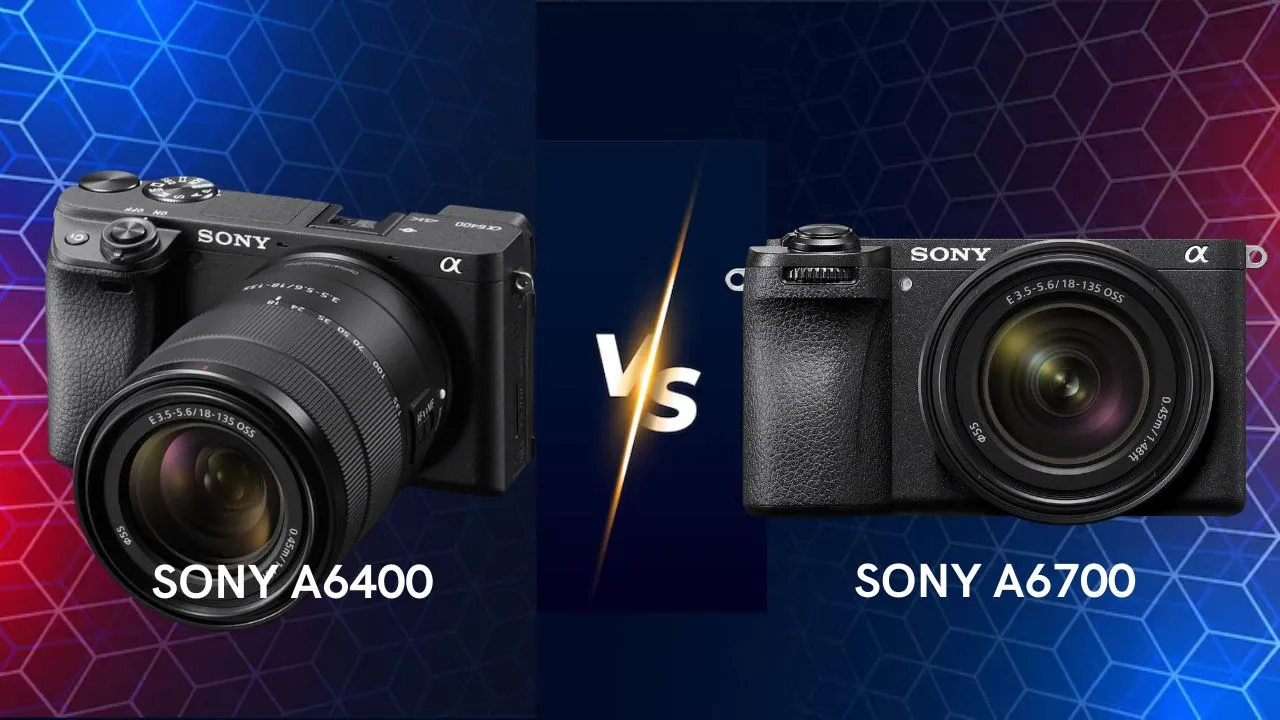
Sony A6400 vs Sony A6700 – Which one is better?
Sony Alpha A6400 vs Sony Alpha A6700 – Which One Is Better?
When choosing between the Sony A6400 and Sony A6700, you’re comparing two capable APS-C mirrorless cameras from Sony’s Alpha range.
The A6400 is a strong value-hybrid option, while the A6700 introduces the newer generation of features aimed at creators seeking higher performance.
Let’s break down how they compare and which might be better for your needs.
⚙️ Overview – Value Hybrid vs Next-Gen Performance
Sony A6400:
An APS-C mirrorless camera launched in early 2019, offering excellent autofocus, solid stills and video capabilities, and strong value for money.
Sony A6700:
A next-generation APS-C mirrorless camera announced in mid-2023, built to offer significantly improved performance—higher resolution, advanced AF, more modern video and workflow features.
In short:
-
A6400 = Best if you want great performance at lower cost, with proven reliability.
-
A6700 = Best if you want more future-proof features, higher specs and longer-term usability.
📸 Detailed Specifications Comparison
| Feature | Sony A6400 | Sony A6700 |
|---|---|---|
| Release Date | January 2019 | July 2023 |
| Camera Type | Mirrorless (APS-C) | Mirrorless (Hybrid APS-C) |
| Sensor | APS-C 24.2 MP CMOS | APS-C 26.0 MP BSI-CMOS |
| Image Processor | BIONZ X | BIONZ XR + AI Processing Unit |
| Lens Mount | Sony E-mount | Sony E-mount |
| ISO Range | 100–32,000 (expandable to 102,400) | 100–32,000 (expandable to 102,400) |
| In-Body Image Stabilization (IBIS) | No | Yes, 5-axis |
| Autofocus System | Hybrid phase-detection AF (425 points) | Hybrid phase-detection AF (759 points) |
| AF Subject Recognition | Humans, animals (limited Eye AF) | Humans, animals, birds, insects, vehicles, aircraft |
| Continuous Shooting Speed | Up to 11 fps | Up to 11 fps |
| Video Recording | Up to 4K 30p | Up to 4K 120p |
| Video Bit Depth / Color | 8-bit 4:2:0 internal | 10-bit 4:2:2 internal |
| Color Profiles | S-Log2, S-Log3, HLG | S-Log3, S-Cinetone, HLG |
| RAW Video Output | No | Yes, 16-bit via HDMI |
| Recording Limit | No recording limit | No recording limit (thermal dependent) |
| Viewfinder | 2.36M-dot OLED EVF | 2.36M-dot OLED EVF |
| LCD Screen | 3.0″ flip-up touchscreen (921k dots) | 3.0″ fully articulating touchscreen (1.03M dots) |
| Touch Functions | Limited (AF only) | Yes (AF, tracking, menus) |
| Product Showcase Mode | No | No |
| Background Defocus Button | No | No |
| Body Material | Magnesium alloy | Magnesium alloy |
| Weather Sealing | Yes (basic) | Yes (basic) |
| Audio Options | Mic input only | Mic input, headphone out, digital MI shoe |
| Connectivity | Wi-Fi, Bluetooth, USB, HDMI | Wi-Fi, Bluetooth, USB-C, HDMI |
| Battery Type | NP-FW50 | NP-FZ100 |
| Battery Life (CIPA) | Approx. 410 shots | Approx. 570 shots |
| Dimensions (W × H × D) | 120 × 66.9 × 59.7 mm | 122 × 69 × 75.1 mm |
| Weight (Body Only) | Approx. 403 g | Approx. 409 g |
| Price (Body Only) | Approx. USD 900 (check on Amazon) | Approx. USD 1,399 (check on Amazon) |
🧱 Build, Handling & Portability
The A6400 offers a compact, lightweight body which makes it a strong choice for creators who want high performance while keeping gear manageable.
The A6700, while still APS-C, carries additional features (IBIS, larger battery, enhanced internals) and thus may be slightly larger or heavier. The boost in spec justifies that for many users.
👉 Verdict:
-
Choose A6400 if portability, cost-efficiency and proven performance matter most.
-
Choose A6700 if you’re comfortable with the additional investment and want more power/features for the future.
🎯 Autofocus & Performance
Autofocus is a standout for both—but the A6700 takes it further. The A6400 introduced very fast AF and reliable tracking for its time. The A6700 upgrades to many more focus points, improved tracking algorithms and better performance for both photo and video.
👉 Verdict:
-
For fast-moving subjects, action, video-centric shooting: A6700 has the edge.
-
For stills, general hybrid use and value: A6400 remains very capable.
🎥 Video & Hybrid Capabilities
Video workflows benefit a lot from advanced features.
-
The A6700 offers higher frame-rate video, modern codecs, possibly better low-light and dynamic range due to newer sensor and processor.
-
The A6400 provides strong video potential (4K, good AF) and remains a good value for creators who don’t need the absolute top tier.
👉 Verdict:
-
If video-heavy or future-looking creator: go A6700.
-
If hybrid use with stills predominant, value matters: A6400 fits well.
🧠 Image Quality (Stills)
Both cameras deliver excellent still image quality. The jump in sensor resolution and processing in the A6700 will benefit bigger prints, cropping flexibility and longer life-cycle. The A6400 remains very solid.
👉 Verdict:
-
If you aim for top image quality and future-proofing: A6700.
-
If stills are important and budget is key: A6400 gives nearly all you need.
🔋 Ecosystem, Lenses & Future-Proofing
Both use Sony E-Mount, so lens and accessory support is excellent in both cases. The main difference is that the A6700’s newer spec means it’s more future-proof for upgrades and advanced workflows.
👉 Verdict:
-
Lens mount: both win.
-
Future upgrade: A6700 slightly ahead due to newer architecture.
💰 Price & Value
Given its earlier release and fewer high-end features, the A6400 usually comes at a lower price point, offering strong value. The A6700 commands a premium but brings more features.
👉 Verdict:
-
For value: A6400.
-
For premium investment: A6700.
Check availability and price on Amazon 🛒
📷 Sony A6400 — Amazon USA / Amazon Canada / Amazon UK / Amazon Australia
📷 Sony A6700 — Amazon USA / Amazon Canada / Amazon UK / Amazon Australia
Note: camerafight.com participates in the Amazon Associates Program. As an Amazon Associate, we earn from qualifying purchases.
🏁 Final Verdict — Sony A6400 vs Sony A6700
| Type of User | Recommended Camera |
|---|---|
| Budget-conscious creator wanting strong hybrid performance | Sony A6400 |
| Advanced creator or enthusiast wanting future-proof APS-C body | Sony A6700 |
| Travel or carry-everyday photographer needing lightweight gear | A6400 |
| Video or hybrid shooter needing advanced AF, IBIS and higher performance | A6700 |
✅ In short:
Choose the Sony A6400 if you want excellent performance in a compact APS-C body at a strong value point.
Choose the Sony A6700 if you want a higher-spec APS-C body with advanced autofocus, stabilisation, video features, and are willing to invest more.
🧠 Final Thoughts
Both cameras are excellent — the best one for you depends on how you shoot, what you carry, and which features matter most.
-
If you carry your camera often, shoot stills/hybrid and want value → A6400 is a smart pick.
-
If you shoot video, need stabilisation, want longevity and higher specs → A6700 is the stronger choice.
Think about your workflow, gear habits, budget and future plans — then pick the camera that best aligns with you.