Panasonic Lumix S9 vs Sony A7 III – Which one is better?
Panasonic Lumix S9 vs Sony A7 III – Which One Is Better?
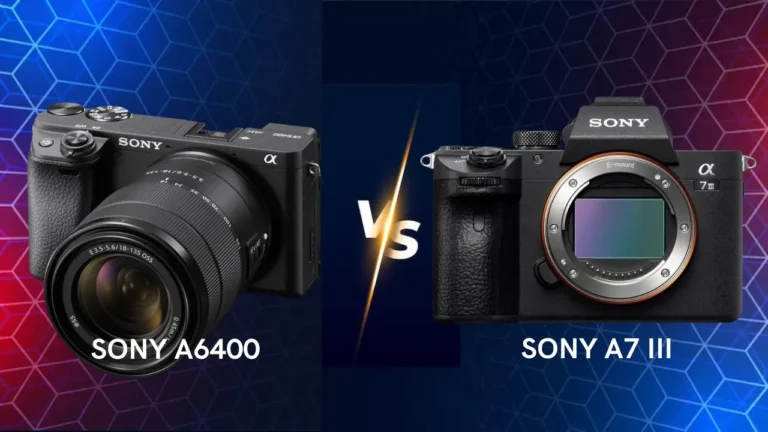
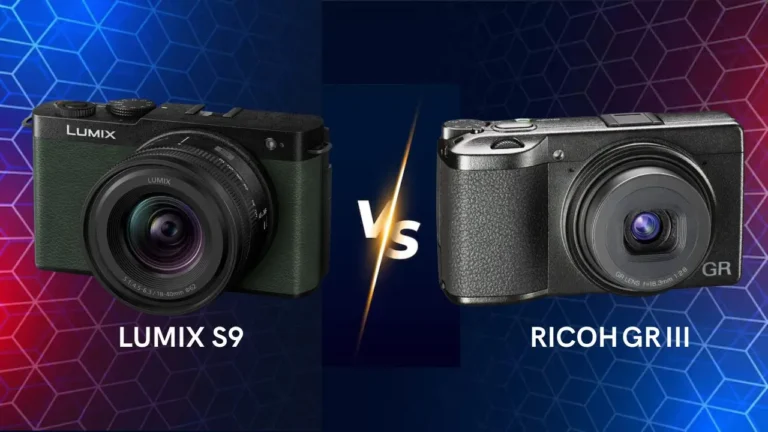
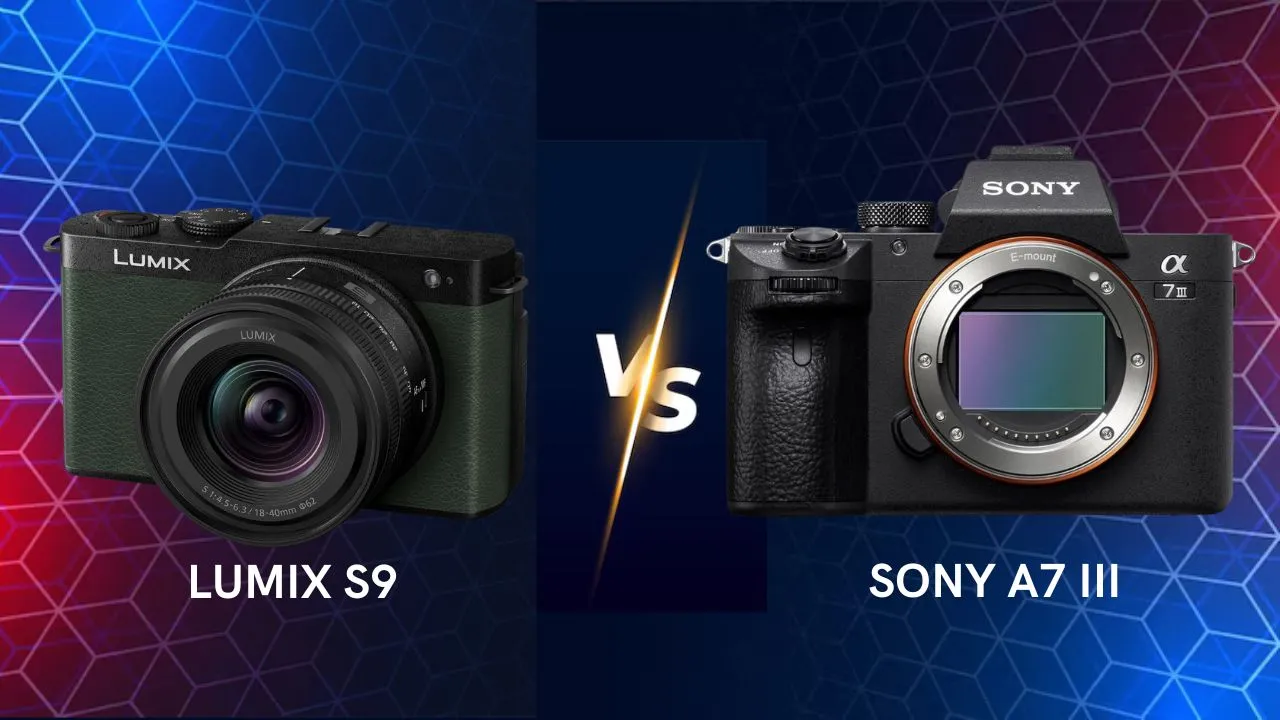
The Panasonic Lumix S9 and the Sony Alpha A7 III are two very capable mirrorless cameras, but they serve slightly different types of photographers and workflows.
The S9 offers full-frame image quality in a compact, creator-friendly form. The A7 III is a proven full-frame tool with excellent all-round performance, especially for stills and with a strong lens ecosystem. Let’s compare them to see which one may be the better fit for you.
⚙️ Overview — Compact Full-Frame vs Established All-Rounder
Panasonic Lumix S9:
A full-frame mirrorless camera designed for creators who want portability, strong image quality, and hybrid photo/video capability in a simplified form factor.
Sony Alpha A7 III:
A full-frame mirrorless camera celebrated for its reliability, excellent stills image quality, a mature feature set, and broad lens/accessories ecosystem.
In short:
-
S9 = Best for creators who carry gear, value portability, and shoot both stills and video.
-
A7 III = Best for photographers who want a reliable full-frame system, broad lens options, excellent AF and stills performance.
📸 Specifications Comparison
| Specification | Panasonic Lumix S9 | Sony A7 III |
|---|---|---|
| Release date | May 2024 | April 2018 |
| Camera type | Mirrorless | Mirrorless |
| Sensor format | Full Frame (35.6 × 23.8 mm) | Full Frame (35.6 × 23.8 mm) |
| Sensor type | CMOS | BSI-CMOS |
| Resolution | 24.2 MP | 24.2 MP |
| Image processor | Venus Engine | BIONZ X |
| ISO range | 100–51,200 (expandable to 204,800) | 100–51,200 (expandable to 204,800) |
| Autofocus system | Phase Hybrid AF (779-point) | 693-point phase-detection AF |
| Continuous shooting | Up to 30 fps (electronic) | Up to 10 fps |
| Video recording | 6K up to 30p, 4K up to 60p (10-bit internal) | 4K up to 30p (8-bit, 4:2:0 internal) |
| Viewfinder | None | 2.36M-dot OLED EVF |
| LCD screen | 3.0″ fully articulating touchscreen, 1.84M dots | 3.0″ tilting screen, 922k dots |
| In-body image stabilization (IBIS) | Yes, 5-axis | Yes, 5-axis |
| Memory card slots | 1× SD (UHS-II) | 2× SD (1× UHS-II, 1× UHS-I) |
| Battery life (CIPA) | Approx. 470 shots | Approx. 710 shots |
| Weight (with battery & card) | Approx. 486 g | Approx. 650 g |
| Launch price (body only) | Approx. USD 1,500 (check on Amazon) | Approx. USD 2,000 (check on Amazon) |
🧱 Build & Handling
The S9 stands out for its portability among full-frame bodies: lighter, easier to carry, ideal for hybrid creators who travel or shoot on the move. The A7 III offers a tried-and-true body design with great ergonomics, durability, and comfortable grip—ideal for longer shoots and more demanding still photography.
Verdict:
-
Choose S9 if portability and full-frame quality with lighter gear matter most.
-
Choose A7 III if you want a robust body, more comfortable shooting experience, and broader system support.
🎯 Autofocus & Performance
Autofocus is an area where the A7 III has an established edge: it features a proven hybrid AF system, excellent subject tracking, and phase-detect across the frame. The S9, while capable and modern, may not match the same level of tracking and system maturity yet.
Verdict:
-
If moving subjects, fast action, or reliability are key, go A7 III.
-
If you shoot more controllable situations, hybrid work and value portability, the S9 is very capable.
🎥 Video Capabilities
For video or hybrid shooters:
-
The S9 gives full-frame advantage (depth of field, low-light performance), compact body and strong video features.
-
The A7 III provides excellent stills quality and very good video features, though full-frame in a slightly larger body and perhaps a bit less video-centric than the S9’s aim.
Verdict:
-
S9 is better for creators who shoot both stills and video and want full-frame look in a lighter gear setup.
-
A7 III is better if stills are your primary focus and video is secondary, or if you already invest in Sony’s system.
🧠 Image Quality (Stills)
Since both are full-frame with ~24 MP sensors, you’ll get excellent image quality, depth of field, dynamic range and low-light performance from both. For many users, the differences in stills will be subtle.
Verdict:
-
If you emphasise stills and lens repertoire, A7 III wins for system maturity.
-
If you value full-frame in a smaller form and portability, S9 gives very strong quality with less bulk.
🔋 Ecosystem & Future-Proofing
Lens ecosystem matters:
-
Sony E-Mount offers one of the deepest ranges of lenses and accessories, and strong third-party support.
-
L-Mount (for S9) is growing, with quality lenses by Panasonic, Leica & Sigma, but still comparatively less breadth.
Verdict:
-
For long-term expansion and lens diversity, A7 III has the edge.
-
For immediate portability and full-frame value, S9 is compelling.
💰 Price & Value
The S9 often presents better value if you want full-frame plus portability and hybrid capability. The A7 III, though older generation, still stands very strong in value, given its system and stills performance.
Verdict:
-
If budget and portability are high priorities → S9.
-
If system build, stills focus and lens investment matter → A7 III.
Check availability and price on Amazon 🛒
📷 Panasonic Lumix S9 — Amazon USA / Amazon Canada / Amazon UK / Amazon Australia
📷 Sony A7 III — Amazon USA / Amazon Canada / Amazon UK / Amazon Australia
🏁 Final Verdict — Panasonic Lumix S9 vs Sony Alpha A7 III
| Type of User | Recommended Camera |
|---|---|
| Creator who carries camera daily | Panasonic Lumix S9 |
| Photographers/creators with broader system investment | Sony Alpha A7 III |
| Travel shooter wanting full-frame in lightweight form | S9 |
| Event/portrait shooter needing reliable AF & lenses | A7 III |
✅ In short:
Choose the Panasonic Lumix S9 if you want full-frame quality, portability, hybrid photo/video performance, and a lighter gear load.
Choose the Sony Alpha A7 III if you prioritise stills, system depth, lens options, and proven performance.
🧠 Final Thoughts
Both cameras are excellent and more “right” for different people. The best choice comes down to how you shoot, what you carry, what gear you plan to invest in, and what you prioritise.
If you shoot a lot on the go, carry light gear, hybrid your work (stills + video) → go S9.
If you’re a serious stills creator or you want the lens ecosystem and reliability of Sony → go A7 III.
Think about your workflow, your gear habits, your priorities — then choose the camera that aligns best with you.