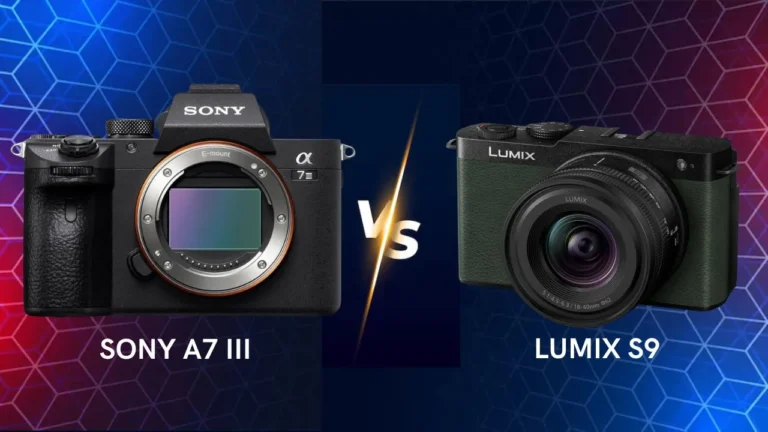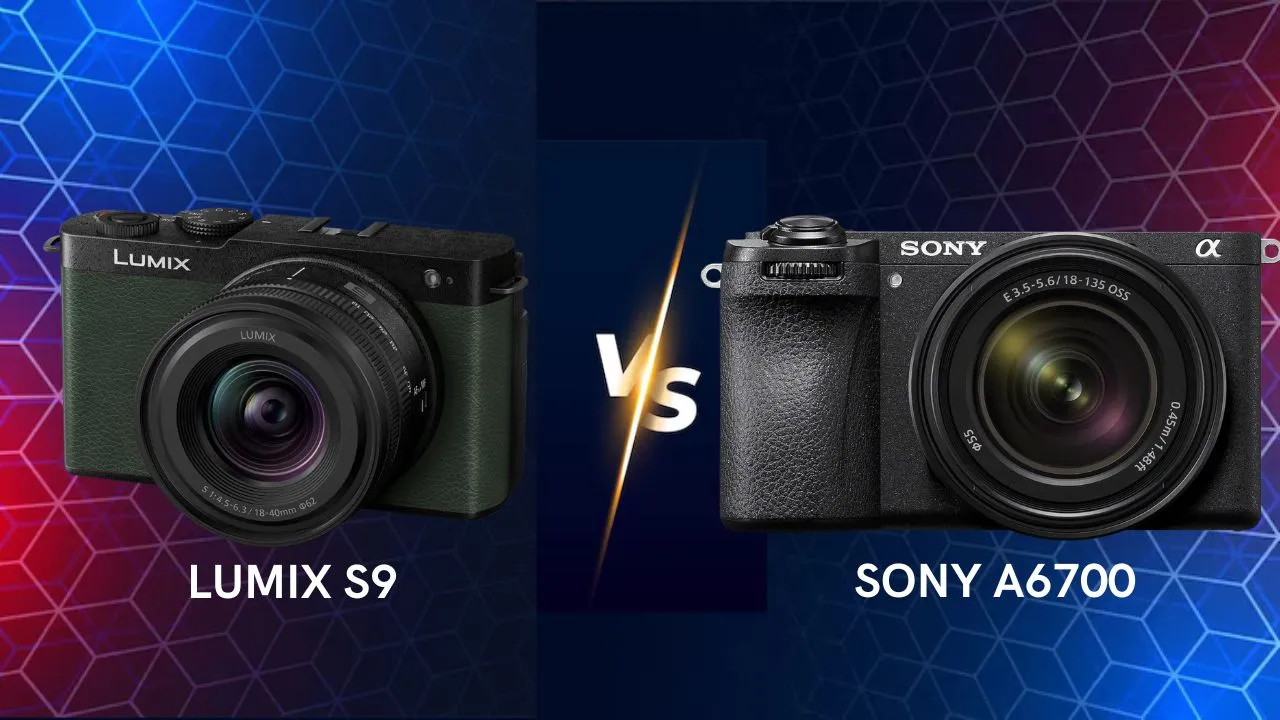
Panasonic Lumix S9 vs Sony A6700 – Which one is better?
Panasonic Lumix S9 vs Sony A6700 – Which One Is Better?
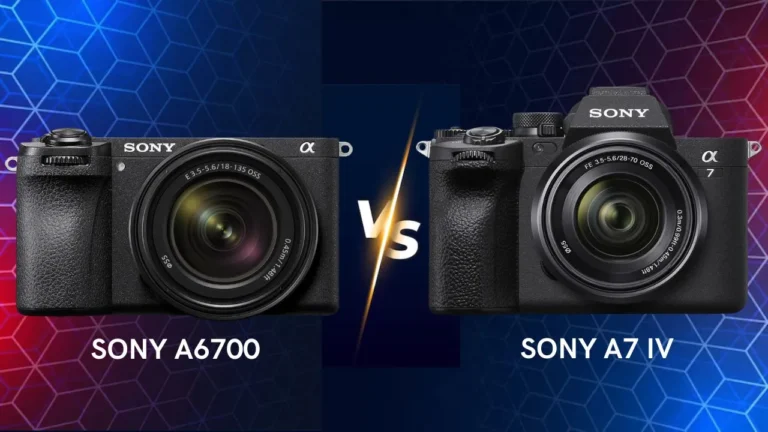
The Panasonic Lumix S9 and Sony A6700 are both excellent mirrorless cameras—but aimed at different kinds of creators.
The Lumix S9 is a full-frame system designed for creators who want high image quality, hybrid photo/video features, and portability.
The Sony A6700 is an APS-C camera geared toward enthusiasts who prioritize speed, autofocus, and a lighter system. Here’s a detailed comparison to help you decide which is the better fit for you.
⚙️ Overview — Full-Frame Hybrid vs APS-C Speed & Autofocus
Panasonic Lumix S9:
A full-frame mirrorless camera built for hybrid creators who value full-frame depth, strong video features, and portability while maintaining serious image quality.
Sony A6700:
An APS-C mirrorless camera with advanced autofocus, high-speed performance, and a lighter/lower-cost system—ideal for creators focused on action, learning, or budget-conscious full-frame alternatives.
In short:
-
S9 = Best for full-frame image quality, hybrid workflows, depth of field control.
-
A6700 = Best for speed, autofocus excellence, system affordability, lighter gear.
📸 Specifications Comparison
| Feature | Panasonic Lumix S9 | Sony A6700 |
|---|---|---|
| Release Date | May 2024 | July 2023 |
| Camera Type | Mirrorless (Video-focused, Full Frame) | Mirrorless (Hybrid APS-C) |
| Sensor | Full-Frame 24.2 MP CMOS | APS-C 26.0 MP BSI-CMOS |
| Image Processor | Venus Engine | BIONZ XR + AI Processing Unit |
| Lens Mount | L-Mount | Sony E-mount |
| ISO Range | 100–51,200 (expandable to 204,800) | 100–32,000 (expandable to 102,400) |
| In-Body Image Stabilization (IBIS) | Yes, 5-axis | Yes, 5-axis |
| Autofocus System | Phase Hybrid AF (779 points) | Hybrid phase-detection AF (759 points) |
| AF Subject Recognition | Humans, animals, vehicles | Humans, animals, birds, insects, vehicles, aircraft |
| Continuous Shooting Speed | Up to 30 fps (electronic) | Up to 11 fps |
| Video Recording | Up to 6K 30p, 4K 60p | Up to 4K 120p |
| Video Bit Depth / Color | 10-bit internal | 10-bit 4:2:2 internal |
| Color Profiles | V-Log, Real Time LUTs | S-Log3, S-Cinetone, HLG |
| RAW Video Output | No | Yes, 16-bit via HDMI |
| Recording Limit | No recording limit (thermal dependent) | No recording limit (thermal dependent) |
| Viewfinder | None | 2.36M-dot OLED EVF |
| LCD Screen | 3.0″ fully articulating touchscreen (1.84M dots) | 3.0″ fully articulating touchscreen (1.03M dots) |
| Touch Functions | Yes (AF, menus, LUT control) | Yes (AF, tracking, menus) |
| Product Showcase Mode | No | No |
| Background Defocus Button | No | No |
| Body Material | Magnesium alloy | Magnesium alloy |
| Weather Sealing | No | Yes (basic sealing) |
| Audio Options | Mic input, headphone via USB-C | Mic input, headphone out, digital MI shoe |
| Connectivity | Wi-Fi, Bluetooth, USB-C, HDMI | Wi-Fi, Bluetooth, USB-C, HDMI |
| Battery Type | DMW-BLK22 | NP-FZ100 |
| Battery Life (CIPA) | Approx. 470 shots | Approx. 570 shots |
| Dimensions (W × H × D) | 126 × 73.9 × 46.7 mm | 122 × 69 × 75.1 mm |
| Weight (Body Only) | Approx. 403 g | Approx. 409 g |
| Price (Body Only) | Approx. USD 1,500 (check on Amazon) | Approx. USD 1,399 (check on Amazon) |
🧱 Build, Handling & Portability
The S9 offers full-frame size and benefits while being more compact than many full-frame bodies, making it a solid choice for creators who carry gear often. Its full-frame design means lenses may be larger and heavier, though.
The A6700 (APS-C) is lighter, more compact, easier to carry all day, and cheaper. It’s ideal for travel, street, events or action where gear weight and size matter.
👉 Verdict:
-
Choose S9 if you want full-frame benefits and accept slightly larger gear.
-
Choose A6700 if size/weight are critical, and you’ll benefit from the speed and autofocus in a lighter body.
🎯 Autofocus & Performance
Autofocus is a major strength of the Sony A6700. With high-density phase-detection points, excellent tracking, real-time eye/subject detection and fast burst shooting, it’s very strong for action, run-and-gun, moving subjects and hybrid use.
The Lumix S9, while very capable, may have slightly less advantage in raw AF speed and tracking compared to Sony’s top APS-C model—but the tradeoff is full-frame depth and quality.
👉 Verdict:
-
A6700: Better if your priority is fast subject tracking, burst action, sports, or unpredictable shooting.
-
S9: Better if your priority is depth of field, full-frame image quality, and hybrid video/still use.
🎥 Video Capabilities
For video content creation:
-
The S9 provides full-frame benefits: shallow depth of field, better low-light performance, full-frame field of view, and strong stabilization. Its features better suit hybrid creators looking for a high-end body.
-
The A6700 offers excellent video for an APS-C camera—good quality, mobile-friendly size, often strong codec support—but sensor size limits depth and some full-frame characteristics.
👉 Verdict:
-
S9: Best for creators who do video and stills and want full-frame look and flexibility.
-
A6700: Very good video in a lighter body; perfect if you shoot content, social, or travel video and care about portability.
🧠 Image Quality (Stills)
A full-frame sensor like the S9 offers shallower depth of field, better low-light headroom, and more “luxury” image quality—especially visible when using fast lenses or shooting for large prints.
The A6700 APS-C sensor provides excellent quality and will serve most photographers brilliantly—it’s just that full-frame may provide an edge in certain scenarios.
👉 Verdict:
-
If you print large, shoot in low-light, or value full-frame look → S9.
-
If you shoot for web, travel, daily use and value lighter gear → A6700 is more than capable and may deliver “enough” quality.
🔋 Ecosystem, Lenses & Future-Proofing
Lens ecosystem matters. The Sony E-Mount (for A6700) has one of the broadest offering of native lenses, third-party support, and system accessories. It makes future upgrades easier.
The L-Mount (for S9) is also strong (Panasonic/Leica/Sigma) and full-frame, but may have fewer available compact action lenses for size-sensitive use compared to Sony’s extensive APS-C/Full-Frame mix.
👉 Verdict:
-
A6700: Better system flexibility and lens options.
-
S9: Great system and full-frame quality, but may require more investment in gear due to lens size/price.
💰 Price & Value
APS-C bodies like the A6700 often carry lower cost (body + lenses) than full-frame options. The S9, being full-frame, will likely be higher priced but deliver more in sensor size and hybrid flexibility.
👉 Verdict:
-
If budget and light gear matter → A6700.
-
If you invest for quality and full-frame look, S9 is justified.
Check availability and price on Amazon 🛒
📷 Lumix S9 — Amazon USA / Amazon Canada / Amazon UK / Amazon Australia
📷 Sony A6700 — Amazon USA / Amazon Canada / Amazon UK / Amazon Australia
Note: camerafight.com participates in the Amazon Associates Program. As an Amazon Associate, we earn from qualifying purchases.
🏁 Final Verdict — Panasonic Lumix S9 vs Sony A6700
| Type of User | Recommended Camera |
|---|---|
| Travel / social content creator who wants portability | Sony A6700 |
| Hybrid photo + video creator wanting full-frame depth | Panasonic Lumix S9 |
| Action/event shooter needing fast AF and burst speed | A6700 |
| Photographer who prioritizes image quality, full-frame look | S9 |
| Budget-conscious creator who wants strong results with lighter gear | A6700 |
✅ In short:
Choose the Panasonic Lumix S9 if you want full-frame, the best image quality and hybrid video/still capability, and are willing to carry slightly larger gear.
Choose the Sony A6700 if you want a versatile, lighter system, excellent autofocus, and great value with strong performance in many use-cases.
🧠 Final Thoughts
Both cameras are impressive—but the right one depends on how you shoot, what you carry, and what matters most to you.
-
If you carry your camera everywhere, shoot spontaneous content, and want something lightweight yet capable → go A6700.
-
If you shoot more serious projects, want full-frame look, or build lens/system over time → go Lumix S9.
Consider your workflow, lens ownership, the kinds of subjects you shoot, and your priorities—then pick the camera that matches you.