Panasonic Lumix S9 vs Ricoh GR III – Which one is better?
Panasonic Lumix S9 vs Ricoh GR III – Which One Is Better?
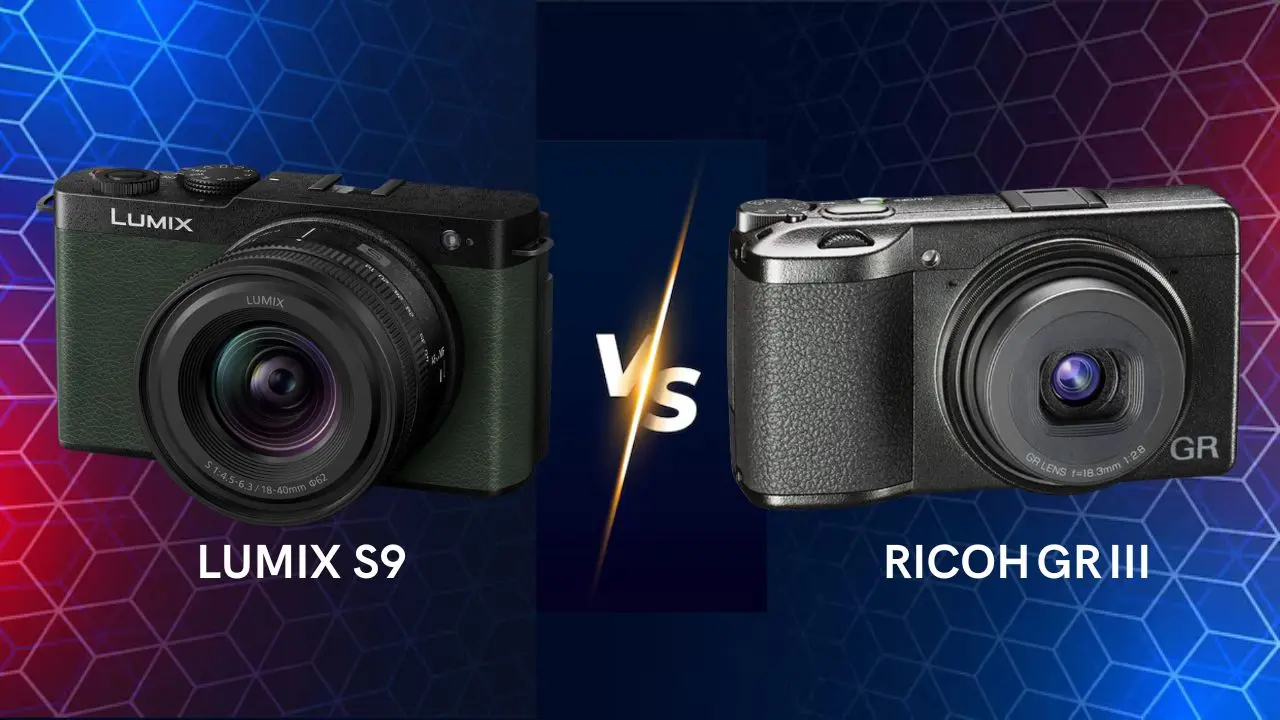
If you’re choosing between the Panasonic Lumix S9 and the Ricoh GR III, you’re comparing two very different cameras that each excel in their own niche.
The S9 is a full-frame mirrorless interchangeable-lens system camera aimed at creators who want hybrid photo + video performance, while the GR III is a fixed-lens, APS-C compact designed for street, travel, and everyday carry.
The one “better” for you depends entirely on how and what you shoot.
Here’s a full breakdown to help you decide.
⚙️ Overview – Full-Frame Hybrid vs Ultra-Compact Street Tool
Lumix S9:
A full-frame mirrorless body with 24 MP resolution, designed to deliver excellent stills and video quality. With IBIS, full-frame benefits, interchangeable lenses and modern hybrid features, it’s built for creators who want flexibility and high performance.
GR III:
An APS-C, large-sensor compact camera with a fixed 28mm-equivalent f/2.8 prime lens. Ultra-portable, discreet, and designed for street photography, travel, or any situation where you want top image quality in the smallest package possible.
In short:
-
Go Lumix S9 when you want full-frame shooting, interchangeable lenses, video/still hybridity.
-
Go GR III when you want “carry-anything” convenience, street readiness, simplicity and great image quality in a compact.
📸 Specifications Comparison
| Specification | Panasonic Lumix S9 | Ricoh GR III |
|---|---|---|
| Release Date | 2024 | 2019 |
| Camera Type | Full-frame mirrorless (interchangeable lens) | APS-C GR-series compact (fixed lens) |
| Sensor | 24.2 MP full-frame CMOS | ~24 MP APS-C CMOS |
| Image Processor | Panasonic Venus Engine | Ricoh processor (proprietary) |
| Lens Mount / Lens | Leica L-Mount (interchangeable) | Fixed 28 mm equiv. f/2.8 lens |
| ISO Range | 100–51 200 (ext. to 50–204 800) | 100–102 400 (native) |
| In-Body Image Stabilization (IBIS) | Yes, 5-axis | Yes, 3-axis |
| Autofocus System | Hybrid AF (phase + contrast) ~779 points | Contrast/phase hybrid AF |
| AF Subject Recognition | Humans & animals (wide coverage) | Basic face/subject detection |
| Continuous Shooting Speed | Up to ~9 fps | ~4 fps |
| Video Recording | 6K30p / 4K60p (10-bit options) | Full HD up to 60p |
| Video Bit Depth / Color | 10-bit internal options | 8-bit typical |
| Color Profiles | V-Log, LUT support | Standard Ricoh color modes |
| RAW Video Output | Yes (via HDMI) | No |
| Recording Limit | Depends on codec & firmware | Typical ~30 min cap |
| Viewfinder | None (LCD-only) | None (LCD-only) |
| LCD Screen | 3.0″ fully articulating touchscreen (~1.84M dots) | 3.0″ fixed touchscreen (~1.23M dots) |
| Touch Functions | Full touch control | Touch controls |
| Product Showcase Mode | No | No |
| Background Defocus Button | No | No |
| Body Material | Compact full-frame body | Ultra-compact light body |
| Weather Sealing | Yes (splash/dust resistant) | No (no official sealing) |
| Audio Options | Mic input (no headphone) | Built-in mic only |
| Connectivity | Wi-Fi, Bluetooth, USB-C, micro-HDMI | Wi-Fi, USB-C |
| Battery Type | Panasonic DMW-BLK22 | Ricoh DB-110 |
| Battery Life (CIPA) | ~470 shots | ~200 shots |
| Dimensions (W × H × D) | ~126 × 74 × 47 mm | ~109 × 62 × 35 mm |
| Weight (Body Only) | ~486 g (with battery) | ~262 g (with battery) |
| Approx. Price (Body Only) | ~€1 000–€1 500 (varies) (check on Amazon) | ~€800–€900 (varies) |
🧱 Build and Handling
The Lumix S9 gives you full-frame presence: you’ll benefit from better depth of field control, low-light performance and the ability to change lenses for different creative uses. That means larger gear, but with serious capabilities.
The GR III is built to vanish into your pocket or bag. It’s ideal when you want minimal gear and maximum freedom of movement. Its fixed 28mm lens means you won’t swap lenses, but you’ll carry less and shoot more often.
👉 Verdict:
-
Choose the Lumix S9 if you don’t mind gear size and want full-frame versatility.
-
Choose the GR III if portability, stealth, and simplicity matter more than lens flexibility.
🎯 Autofocus and Performance
Both cameras perform well, but in different scopes:
-
The Lumix S9 is designed for hybrid shooting and therefore handles more demanding autofocus/tracking tasks, especially when paired with the right lenses.
-
The GR III, while excellent for stills, is less optimized for fast-moving subjects or heavy video/tracking workflows.
👉 Verdict:
-
Lumix S9 has the edge for fast action or mixed video + stills.
-
GR III is adequate for everyday, static or street situations.
🎥 Video Capabilities
If video is part of your workflow:
-
The Lumix S9 delivers full-frame video benefits, interchangeable lenses, stabilization and flexibility to shoot both stills and video at high level.
-
The GR III is fine for casual video or recording quick clips, but it’s not built as a video-first machine. Its fixed lens and compact body constrain some video choices.
👉 Verdict:
-
For video + stills workflows, go Lumix S9.
-
For stills-centric shooters who occasionally record video, the GR III is fine.
🧠 Image Quality (Stills)
Both cameras deliver excellent still image quality. The full-frame sensor of the S9 gives advantages in shallow depth of field, larger prints and low-light. The GR III’s APS-C sensor is still very capable, especially considering the compact form factor.
👉 Verdict:
-
If you print large, blur backgrounds, or often shoot in challenging light — S9 wins.
-
If you shoot for web/social, enjoy compactness and still want top image quality — the GR III is very good.
🔋 System, Lenses & Future Planning
-
The Lumix S9 uses the L-Mount system. You have lens choices, upgrades, expandability.
-
The GR III has a fixed lens — simplicity is its strength but it lacks that flexibility.
👉 Verdict:
-
For long-term growth and system investment → S9.
-
For grab-and-go simplicity without lens hunting → GR III.
💰 Price and Value
Often you’ll pay more for full-frame interchangeable gear (Lumix S9) plus lenses. The GR III can cost less overall and give you full-frame-level image quality in a compact body. Value depends on your gear needs.
👉 Verdict:
-
GR III offers excellent value if you accept fixed-lens and stills focus.
-
S9 offers best value if you’ll use its flexibility and full-frame capability.
Check availability and price on Amazon 🛒
📷 Ricoh GR III — Amazon USA / Amazon Canada / Amazon UK / Amazon Australia
📷 Panasonic Lumix S9 — Amazon USA / Amazon Canada / Amazon UK / Amazon Australia
Note: camerafight.com participates in the Amazon Associates Program. As an Amazon Associate, we earn from qualifying purchases.
🏁 Final Verdict — Lumix S9 vs GR III
| Type of User | Recommended Camera |
|---|---|
| Travel/Street photographer wanting ultra portability | Ricoh GR III |
| Hybrid creator doing stills + video with interchangeable lenses | Panasonic Lumix S9 |
| Photographer who shoots frequently on the move, minimal gear | GR III |
| Photographer + videographer who wants full-frame flexibility and lens choices | S9 |
✅ In Short:
Choose the Panasonic Lumix S9 if you want full-frame, interchangeable lenses, strong hybrid capabilities and are comfortable with somewhat larger gear.
Choose the Ricoh GR III if you want a compact camera you carry everywhere, excellent image quality for stills, minimal fuss and fixed-lens simplicity.
🧠 Final Thoughts
Both cameras are excellent—but for very different use-cases. The best one is the one that fits how you shoot, what you carry, and what you value.
-
If you carry light, shoot spontaneously, travel often and favour portability → go GR III.
-
If you build gear, shoot both stills & video, want full-frame and lens flexibility → go Lumix S9.
Reflect on your priorities: size vs flexibility, stills vs video, simplicity vs system growth—and pick accordingly.