Panasonic Lumix S9 vs Panasonic Lumix S5 II – Which one is better?
Panasonic Lumix S9 vs Panasonic Lumix S5 II – Which One Is Better?
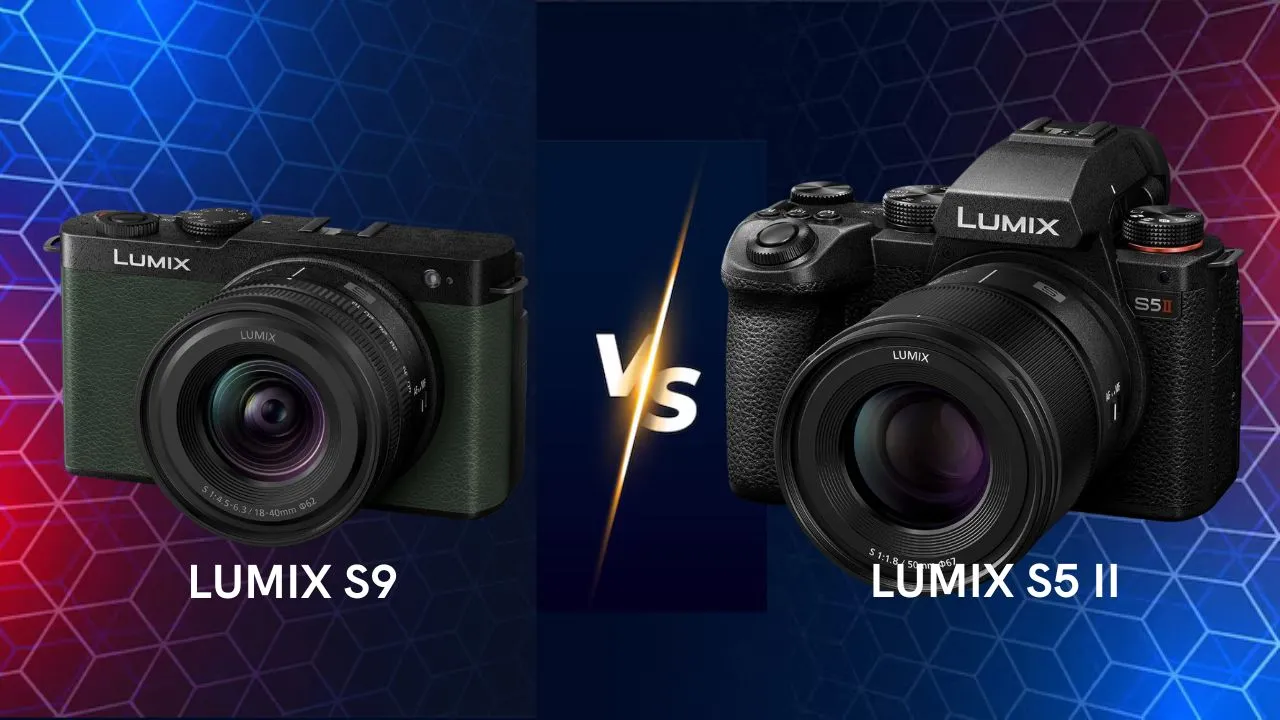
The Panasonic Lumix S9 and Panasonic Lumix S5 II are both full-frame mirrorless cameras from Panasonic designed for creators who value image quality, modern features, and hybrid workflows.
Yet they cater to slightly different user profiles. The S9 is the newer, more compact maker-friendly model, while the S5 II is a more established hybrid body with advanced autofocus and pro features.
Let’s dive into how they compare and determine which might be the better option for you.
⚙️ Overview – Compact Creator vs Hybrid Powerhouse
Panasonic Lumix S9:
A full-frame mirrorless aimed at creators who want high image quality in a compact form factor. It emphasises ease of carry, portability, and modern connectivity while still delivering full-frame benefits.
Panasonic Lumix S5 II:
A more robust hybrid full-frame body that brings a phase-detect autofocus system, strong stills performance, and serious video capabilities. It’s ideally suited for creators who shoot both high-end stills and video and want a well-rounded system.
In short:
-
S9 = The compact full-frame creator’s tool, portability, simplicity, full-frame look.
-
S5 II = The hybrid performer for stills + video, strong autofocus, and professional features.
📸 Specifications Comparison
| Specification | Panasonic Lumix S9 | Panasonic Lumix S5 II |
|---|---|---|
| Release Date | 2024 | 2023 |
| Camera Type | Full-frame mirrorless | Full-frame mirrorless |
| Sensor | 24.2 MP full-frame CMOS | 24.2 MP full-frame CMOS |
| Image Processor | Venus Engine | Venus Engine (updated with advanced AF) |
| Lens Mount | Leica L-Mount | Leica L-Mount |
| ISO Range | 100–51,200 (expandable to 50–204,800) | 100–51,200 (expandable to 50–204,800) |
| In-Body Image Stabilization (IBIS) | Yes, 5-axis sensor-shift | Yes, 5-axis sensor-shift |
| Autofocus System | Hybrid AF (phase + contrast) | Advanced Hybrid AF with dedicated phase-detect |
| AF Subject Recognition | Humans & animals | Humans, animals, vehicles |
| Continuous Shooting Speed | ~9 fps | ~9 fps |
| Video Recording | Up to 6K30p, 4K60p | Up to 6K30p, 4K60p |
| Video Bit Depth / Color | 10-bit internal options | 10-bit internal 4:2:2 |
| Color Profiles | LUT support & creative looks | V-Log, CineLike and advanced color tools |
| RAW Video Output | Yes (via HDMI) | Yes (via HDMI, ProRes RAW with supported external recorder) |
| Recording Limit | Typical ~30 min cap at high bitrate | Longer limits in select modes |
| Viewfinder | None (LCD-only) | Built-in EVF (~3.68M dots) |
| LCD Screen | 3.0″ fully articulating touchscreen | 3.0″ fully articulating touchscreen |
| Touch Functions | Full touchscreen | Full touchscreen |
| Product Showcase Mode | No | No |
| Background Defocus Button | No | No |
| Body Material | Compact lightweight body | Larger, more traditional body |
| Weather Sealing | Yes (dust/splash-resistant) | Yes (robust weather sealing) |
| Audio Options | Mic input (no headphone) | Mic input & headphone jack |
| Connectivity | Wi-Fi, Bluetooth, USB-C, micro-HDMI | Wi-Fi, Bluetooth, USB-C, full-size HDMI |
| Battery Type | DMW-BLK22 | DMW-BLK22 |
| Battery Life (CIPA) | ~470 shots (approx.) | ~370–470 shots (approx.) |
| Dimensions (W × H × D) | Smaller, more compact | Larger, more traditional grip |
| Weight (Body Only) | ~486 g | ~740 g |
| Approx. Price (Body Only) | Mid-range full-frame pricing (check on Amazon) | Slightly higher full-frame pricing (check on Amazon) |
🧱 Build and Handling
The S9’s standout is its compact full-frame design — lighter and easier to carry than many full-frame bodies, making it appealing for creators out in the field, travel, or everyday use. It pairs full-frame image quality with portability.
The S5 II has a larger body designed to accommodate more controls, deeper grip, perhaps better suited for longer sessions, mixed stills/video rigs, or creators who prioritise feature depth over minimalism.
👉 Verdict:
-
Choose S9 if you carry your camera often, prioritise portability, and want full-frame quality in a lighter package.
-
Choose S5 II if you want full-frame quality and don’t mind slightly larger gear for extra features and performance.
🎯 Autofocus and Performance
Autofocus is a key differentiation:
-
The S5 II features a phase-detect hybrid AF system which offers faster, more reliable subject tracking and performance for both stills and video.
-
The S9, while very capable, may use a simpler hybrid AF or newer but more minimal system allowing design simplification and size savings.
👉 Verdict:
-
If you frequently shoot moving subjects, events, video workflows that require tracking, go S5 II.
-
If your work is more controlled, access-friendly, or you shoot static/hybrid content and value portability, the S9 is sufficient.
🎥 Video Capabilities
For creators doing video:
-
The S5 II offers strong video features: full-frame, 10-bit recording, strong codec support, hybrid stills/video performance — ideal for creators who must deliver both high-end video and stills.
-
The S9 also offers excellent video features for its size and price, giving full-frame look and stabilisation, but may have fewer pro video features (e.g., fewer custom profiles or external recorder options) compared to the higher spec body.
👉 Verdict:
-
S5 II: Better for video-heavy creators or those who shoot both stills and video professionally.
-
S9: Great for creators who do video but prioritise portability and simpler workflows.
🧠 Image Quality (Stills)
Both cameras share full-frame sensors and should deliver comparable image quality in terms of dynamic range, colour, and low-light performance. The difference will be subtle in many real-world scenarios.
👉 Verdict:
-
If your priority is stills and image quality, both will satisfy; choose based on form factor and features.
-
If you also want advanced autofocus or video output, the S5 II has the edge.
🔋 Ecosystem and Future-Proofing
Both use the L-Mount, so lenses and accessories are interchangeable between them, which is a strong plus.
If you plan to expand your system, shoot diverse content (stills/video), and invest in lenses or accessories, the S5 II offers slightly more head-room for advanced workflows. The S9, however, serves beautifully for many creators and may represent a lighter investment in gear size and weight.
💰 Price and Value
The S9 will typically be priced lower or positioned at a value for full-frame portability. The S5 II will cost more but justify it through more advanced features and performance.
👉 Verdict:
-
S9: Better value if you prioritise full-frame image quality, hybrid use, portability, and don’t need the most advanced features.
-
S5 II: Better underwriting for hybrid professionals or creatives who will make full use of its higher specs.
Check availability and price on Amazon 🛒
📷 Panasonic Lumix S5 II — Amazon USA / Amazon Canada / Amazon UK / Amazon Australia
📷 Panasonic Lumix S9 — Amazon USA / Amazon Canada / Amazon UK / Amazon Australia
Note: camerafight.com participates in the Amazon Associates Program. As an Amazon Associate, we earn from qualifying purchases.
🏁 Final Verdict — Panasonic Lumix S9 vs Panasonic Lumix S5 II
| Type of User | Recommended Camera |
|---|---|
| Creator who carries camera daily, values compactness and full-frame look | Panasonic Lumix S9 |
| Creator shooting serious stills + video, needing advanced AF and features | Panasonic Lumix S5 II |
| Travel content creator who values lighter gear and strong image quality | S9 |
| Hybrid shooter splitting time between commercial stills and branded video | S5 II |
| Enthusiast wanting full-frame without heavy gear | S9 |
| Professional planning system build and workflow expansion | S5 II |
✅ In short:
Choose the Panasonic Lumix S9 if your priority is portability, full-frame image quality, and you do shoot a mix of stills/video but in lighter setups.
Choose the Panasonic Lumix S5 II if you want an all-round hybrid powerhouse with strong autofocus, advanced video features, and the flexibility to grow your system.
🧠 Final Thoughts
Both cameras are excellent; they serve different needs. The best one is the one that fits how you shoot, what you carry, and what you value.
-
If your kit must be light and you shoot spontaneously, the S9 is a smart choice.
-
If your project demands higher performance, complex workflows or you shoot a lot of video/fast action, the S5 II gives you more headroom.
Reflect on your priorities: how you carry gear, what you shoot most often, and how much you’ll invest in lenses/workflow — then choose the camera that aligns with you.