Panasonic Lumix S9 vs Fujifilm X-M5 – Which one is better?
Panasonic Lumix S9 vs Fujifilm X-M5 – Which One Is Better?
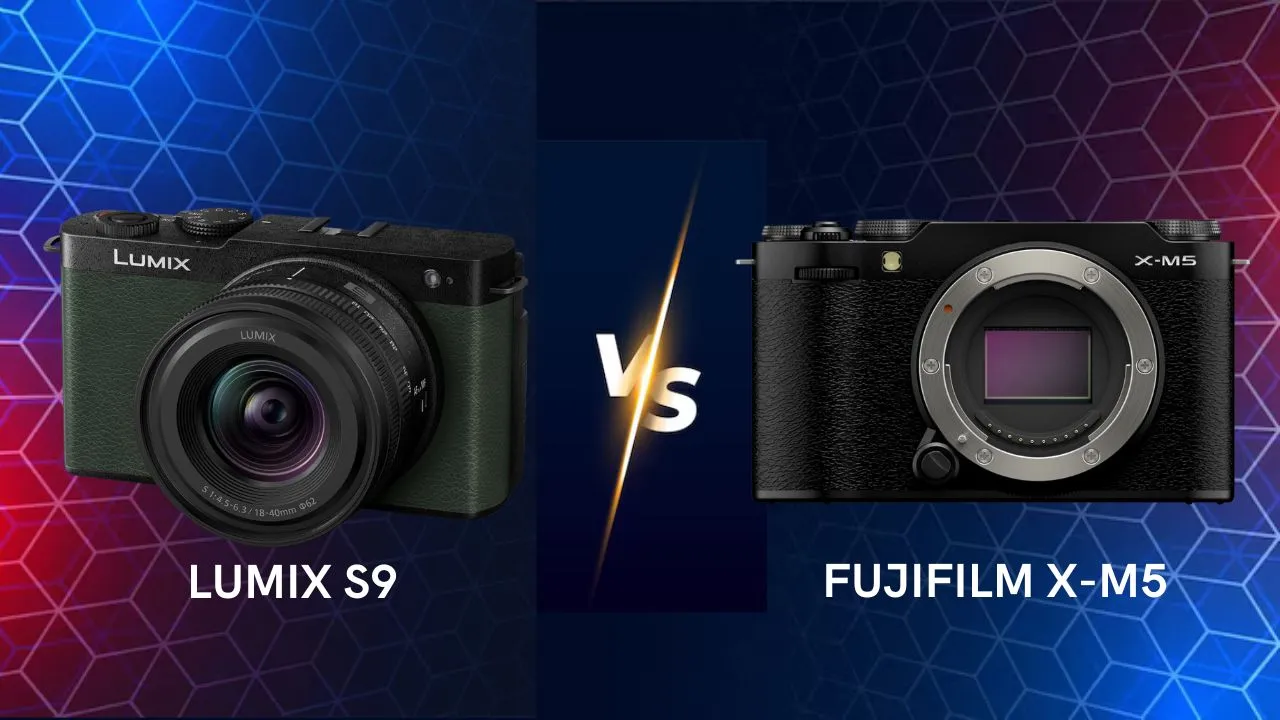
If you’re deciding between the Panasonic Lumix S9 and the Fujifilm X-M5, you’re comparing two excellent mirrorless cameras — yet they cater to slightly different creators.
The S9 brings full-frame power and hybrid video features, while the X-M5 offers APS-C size, retro style, and a photographer-centric experience.
Let’s break down which one might be the better fit for you.
⚙️ Overview – Full-Frame Hybrid vs APS-C Photographer’s Tool
Panasonic Lumix S9: A full-frame mirrorless camera designed for creators who want high image quality, strong video features, full-frame depth and stabilization, in a compact body.
Fujifilm X-M5: An APS-C mirrorless camera designed primarily for photographers who value image quality, tactile controls, stylish design and the film-simulation look Fujifilm is known for. It delivers fewer video bells and whistles, but excels in stills and pure photographic experience.
In short:
-
S9 = Best option for those wanting full-frame, video + stills, big sensor perks.
-
X-M5 = Best option for photographers prioritizing stills, portability, style, and APS-C convenience.
📸 Specifications Comparison
| Specification | Panasonic Lumix S9 | Fujifilm X-M5 |
|---|---|---|
| Release Date | May 2024 | November 2024 |
| Camera Type | Full-frame mirrorless | APS-C mirrorless |
| Sensor | 24.2 MP full-frame CMOS | 26.1 MP APS-C X-Trans CMOS 4 |
| Image Processor | Panasonic Venus Engine (latest) | Fujifilm X-Processor 5 |
| Lens Mount | Leica L-Mount | Fujifilm X-Mount |
| ISO Range | 100–51 200 (extendable to 50–204 800) | 160–12 800 (expandable 80–51 200) |
| In-Body Image Stabilization (IBIS) | Yes, 5-axis sensor-shift | No IBIS (relies on lens stabilization) |
| Autofocus System | Hybrid AF with ~779 points | Intelligent Hybrid AF (phase + contrast) |
| AF Subject Recognition | Humans & animals (expanded) | People & tracked subjects |
| Continuous Shooting Speed | ~9 fps (approx.) | 5 fps mechanical / up to 20 fps electronic |
| Video Recording | 6K30p & 4K60p (full-frame) | 6.2K30p & 4K60p (1.18× crop) |
| Video Bit Depth / Color | 10-bit internal (4:2:2) | 10-bit 4:2:2 (F-Log & F-Log2) |
| Color Profiles | LUT support & cinematic looks | Fujifilm Film Simulations, F-Log2 |
| RAW Video Output | Yes (via HDMI) | Yes (via HDMI) |
| Recording Limit | ~30 min typical at high bitrate | ~30 min typical |
| Viewfinder | None (LCD-only) | None (LCD-only) |
| LCD Screen | 3.0″ fully articulating touchscreen | 3.0″ vari-angle touchscreen (~1.84M dots) |
| Touch Functions | Full touchscreen | Full touchscreen |
| Product Showcase Mode | No dedicated mode | No dedicated mode |
| Background Defocus Button | No dedicated button | No dedicated button |
| Body Material | Compact composite / solid build | Lightweight composite metal |
| Weather Sealing | Yes (dust & splash resistant) (Wikipédia) | No official sealing |
| Audio Options | Mic input (no headphone) | Mic & headphone jacks |
| Connectivity | Wi-Fi, Bluetooth, USB-C, micro-HDMI | Wi-Fi, Bluetooth, USB-C, HDMI |
| Battery Type | Panasonic DMW-BLK22 | Fujifilm NP-W126S |
| Battery Life (CIPA) | ~470 shots (approx.) | ~460–500 shots |
| Dimensions (W × H × D) | ~126×74×47 mm | ~119×72×47 mm |
| Weight (Body Only) | ~486 g | ~355 g |
| Approx. Price (Body Only) | ~€1,000–€1,500 (check on Amazon) | ~€900–€1,200 (varies) |
🧱 Build and Handling
The Lumix S9, being full-frame, will tend to have slightly larger body and lenses than the APS-C X-M5. However Panasonic has styled it to be more compact than typical full-frame rigs, making full-frame portability more feasible. It offers full-frame benefits like shallow depth, strong low-light performance, and versatile video/stills combos.
The X-M5 emphasizes compactness, retro styling, intuitive dials and a more photographic feel. It’s lighter, easier to carry all day, and more discreet for street/travel work. On the flip side the smaller sensor (APS-C) gives slightly less in depth of field and may have somewhat less low-light headroom than a comparable full-frame.
👉 Verdict:
-
Choose S9 if you accept slightly larger gear for full-frame quality and hybrid video/stills.
-
Choose X-M5 if you prioritize portability, stills shooting, and a “camera you want to carry everywhere”.
🎯 Autofocus and Performance
Both cameras will deliver very good autofocus performance for stills. The Panasonic S9 benefits from full-frame sensor and likely newer hybrid AF system — particularly useful if you shoot people, events, or mixed video/stills. The Fujifilm X-M5 offers excellent focus performance for photography: fast, accurate, great eye/face detection, very usable for everyday use and travel.
👉 Verdict:
-
S9: May edge out in versatility, video contexts, full-frame tracking.
-
X-M5: Very strong for stills and hybrid photo use; maybe less focused on heavy video demands.
🎥 Video Capabilities
If video matters to you, the S9 has the advantage of full-frame sensor and video-leaning features (better depth, full-frame look, likely stronger codec, better stabilization). The Fujifilm X-M5 will do video well for casual use, social content and hybrid photography, but is less optimized for high-end video workflows (compared to full-frame dedicated hybrids).
👉 Verdict:
-
S9: Better choice if you will shoot a lot of video or hybrid.
-
X-M5: Perfect for still-oriented shooters who may occasionally shoot video.
🧠 Image Quality
In terms of image quality for stills: full-frame S9 gives deeper background blur, slightly better low-light performance, and more “luxury” sensor characteristics. The X-M5 gives very high quality for APS-C: excellent detail, dynamic range, and lighter gear. For many users the difference in real-world may be subtle unless you produce large prints, shoot low light professionally or value full-frame bokeh.
👉 Verdict:
-
If you want maximum image quality and full-frame characteristics → S9.
-
If you want excellent quality in a lighter form factor and value portability → X-M5.
🔋 Lens Ecosystem & Future Proofing
Lumix S9 uses L-Mount, which is getting excellent lenses (Panasonic, Sigma, Leica) and full-frame support. However, the number of compact affordable lenses may be less than APS-C systems. Fujifilm X-Mount is very mature in APS-C: lots of lens choices, many primes especially compact, good third-party support, making it very photographer-friendly.
👉 Verdict:
-
X-M5: Stronger ecosystem for photographers who value lens selection and compact primes.
-
S9: Great for full-frame system investment, especially if you already have or plan high quality full-frame lenses.
💰 Price & Value
Typically, APS-C bodies like the X-M5 offer excellent value for the quality they deliver. Full-frame bodies like the S9 often cost more (body + lenses) but deliver more in terms of sensor size and hybrid capability.
👉 Verdict:
-
X-M5: Better value if budget and portability are key.
-
S9: Worth it if you will benefit from full-frame and use both stills + video.
Check availability and price on Amazon 🛒
📷 Fuji X-M5 — Amazon USA / Amazon Canada / Amazon UK / Amazon Australia
📷 Panasonic Lumix S9 — Amazon USA / Amazon Canada / Amazon UK / Amazon Australia
Note: camerafight.com participates in the Amazon Associates Program. As an Amazon Associate, we earn from qualifying purchases.
🏁 Final Verdict — Panasonic Lumix S9 vs Fujifilm X-M5
| Type of User | Recommended Camera |
|---|---|
| Travel photographer or everyday carry shooter | Fujifilm X-M5 |
| Content creator/hybrid photo + video with full-frame ambition | Panasonic Lumix S9 |
| Street/film-look photographer wanting compact and fun camera | X-M5 |
| Photographer/videographer wanting full-frame quality and depth of field | S9 |
| Budget-conscious creator valuing portability and ease | X-M5 |
| System-builder investing in full-frame lenses and future proofing | S9 |
✅ In short:
Choose the Panasonic Lumix S9 if you want full-frame performance, strong video features, and you’re comfortable with slightly larger gear and the L-Mount system.
Choose the Fujifilm X-M5 if you value portability, stills and photographic experience, and want a compact camera with high quality and fun control.
🧠 Final Thoughts
Both the Panasonic Lumix S9 and Fujifilm X-M5 are excellent cameras — the “better” one really depends on what you shoot, how you shoot, and what gear you’re comfortable with.
-
If you carry your camera everywhere and prioritize lightness and style, go with the X-M5.
-
If you shoot more seriously, want full-frame depth and video output, go with the S9.
Think about your priorities: image quality vs portability, video vs stills, future system growth vs quick carry-on — and choose accordingly.