Panasonic Lumix S9 vs Canon R8 – Which one is better?
Panasonic Lumix S9 vs Canon EOS R8 – Which One Is Better?
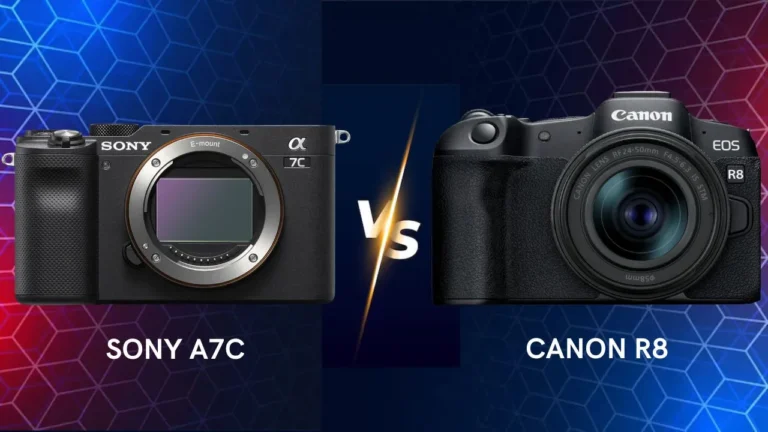
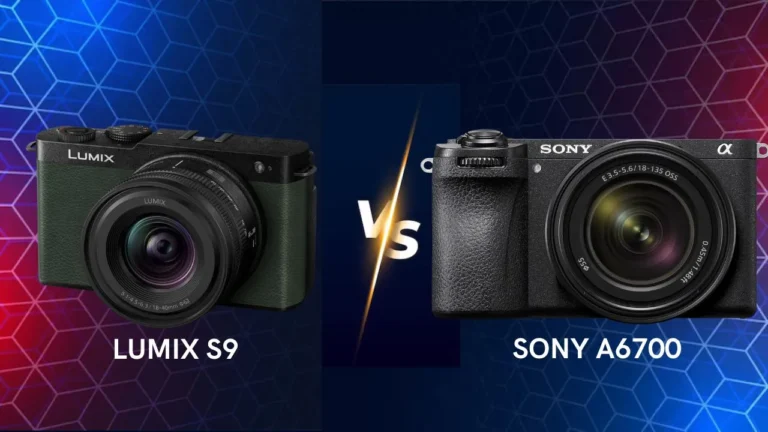
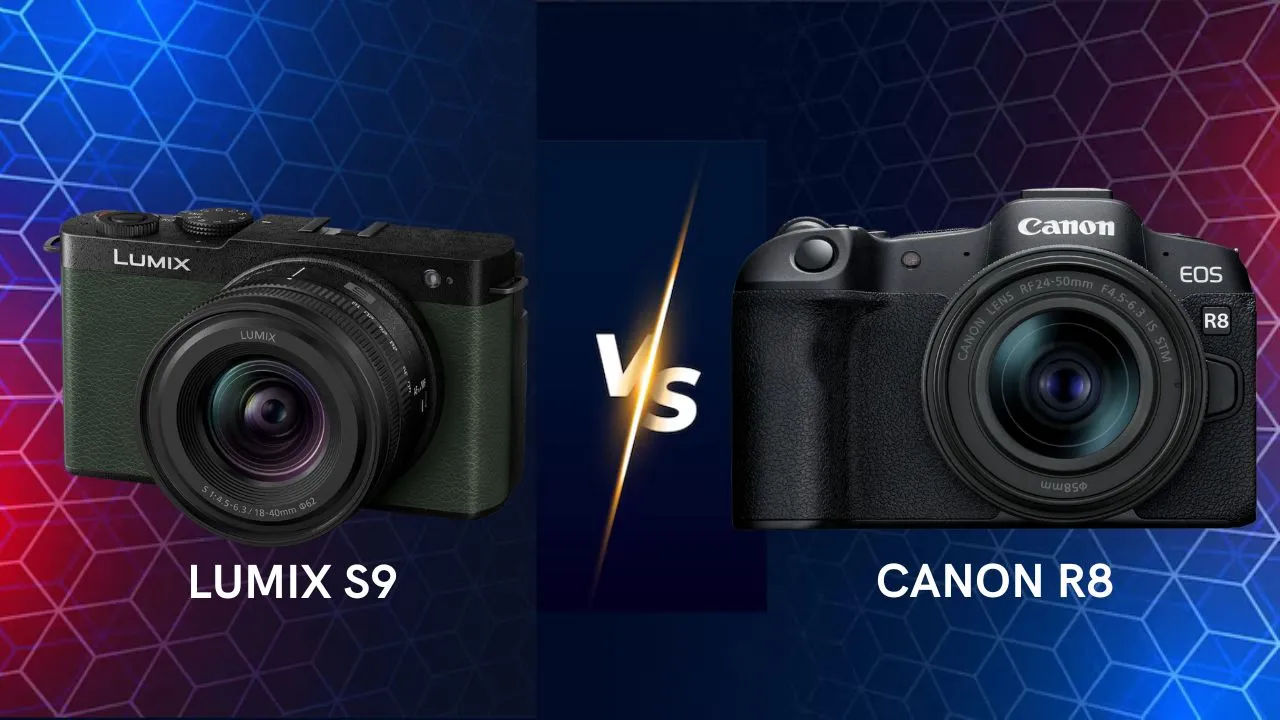
When deciding between the Panasonic Lumix S9 and the Canon EOS R8, you’re comparing two full-frame mirrorless cameras aimed at different types of creators.
One prioritises compact-style portability and modern video features (the S9), while the other emphasises stills performance, autofocus strength, and a broader lens ecosystem (the R8).
Let’s compare them in detail to see which fits your needs best.
⚙️ Overview – Compact Hybrid vs Balanced Full-Frame All-rounder
Panasonic Lumix S9:
A stylish, compact full-frame mirrorless camera with a 24.2MP sensor, strong hybrid video features (open-gate 6K, full-frame IBIS, LUT support) and a form factor aimed at creators who move fast.
Canon EOS R8:
A full-frame mirrorless camera with 24.2MP, Canon RF mount, advanced autofocus (Dual Pixel CMOS AF II), and strong stills + video capabilities — very much positioned as a versatile camera for photographers and videographers.
In short:
-
Lumix S9 = Compact, creator-friendly hybrid, video-leaning.
-
Canon R8 = Full-frame all-rounder, stronger stills focus and system flexibility.
📸 Specifications Comparison
| Feature | Panasonic Lumix S9 | Canon EOS R8 |
|---|---|---|
| Release Date | May 2024 | February 2023 |
| Camera Type | Mirrorless (Video-focused Full Frame) | Mirrorless (Hybrid Full Frame) |
| Sensor | Full-Frame 24.2 MP CMOS | Full-Frame 24.2 MP CMOS |
| Image Processor | Venus Engine | DIGIC X |
| Lens Mount | L-Mount | Canon RF |
| ISO Range | 100–51,200 (expandable to 204,800) | 100–102,400 (expandable to 204,800) |
| In-Body Image Stabilization (IBIS) | Yes, 5-axis | No |
| Autofocus System | Phase Hybrid AF (779 points) | Dual Pixel CMOS AF II (1053 zones) |
| AF Subject Recognition | Humans, animals, vehicles | Humans, animals, birds, vehicles |
| Continuous Shooting Speed | Up to 30 fps (electronic) | Up to 40 fps (electronic), 6 fps (mechanical) |
| Video Recording | Up to 6K 30p, 4K 60p | Up to 4K 60p (oversampled from 6K) |
| Video Bit Depth / Color | 10-bit internal | 10-bit internal |
| Color Profiles | V-Log, Real-Time LUTs | Canon Log 3, HDR PQ |
| RAW Video Output | No | No |
| Recording Limit | No recording limit (thermal dependent) | No recording limit (thermal dependent) |
| Viewfinder | None | 2.36M-dot OLED EVF |
| LCD Screen | 3.0″ fully articulating touchscreen (1.84M dots) | 3.0″ fully articulating touchscreen (1.62M dots) |
| Touch Functions | Yes (AF, menus, LUT control) | Yes (AF, tracking, menus) |
| Product Showcase Mode | No | No |
| Background Defocus Button | No | No |
| Body Material | Magnesium alloy | Magnesium alloy |
| Weather Sealing | No | No |
| Audio Options | Mic input, headphone via USB-C | Mic input, headphone via USB-C |
| Connectivity | Wi-Fi, Bluetooth, USB-C, HDMI | Wi-Fi, Bluetooth, USB-C, HDMI |
| Battery Type | DMW-BLK22 | LP-E17 |
| Battery Life (CIPA) | Approx. 470 shots | Approx. 370 shots |
| Dimensions (W × H × D) | 126 × 73.9 × 46.7 mm | 132.5 × 86.1 × 70 mm |
| Weight (Body Only) | Approx. 403 g | Approx. 414 g |
| Price (Body Only) | Approx. USD 1,500 (check on Amazon) | Approx. USD 1,500 (Check on Amazon) |
🧱 Build and Handling
The Lumix S9 stands out for its ultra-compact full-frame body — reviewers note its lightweight build, stylish colours, and artefact design tailored for on-the-go creators. It feels more casual and creator-friendly in form factor.
The Canon R8, while not ultra-compact like the S9, offers a very mature and comfortable full-frame body with excellent handling, a deep grip, and broad system support. It feels more “serious photographer”-grade.
👉 Verdict:
-
For portability and video/creator use: S9 has the edge.
-
For system support, comfortable full-frame shooting for stills: R8 wins.
🎯 Autofocus and Performance
Autofocus is a key difference: The R8 uses Canon’s Dual Pixel CMOS AF II with excellent subject/face/eye tracking and phase-detect AF across the frame. The S9 introduces phase-detect AF features in the L-Mount line and has improved hybrid AF, but still may not match Canon’s AF depth and ecosystem matured detection/tracking.
👉 Verdict:
-
Canon R8 is stronger for fast action, moving subjects, high reliability autofocus.
-
Panasonic S9 is capable, but for high-end AF demands the R8 remains ahead.
🎥 Video Capabilities
If you shoot video or hybrid content:
-
The S9 offers features like 6K open-gate, LUT in-camera, compact handy body, stylised colour workflows — excellent for content creators.
-
The R8 also provides very good video (4K 60p oversampled from 6K, 10-bit internal in certain modes), though its video features are slightly less forward-leaning than a creator-centric body.
👉 Verdict:
-
S9 is slightly more tailored for creators/video work out-of-the-box.
-
R8 is very good for video, but shines in stills + hybrid; if video is your primary focus you may prefer S9.
🧠 Image Quality (Stills)
Both cameras use ~24 MP full-frame sensors, which means very similar performance in stills: depth of field, low light, dynamic range. The differences will come down to AF, lens quality, IBIS, and workflow.
Because the S9 has IBIS (good for handheld, video/stills), it gives an advantage in low-light or handheld video/stills. The R8, lacking IBIS, may rely more on lens/stabilisation or gimbal/rig for video.
👉 Verdict:
-
For stills, both will impress.
-
For handheld/stabilised hybrid work, the S9 may have an edge thanks to IBIS.
-
For wide lens choices + system growth, R8 has long-term advantage.
🔋 Ecosystem, Lenses & Future-Proofing
Canon’s RF-Mount is very mature, many lenses available (native), plenty of third-party support, large user base. That means long-term lens flexibility and accessory support.
L-Mount (used by the Panasonic S9) is growing (Panasonic, Leica, Sigma) and offers excellent lenses, but perhaps fewer budget options/lens diversity compared to RF-Mount.
👉 Verdict:
-
R8 is better for lens ecosystem and upgrade path.
-
S9 is fine for many users, but if you foresee building a large system or require niche lenses, RF-Mount might be safer.
💰 Price & Value
The S9 is positioned as a creator-friendly full-frame with strong video features and compact body; could offer very good value for creators. The R8 is a bit more “all-rounder” full-frame that offers strong value in stills/hybrid.
👉 Verdict:
-
If you prioritise compactness + video, S9 gives excellent value.
-
If you prioritise system growth, stills performance, lens ecosystem, R8 offers strong value.
Check availability and price on Amazon 🛒
📷 Canon R8 — Amazon USA / Amazon Canada / Amazon UK / Amazon Australia
📷 Panasonic Lumix S9 — Amazon USA / Amazon Canada / Amazon UK / Amazon Australia
Note: camerafight.com participates in the Amazon Associates Program. As an Amazon Associate, we earn from qualifying purchases.
🏁 Final Verdict — Panasonic Lumix S9 vs Canon EOS R8
| Type of User | Recommended Camera |
|---|---|
| Creator/YouTuber/Hybrid (photo + video) who values portability | Panasonic Lumix S9 |
| Photographer who values lens system, stills performance & upgrade path | Canon EOS R8 |
| Travel shooter wanting full-frame in lightweight body | S9 |
| Event/portrait shooter needing reliable AF + lens choices | R8 |
| Video-first shooter who wants compact body + modern video workflows | S9 |
| All-rounder shooter doing both stills and video and investing in a system | R8 |
✅ In short:
Choose the Panasonic Lumix S9 if you want a compact full-frame camera with very good video features and portability, and you are comfortable with the L-Mount ecosystem.
Choose the Canon EOS R8 if you want a full-frame camera with a robust lens ecosystem, excellent autofocus, strong stills and very good video — especially if you’re shooting more photography or plan to build a system.
🧠 Final Thoughts
Both cameras are excellent — but they serve slightly different priorities.
If your workflow involves a lot of video, handheld shooting, portability, the S9 will appeal.
If your workflow emphasises photography, system building, lens options, AF performance, the R8 is the smarter investment.
Consider what you shoot most, how you shoot, and what gear you already have or plan to buy — that will determine which camera is better for you.