Panasonic Lumix S5D vs Sony A7 III – Which one is better?
Panasonic Lumix S5D vs Sony Alpha A7 III – Which One Is Better?
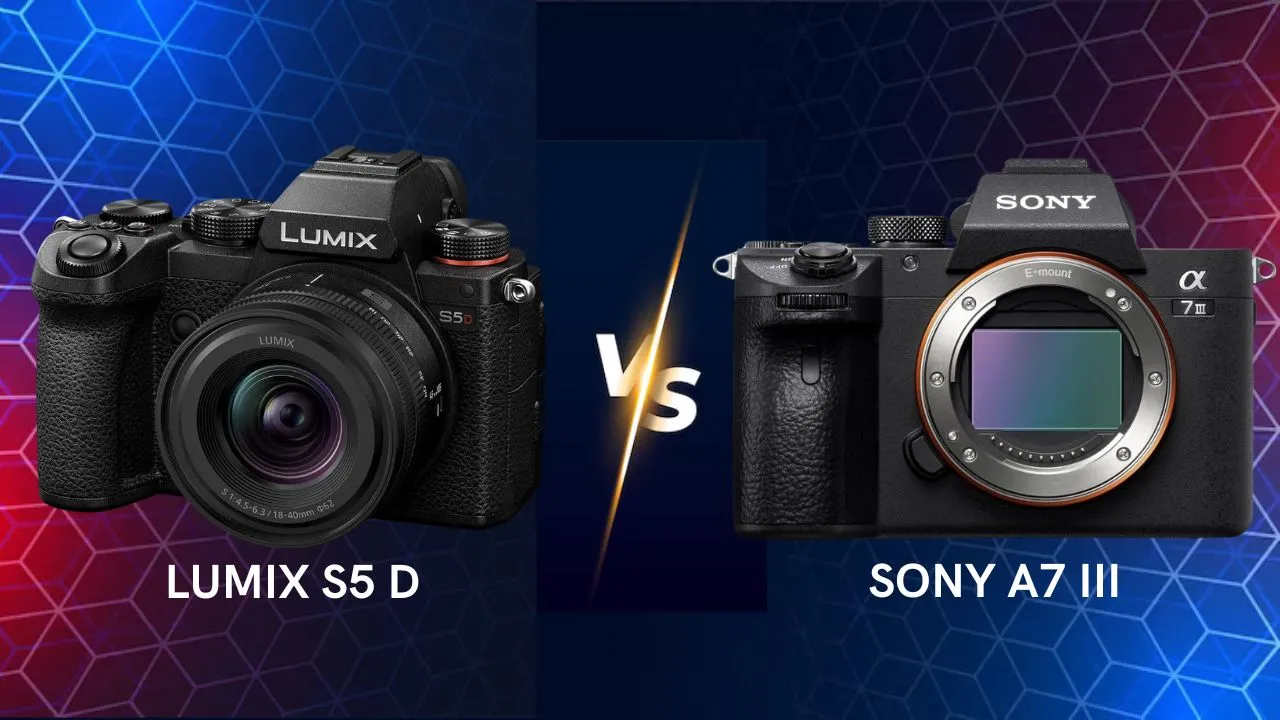
When comparing the Panasonic Lumix S5D and the Sony Alpha A7 III, you’re looking at two very capable full-frame mirrorless cameras—but with different strengths and slightly different target users.
Below is a detailed breakdown to help you see which one is the better fit for you.
⚙️ Overview – Video-Ready Hybrid vs Proven All-Rounder
Panasonic Lumix S5D
A hybrid-focused full-frame mirrorless camera built around a 24.2 MP sensor, with a strong emphasis on video workflows (internal 10-bit, HDMI output, etc). It’s designed for creators who want full-frame stills quality and serious video features.
Sony Alpha A7 III
A well-rounded full-frame mirrorless camera known for excellent stills image quality, very capable video, and a large, mature lens ecosystem. It’s frequently considered “the full-frame all-rounder” thanks to strong performance across the board.
In short:
-
S5D = Best if you’ll shoot a lot of video (or hybrid photo/video) and want a body with strong internal video specs.
-
A7 III = Best if you prioritise still photography, want broad lens choices, and want a camera that does everything well.
📸 Specifications Comparison
Here are some key specs side by side:
| Specification | Panasonic Lumix S5D | Sony Alpha A7 III |
|---|---|---|
| Release date | January 2024 | April 2018 |
| Camera type | Mirrorless | Mirrorless |
| Sensor format | Full Frame (35.6 × 23.8 mm) | Full Frame (35.6 × 23.8 mm) |
| Sensor type | CMOS | BSI-CMOS |
| Resolution | 24.2 MP | 24.2 MP |
| Image processor | Venus Engine | BIONZ X |
| ISO range | 100–51,200 (expandable to 204,800) | 100–51,200 (expandable to 204,800) |
| Autofocus system | Phase Hybrid AF (779-point) | 693-point phase-detection AF |
| Continuous shooting | Up to 9 fps (mechanical), 30 fps (electronic) | Up to 10 fps |
| Video recording | 6K up to 30p, 4K up to 60p (10-bit internal) | 4K up to 30p (8-bit, 4:2:0 internal) |
| Viewfinder | 2.36M-dot OLED EVF | 2.36M-dot OLED EVF |
| LCD screen | 3.0″ fully articulating touchscreen, 1.84M dots | 3.0″ tilting screen, 922k dots |
| In-body image stabilization (IBIS) | Yes, 5-axis (up to 6.5 stops with Dual I.S. 2) | Yes, 5-axis |
| Memory card slots | 2× SD (UHS-II) | 2× SD (1× UHS-II, 1× UHS-I) |
| Battery life (CIPA) | Approx. 440 shots | Approx. 710 shots |
| Weight (with battery & card) | Approx. 714 g | Approx. 650 g |
| Launch price (body only) | Approx. USD 1,700 | Approx. USD 2,000 (check on Amazon) |
🧱 Build and Handling
Both cameras offer full-frame heads, good ergonomics, and solid construction. However:
-
The S5D is geared slightly more toward creators who will use video and stills—it offers video-friendly outputs and may lean towards a hybrid workflow.
-
The A7 III is slightly more “traditional” in form and execution: excellent stills, capable video, and arguably a longer lens ecosystem and support network.
👉 Verdict:
-
If your work is mixed photo + video and you value video-centric features, the S5D gives strong value.
-
If you are more still-photography oriented (or want a very well-rounded budget full-frame with broad lens support), the A7 III is very compelling.
🎯 Autofocus and Performance
Autofocus is one of the biggest differentiators:
-
The A7 III has a hybrid phase/contrast AF system with a large number of phase-detection points, excellent tracking and subject recognition.
-
The S5D, while it uses the same sensor as previous S5 models and offers good stills/video results, appears to use a contrast-based or older style AF system rather than the latest phase-detect hybrid.
👉 Verdict:
-
The A7 III is stronger for fast action, moving subjects, and unpredictable shooting environments.
-
The S5D is still very good, especially for controlled shoots, hybrid use, or video where you may manually focus or use assisted focus, but it may not match the A7 III in subject-tracking AF.
🎥 Video Capabilities
This is where the S5D shows its strength:
-
It offers internal 10-bit recording, strong output options (e.g., RAW via HDMI), and video-friendly features.
-
The A7 III offers capable video, but it doesn’t match the S5D’s output flexibility and highest-end video specs (for example in terms of internal 10-bit recording or RAW/HDMI workflows).
👉 Verdict:
-
Choose S5D if video is a significant part of your workflow, and you value internal 10-bit and output flexibility.
-
Choose A7 III if your video needs are more moderate or your primary focus is stills.
🧠 Image Quality (Stills)
Both cameras deliver excellent image quality at 24 MP full-frame. For many shooters, results for stills will be comparable.
However:
-
The S5D benefits from recent sensor tech, good dynamic range (keywords like “14+ stops” in V-Log mode quoted)
-
The A7 III has proven performance over years and a robust system of lenses and accessories.
👉 Verdict:
-
If stills are your priority, both will serve you well.
-
If shooting fast action or tracking subjects, the A7 III’s AF gives it an edge.
-
If shooting stills + video and want high-end video support, S5D is more compelling.
🔋 System, Lenses & Future-Proofing
Lens ecosystem and upgrade path matter:
-
Sony E-Mount (for A7 III) has one of the widest offerings of native lenses, accessories, third-party support, and proven upgrade viability.
-
L-Mount (for S5D) is growing (Panasonic/Leica/Sigma) and offers excellent quality, but may have fewer options (especially specialty lenses) than Sony’s ecosystem.
👉 Verdict:
-
If you already invest in lens ecosystem or foresee upgrading, the A7 III gives more flexibility.
-
If you don’t depend on a huge lens library and are comfortable with L-Mount, the S5D remains a strong choice.
💰 Price and Value
Pricing will vary by region/time, but generally:
The S5D offers high-end video specs and full-frame stills at a very competitive price—especially for creators who will use the video side.
The A7 III offers full-frame stills + video in a tried-and-tested body, often at very good value given its age and lens ecosystem.
👉 Verdict:
-
If budget is tight and you’ll exploit the video abilities, S5D offers excellent value.
-
If value is important and stills are your focus, the A7 III is exceptional.
Check availability and price on Amazon 🛒
📷 Panasonic Lumix S5D — Amazon USA / Amazon Canada / Amazon UK / Amazon Australia
📷 Sony A7 III — Amazon USA / Amazon Canada / Amazon UK / Amazon Australia
🏁 Final Verdict — Panasonic Lumix S5D vs Sony Alpha A7 III
| Type of User | Recommended Camera |
|---|---|
| Hybrid photo + video creator who needs strong video output | Panasonic Lumix S5D |
| Video-first creator (requiring high-end video workflows) | Panasonic Lumix S5D |
| Photographer whose main focus is stills, but with some video | Sony Alpha A7 III |
| Generalist creator wanting wide lens/ecosystem support | Sony Alpha A7 III |
| Budget-conscious full-frame shooter who still values good video | Sony Alpha A7 III (or S5D if video dominates) |
✅ In short:
Choose the Panasonic Lumix S5D if you value modern video capabilities (10-bit internal, HDMI/RAW output) and are comfortable with L-Mount and a possibly less advanced AF system.
Choose the Sony Alpha A7 III if you want a well-rounded full-frame camera that excels in stills, has excellent autofocus, a huge lens ecosystem, and still solid video performance.
🧠 Final Thoughts
Both cameras are excellent and more “good” than “bad” choices—but the right one depends on how you shoot, what you shoot, and what gear you already own or plan to use.
-
If your workflow includes serious video or hybrid workflows and you’ll use the advanced video specs the S5D offers, it’s the smarter pick.
-
If your priority is stills, or you want a broad ecosystem with strong AF and future lens options, the A7 III is likely the more sensible investment.
Evaluate what matters most for your creative use—then pick accordingly.