Panasonic Lumix S5D vs S9 – Which one is better?
Panasonic Lumix S5D vs Panasonic Lumix S9 – Which One Is Better?
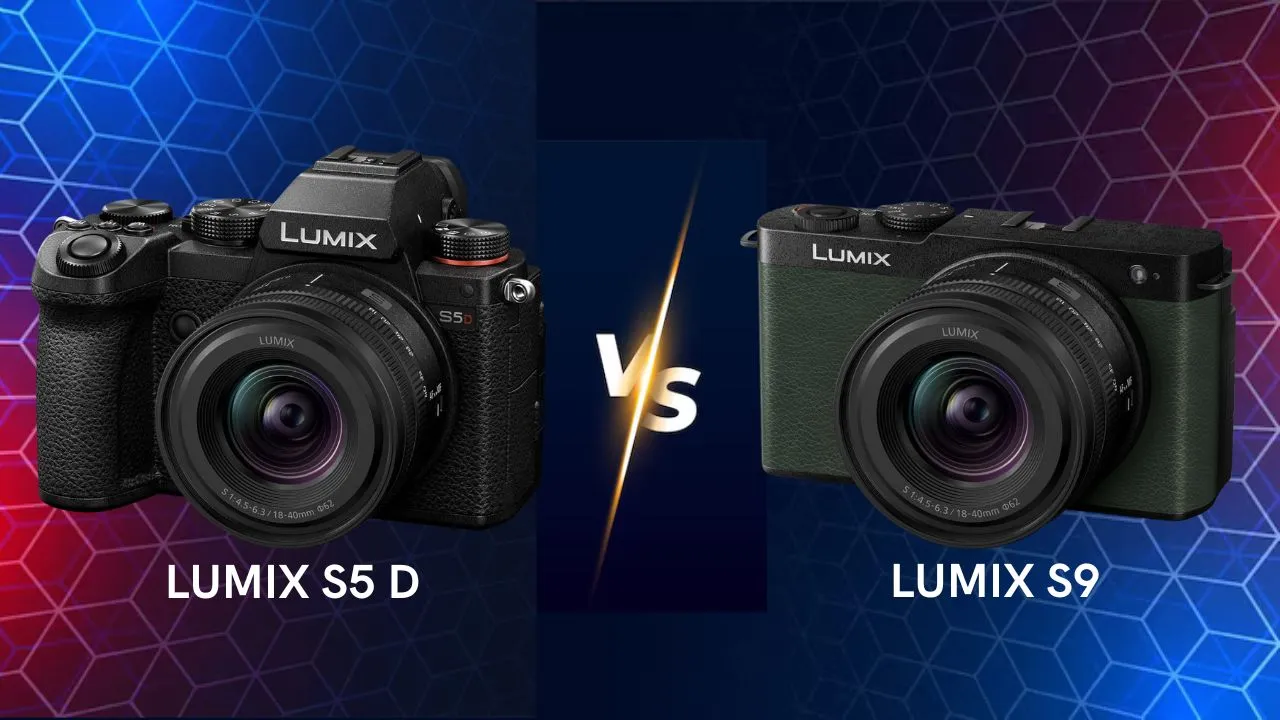
The Panasonic Lumix S5D and Panasonic Lumix S9 are both full-frame L-Mount mirrorless cameras from Panasonic, but they target quite different needs and user profiles.
In this comparison, we’ll explore their strengths and weaknesses to help you decide which is the better fit for your workflow.
⚙️ Overview – Video-Focused Hybrid vs Compact Full-Frame Creator Tool
Panasonic Lumix S5D:
A hybrid full-frame camera aimed at creators who need serious video performance alongside stills. It uses a 24.2 MP sensor and emphasizes 10-bit internal recording, strong HDMI/RAW output, and advanced video tools.
Panasonic Lumix S9:
A more compact full-frame body designed for creators who want full-frame quality in a lighter package. While still capable for stills and video, it places more emphasis on portability, modern social/creator workflows, and streamlined operation.
In short:
-
S5D = Hybrid stills + video powerhouse, especially for video workflows.
-
S9 = Compact full-frame for creators who value form factor and portability with solid performance.
📸 Specifications Comparison
| Specification | Panasonic Lumix S5D | Panasonic Lumix S9 |
|---|---|---|
| Release Date | 2024 | 2024 |
| Camera Type | Full-frame mirrorless | Full-frame mirrorless |
| Sensor | 24.2 MP full-frame CMOS | 24.2 MP full-frame CMOS |
| Image Processor | Venus Engine | Venus Engine |
| Lens Mount | Leica L-Mount | Leica L-Mount |
| ISO Range | 100–51 200 (expandable to 50–204 800) | 100–51 200 (expandable similarly) |
| In-Body Image Stabilization (IBIS) | Yes, 5-axis IBIS (Dual IS) | Yes, 5-axis Active I.S. |
| Autofocus System | Contrast/DFD AF with approx. 225 points & subject detection (humans, animals) | Phase Hybrid AF system (wide coverage) |
| AF Subject Recognition | Human & Animal | Human & Animal |
| Continuous Shooting Speed | ~9 fps FAST mode | ~9–10 fps (approx.) |
| Video Recording | 4K up to 60p (10-bit internal options) | 6K30p and 4K60p video (10-bit) |
| Video Bit Depth / Color | 10-bit internal (4:2:0 / 4:2:2 options) | 10-bit internal 4:2:0 / 4:2:2 |
| Color Profiles | V-Log & cinematic profiles | LUT support & creative looks |
| RAW Video Output | Yes (via HDMI to external recorder) | Yes (via HDMI) |
| Recording Limit | ~30 min at higher bitrates; no strict cap in 8-bit modes | Typically ~30 min cap |
| Viewfinder | Built-in EVF, ~2.36 M dots | None (screen-only) |
| LCD Screen | 3.2″ fully articulating touchscreen | 3.0″ fully articulating touchscreen (~1.84 M dots) |
| Touch Functions | Full touchscreen | Full touchscreen |
| Product Showcase Mode | No dedicated mode | No dedicated mode |
| Background Defocus Button | No dedicated button | No dedicated button |
| Body Material | Magnesium alloy + robust body | Lightweight composite / smaller body |
| Weather Sealing | Yes (dust/splash-resistant) | Yes (dust/splash-resistant) |
| Audio Options | 3.5 mm mic input & headphone jack | 3.5 mm mic input (no headphone) |
| Connectivity | Wi-Fi, Bluetooth, USB-C, HDMI | Wi-Fi, Bluetooth, USB-C, micro-HDMI |
| Battery Type | DMW-BLK22 | DMW-BLK22 |
| Battery Life (CIPA) | ~300–400 shots (approx.) | ~470 shots (approx.) |
| Dimensions (W × H × D) | ~132 × 97 × 81 mm (approx.) | ~126 × 74 × 47 mm (approx.) |
| Weight (Body Only) | ~630–714 g (battery & card) | ~486 g (with battery) |
| Approx. Price (Body Only) | ~€800–€900 (varies by kit) | ~€1,099–€1,299 (check on Amazon) |
🧱 Build and Handling
The S5D offers a standard full-frame body with the robust build expected of a Panasonic Lumix S-series camera. It’s designed to handle hybrid workflows—video plus stills—so the ergonomics and controls are tuned for that. The body feels professional and is suited to intentional shooting setups.
In contrast, the S9 emphasises portability. It is significantly lighter and more compact than many full-frame bodies (including the S5D), making it more suited for travel, run-and-gun video, or creators who want full-frame quality without bulk. The trade-off may be fewer pro features or fewer physical controls.
Verdict:
-
Choose the S5D if you want professional body ergonomics and hybrid functionality.
-
Choose the S9 if you value lighter weight, smaller size, and full-frame quality in a compact package.
🎯 Autofocus and Performance
Autofocus is a major differentiator here. The S5D uses a more traditional contrast-based system (DFD) according to specification sheets for that model. This system is solid, especially for stills, but may be less optimal for dynamic video or fast subject tracking.
The S9, however, brings hybrid AF including phase-detect, and is described as inheriting the advanced AF of the S5 II series. This gives it a practical edge in autofocus responsiveness and subject tracking.
Verdict:
-
The S9 wins when autofocus speed/tracking and compact use are important.
-
The S5D is still reliable but less advanced in AF for the most demanding fast-action/continuous scenarios.
🎥 Video Capabilities
If video is a major part of your workflow, the S5D shines. It offers 10-bit internal recording, 4K 60p/50p, and raw-output to external recorders. It’s built for creators who deliver video, need flexibility in post, and value high bitrate/codecs.
The S9 while capable, leans more toward creator friendliness and portability rather than full-studio video specification. It offers great video, but perhaps not to the same degree of output flexibility or high-end codec depth as the S5D.
Verdict:
-
S5D is best for video-heavy workflows, editing, external recorders and advanced output.
-
S9 is best for creators who shoot video but value compactness and simpler/edit-friendly formats.
🧠 Image Quality (Stills)
Both cameras use the same 24.2 MP full-frame sensor, meaning that for stills—resolution, dynamic range, colour—it’s very close. You would expect nearly equivalent quality in many situations. The difference will come more from lens choice, processing, and workflow rather than sensor alone.
Verdict:
-
For stills only, you could choose either and get excellent full-frame quality.
-
If you also shoot video or move between formats, the additional features of the S5D may tip the balance.
🔋 Workflow, System & Future-Proofing
In terms of lens mount, both use the L-Mount system. So your lens investment is transferrable between these models. However, workflow features (external output, codec flexibility, AF sophistication) differ significantly and will affect future-proofing.
If you need advanced video workflows (external recorder, pro-codec, high bitrate), the S5D is a better match. If you prioritise mobility and system simplicity (travel, social media, run-and-gun), then the S9 is very forward-looking.
💰 Price and Value
The S9 has a strong value proposition for creators needing full-frame in a compact package—especially if budget and size matter. The S5D offers advanced features at a higher cost, justified for the video/hybrid professional use case.
Verdict:
-
Pick S5D if the advanced hybrid/video features justify the cost for your work.
-
Pick S9 if you want full-frame quality, portability and great value without needing every pro feature.
Check availability and price on Amazon 🛒
📷 Panasonic Lumix S9 — Amazon USA / Amazon Canada / Amazon UK / Amazon Australia
📷 Panasonic Lumix S9 — Amazon USA / Amazon Canada / Amazon UK / Amazon Australia
Note: camerafight.com participates in the Amazon Associates Program. As an Amazon Associate, we earn from qualifying purchases.
🏁 Final Verdict — Panasonic Lumix S5D vs Panasonic Lumix S9
| Type of User | Recommended Camera |
| Video-centric creator / hybrid stills+video with pro workflows | S5D |
| Travel/social/content creator wanting full-frame quality in compact body | S9 |
| Photographer focused on stills, weight/size matters more than output formats | S9 |
| Creator who needs advanced output (RAW video, external recorders, full codec flexibility) | S5D |
| Enthusiast on a budget wanting full-frame image quality and decent video | S9 |
✅ In short:
Choose the Panasonic Lumix S5D if your priority is top-tier video/hybrid capability, external workflow and you’re comfortable with larger body and more complex setup.
Choose the Panasonic Lumix S9 if you want full-frame image quality in a compact, creator-friendly body, and your workflow is more about mobility, social content, or stills + everyday video rather than high-end production.
🧠 Final Thoughts
Both cameras are excellent in their niches. The best choice depends heavily on what you shoot, how you shoot, and where you carry your gear.
-
If you produce content that goes into edit suites, use external recorders or deliver professional video, the S5D offers the features you’ll appreciate.
-
If you carry your gear around, do run-and-gun shoots, social content, travel, or just want full-frame quality without bulk, the S9 is a very smart option.
Consider your workflow, lens investment, portability needs, and future plans—and pick the camera that aligns best with you.