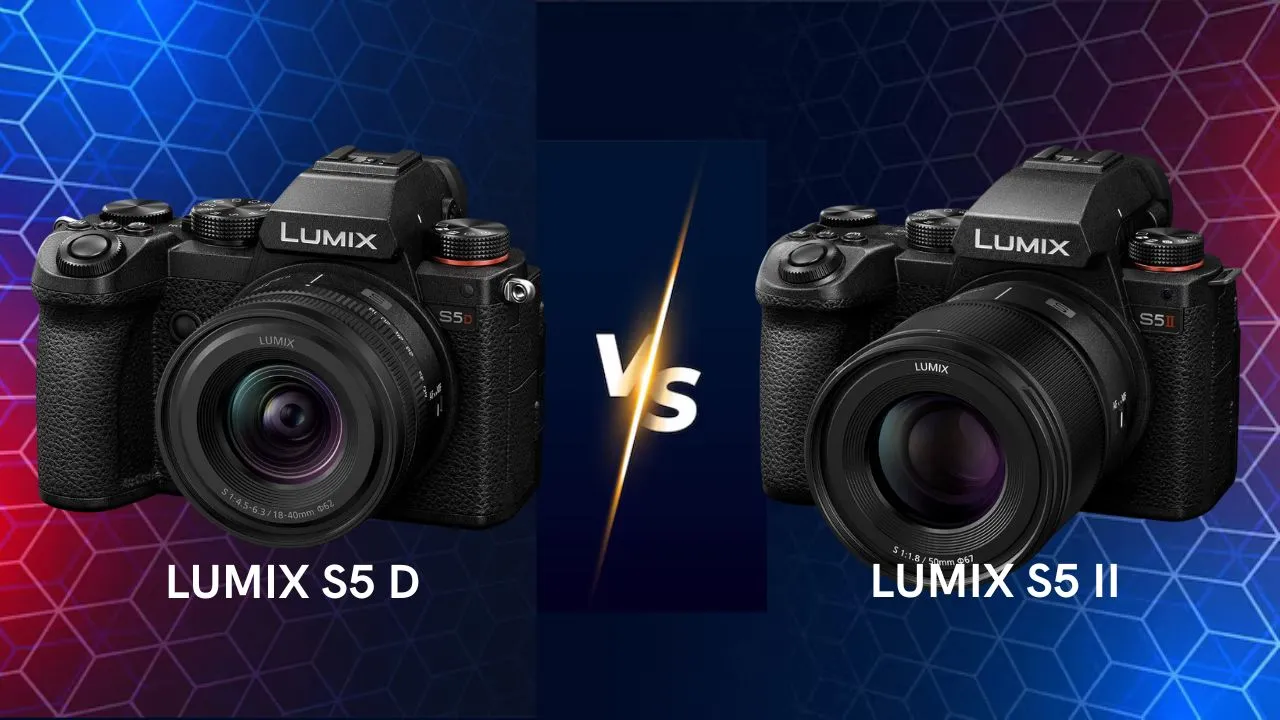
Panasonic Lumix S5D vs S5 II – Which one is better?
Panasonic Lumix S5D vs Panasonic Lumix S5 II — Which One Is Better?
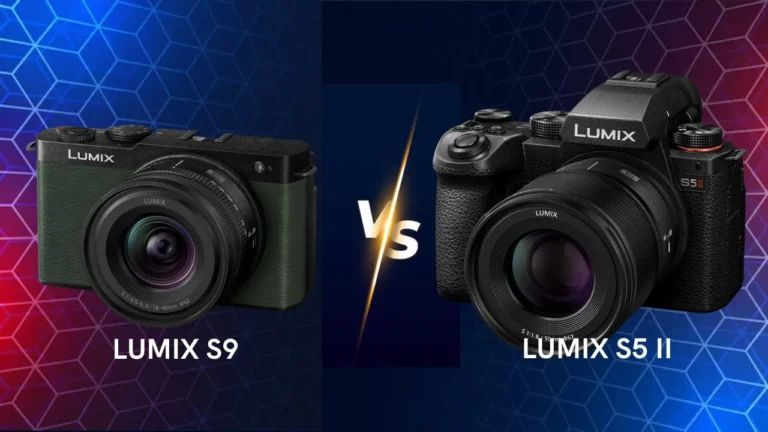
If you’re choosing between the Panasonic Lumix S5D and the Panasonic Lumix S5 II, you’re evaluating two full-frame cameras in the Lumix S series, both built around a 24.2 megapixel sensor and offering strong hybrid photo/video performance — but with different priorities. Below is a detailed comparison so you can decide which one suits your workflow best.
⚙️ Overview — Video-Optimised Variant vs Hybrid Evolution
S5D: The S5D is a refined version of the S5 platform, with enhancements aimed especially at creators who need advanced video outputs, HDMI/RAW capabilities and video-focused features. It uses the same 24.2 MP full-frame sensor as the S5, but adds workflow and output upgrades for video-centric use. (Spec sheet confirms 24.2 MP full-frame sensor, video specs such as 4K 60p/50p 10-bit etc)
S5 II: The S5 II is the next-generation hybrid body in the Lumix lineup. It retains the 24.2 MP full-frame sensor but brings Panasonic’s first full-frame phase-detection autofocus system (hybrid AF), improved video features, and a more modern overall spec sheet.
In short:
-
S5D = Best for creators who prioritise video output, external recorders, HDMI/RAW workflows.
-
S5 II = Best for true hybrid shooters wanting upgraded autofocus, stills + video performance, and modern features.
📸 Specifications Comparison
Here’s a breakdown of the key specs:
| Feature | S5D | S5 II |
|---|---|---|
| Sensor | 24.2 MP full-frame CMOS (same base sensor as S5) | 24.2 MP full-frame CMOS; newer processing and features |
| Video/Output Focus | 4K 60p/50p 10-bit internal; 4K 30p/25p 4:2:2 10-bit; RAW via HDMI in some modes | 6K/4K improved modes, full hybrid focus; newer AF system too |
| Autofocus | Contrast/Hybrid typical of the S5 line (no major phase-detect upgrade indicated) | Phase-detect hybrid AF (reported ~779 focus points) |
| Use-Case Emphasis | Video-centric, output-rich workflows, creators needing external monitors/recorders | Balanced hybrid (photo + video) with upgraded AF and stills/video flexibility |
| Value Proposition | Excellent value if you already focus on video and don’t need the absolute newer AF system | More future-proof for both stills and video, especially if AF, stills quality and speed matter |
🧱 Build and Handling
Both bodies are very similar in form factor (same mount: L-Mount, similar sensor size) and share high build quality typical of Panasonic’s Lumix S full-frame bodies.
Because they share many elements, the handling differences are less dramatic — the real difference is internal features. If you prioritise modern AF and strong hybrid stills/video capabilities, the S5 II will feel more up-to-date. If you primarily shoot video and want strong output features, the S5D handles that well.
👉 Verdict:
-
Choose S5D if video gear, external recorders, HDMI/RAW output is your workflow.
-
Choose S5 II if hybrid shooting (photo + video) and autofocus upgrades matter.
🎯 Autofocus and Performance
This is a key differentiator:
-
The S5D maintains the strong video-centric features but does not introduce the major phase-detect autofocus upgrade found in the S5 II.
-
The S5 II brings phase-detect AF (which significantly improves subject tracking, hybrid shooting and stills performance) and modern processing.
👉 Verdict:
-
S5 II clearly wins in terms of autofocus capability and hybrid performance.
-
S5D is still very capable, but less advanced in AF compared to the S5 II.
🎥 Video Capabilities
Video features are where the S5D shines in specific output workflow terms:
S5D
-
Supports internal 10-bit video, strong HDMI output, RAW video output in some modes.
-
4K 60p/50p internal and 4K 30p/25p 4:2:2 10-bit internal mentioned.
-
Targeted at creators who need external recorders, advanced video workflows.
S5 II
-
Offers upgraded video capabilities too (6K modes, upgraded AF, etc) which make it more versatile for stills + video.
-
Better all-round: if you shoot both stills and video, you benefit from the newer features.
👉 Verdict:
-
S5D: Best for video-first workflows, external gear and output flexibility.
-
S5 II: Best for balanced creators who need both stills and video, and who will benefit from improved AF and stills performance.
🧠 Image Quality and Still Performance
Since both cameras share the same 24.2 MP full-frame sensor base, image quality for stills will be very close — good dynamic range, full-frame look and solid performance. The S5 II benefits from newer processing and autofocus improvements which can yield better stills usage especially with challenging subjects.
👉 Verdict:
-
If you mainly shoot stills, S5 II is the better long-term pick due to updated AF and hybrid enhancements.
-
If stills are secondary and your focus is video output, S5D offers nearly identical stills image quality at likely better value.
🔋 Workflow, Ecosystem & Value
-
Lens mount is the same (L-Mount) for both, so lens compatibility is equal.
-
Workflow wise: the S5D’s video output features may require external recorders, which means additional gear/investment.
-
The S5 II may require less compromise for stills + video hybrid creators, so workflow is more flexible.
👉 Verdict:
-
S5D: Great value if your workflow focuses on video and you’re comfortable with the video output gear.
-
S5 II: Better value for most creators who shoot both stills and video and want modern AF and features.
💰 Price and Value
The S5D may offer a slightly better cost/value ratio if found at a lower price, given the similar sensor and strong video features. The S5 II commands a premium for the hybrid upgrades (AF, stills/video flexibility).
👉 Verdict:
-
Choose S5D if budget is more constrained and video workflow is your priority.
-
Choose S5 II if you have the budget and want a more versatile camera for both stills and video.
Check availability and price on Amazon 🛒
📷 Panasonic Lumix S5 II — Amazon USA / Amazon Canada / Amazon UK / Amazon Australia
📷 Panasonic Lumix S5D — Amazon USA / Amazon Canada / Amazon UK / Amazon Australia
🏁 Final Verdict — S5D vs S5 II
| Type of User | Recommended Camera |
|---|---|
| Video-first creator needing HDMI/RAW output & external recorders | S5D |
| Hybrid photo + video creator needing upgraded autofocus and modern features | S5 II |
| Still photographers who occasionally shoot video | S5 II |
| Budget-conscious creators focusing on video workflows | S5D |
✅ In short:
Go with the Panasonic Lumix S5D if your priority is advanced video output, external recorder compatibility, and your workflow is video-centric.
Go with the Panasonic Lumix S5 II if you want a more future-proof hybrid camera, better autofocus, very good stills and video capabilities in one body.
🧠 Final Thoughts
Both cameras are excellent and share much of the same DNA. The key decision factor is: what type of shooting do you do most?
If you spend most of your time on video and need professional output features, the S5D fits best. If you mix photography and video, especially stills, and value upgraded autofocus and versatility, the S5 II is the smarter investment.
Choose based on how you shoot, what you shoot, and how you plan to grow your kit — then you’ll know which one is truly better for you.