Panasonic Lumix S5D vs Nikon Z5 – Which one is better?
Panasonic Lumix S5D vs Nikon Z5 – Which One Is Better?
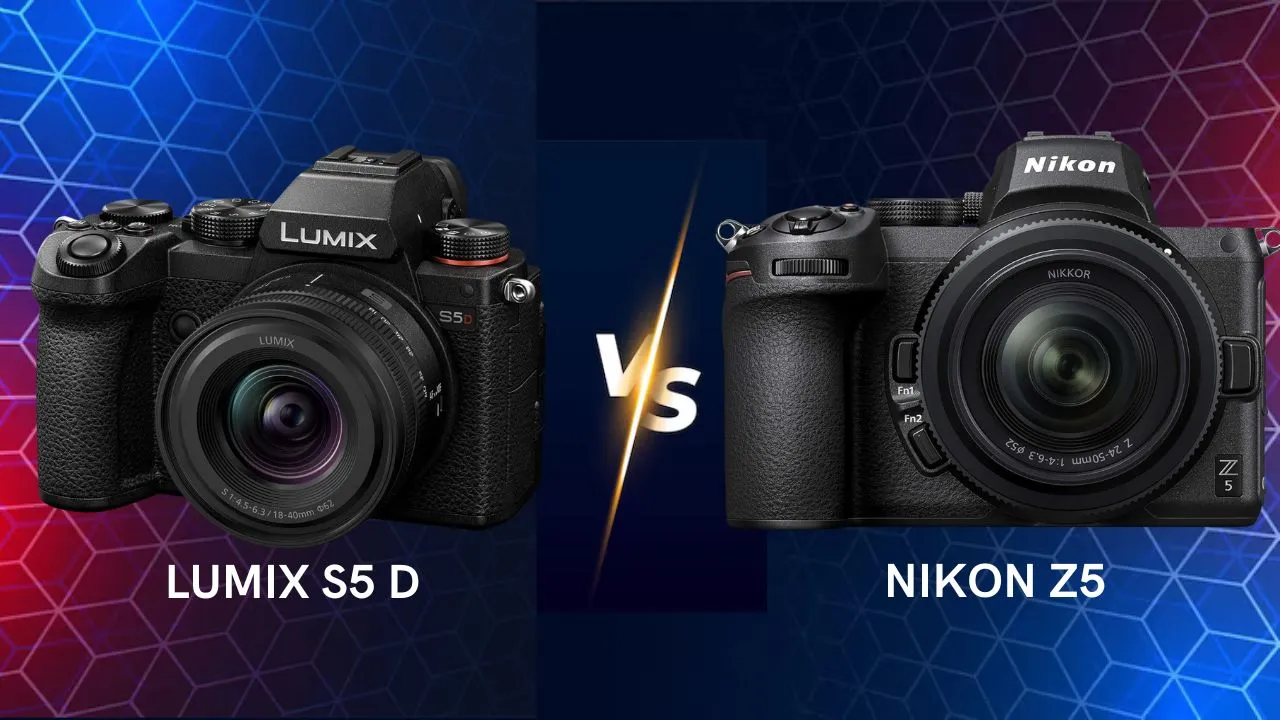
The Panasonic Lumix S5D and Nikon Z5 are both full-frame mirrorless cameras aimed at creators, but they serve somewhat different use-cases and priorities.
The S5D brings advanced video and hybrid features in a modern design; the Z5 offers a solid full-frame entry into photography and video with a strong ecosystem and value.
Let’s dive deeper to see which is better for you.
⚙️ Overview – Hybrid Video-Friendly vs Solid Full-Frame Entry
Panasonic Lumix S5D:
A full-frame camera built around a 24.2 MP sensor, focused on hybrid creators who shoot both stills and video. It offers strong video specs (including internal 10-bit recording and RAW output via HDMI) and modern features for content creators.
Nikon Z5:
A full-frame mirrorless camera with a 24.3 MP sensor, designed for photographers who want full-frame quality with good stills and decent video capability. It emphasizes solid image quality, ease of use, and a well-established lens ecosystem.
In short:
-
S5D = more video/hybrid oriented full-frame.
-
Z5 = more stills-oriented full-frame entry with broad support.
📸 Specifications Comparison
| Specification | Panasonic Lumix S5D | Nikon Z5 |
|---|---|---|
| Release Date | Around 2024 | July 2020 |
| Camera Type | Full-frame mirrorless | Full-frame mirrorless |
| Sensor | 24.2 MP full-frame CMOS (Dual Native ISO) | 24.3 MP full-frame CMOS |
| Image Processor | Panasonic Venus Engine (latest) | Nikon EXPEED 6 |
| Lens Mount | Leica L-Mount | Nikon Z-Mount |
| ISO Range | 100–51,200 (expandable 50–204,800) | 100–51,200 (expandable 50–102,400) |
| In-Body Image Stabilization (IBIS) | Yes, 5-axis sensor-shift | Yes, 5-axis VR (up to ~5 stops) |
| Autofocus System | Contrast/DFD AF with ~225 points; humans & animals | Hybrid AF with ~273 phase-detect points; eye & animal detect |
| AF Subject Recognition | Human & animal detection | Human & animal detection |
| Continuous Shooting Speed | ~9 fps (approx.) | ~4.5 fps |
| Video Recording | Up to 4K 60p/50p (10-bit options internally) | 4K 30p, Full HD up to 60p |
| Video Bit Depth / Color | 10-bit internal options (4:2:0 or 4:2:2) | 8-bit internal |
| Color Profiles | V-Log, cinematic profiles | Nikon standard picture controls |
| RAW Video Output | Yes (external) | No |
| Recording Limit | About 30 min at higher bitrates | ~30 min per clip |
| Viewfinder | EVF (~2.36M dots OLED) | Quad-VGA EVF (~3.69M dots) |
| LCD Screen | 3.2″ fully articulating touchscreen | 3.2″ tilting touchscreen |
| Touch Functions | Full touch support | Full touch support |
| Product Showcase Mode | No dedicated mode | No dedicated mode |
| Background Defocus Button | No dedicated button | No dedicated button |
| Body Material | Magnesium alloy composite | Magnesium alloy |
| Weather Sealing | Yes (dust/splash-resistant) | Yes (dust/moisture sealed) |
| Audio Options | Mic input, headphone via adapter (varies) | Mic input, headphone output |
| Connectivity | Wi-Fi, Bluetooth, USB-C, micro-HDMI | Wi-Fi, Bluetooth, USB-C, HDMI |
| Battery Type | Panasonic DMW-BLK22 | Nikon EN-EL15c |
| Battery Life (CIPA) | ~370–400 shots (est.) | ~470–490 shots |
| Dimensions (W × H × D) | ~134 × 101 × 90 mm (approx.) | ~134 × 100.5 × 69.5 mm |
| Weight (Body Only) | ~740 g (approx.) | ~590 g |
| Approx. Price (Body Only) | ~€799 (kit pricing varies) | ~€799 (check on Amazon) |
🧱 Build and Handling
The S5D offers a design focused on hybrid creators: full-frame size with robust video features (RAW output via HDMI, internal 10-bit recording, etc). It is compact for full-frame hybrid use and is built to handle video workflows as well as stills.
The Z5 provides a well-balanced full-frame body, weather-sealed, sturdy construction, a camera you can build a system around for stills. It’s slightly older generation in video features but very capable for stills and general use.
👉 Verdict:
-
S5D: Best if you frequently film video and also shoot stills; you’ll benefit from modern video specs and hybrid design.
-
Z5: Best if you focus chiefly on stills, want full-frame quality, and value a broad lens ecosystem and proven performance.
🎯 Autofocus and Performance
Autofocus and performance are key in hybrid workflows.
The Z5 offers Nikon’s strong AF system for stills (eye and animal detection, large coverage), and full-frame stills quality. The hybrid video performance is competent but not as cutting-edge as newer video-first models.
The S5D brings features tailored for hybrid use: modern AF with good focus coverage, video-oriented specs including dual native ISO for video, and strong internal recording options. For video-heavy or run-and-gun hybrid creators, that gives it an edge.
👉 Verdict:
-
S5D: Slight advantage for hybrid shooters and creators needing better video support and modern AF features.
-
Z5: Excellent for stills and general use, but may lag slightly for video-first workflows.
🎥 Video Capabilities
For video creators, this is a major differentiator.
-
S5D: Offers 4K 60p internal 10-bit recording, 4K 30p 10-bit 4:2:2 HDMI output, RAW video output to external recorder in some modes — meaning serious video workflows are supported.
-
Z5: Supports full-frame stills very well and delivers 4K (though at up to 30p in many conditions), but lacks some of the high-end video features (e.g., internal 10-bit 4:2:2 at 60p, RAW video output) found in more video-focused models.
👉 Verdict:
-
S5D: Best choice if video is a key part of your workflow and you value internal video specs and hybrid capability.
-
Z5: Better if video is secondary and you prioritise stills performance and full-frame image quality.
🧠 Image Quality and Sensor Considerations
Both cameras use 24 MP full-frame sensors, which is a sweet-spot for many photographers: good detail, manageable file sizes, excellent low-light performance. The full-frame format gives better depth of field control and low-light capabilities than smaller formats.
If stills are your primary concern, the Z5’s full-frame heritage and Nikon colour science make it very compelling. Meanwhile, the S5D’s sensor plus video/hybrid enhancements mean you’re getting a camera that is equally strong in stills but with added video strengths.
👉 Verdict:
-
Z5: Excellent image quality for stills, full-frame advantage and proven system.
-
S5D: Very strong image quality too, with added benefit of better video features and hybrid readiness.
🔋 System, Lenses & Future-Proofing
The Nikon Z-Mount has a very broad lens ecosystem: many native Z lenses, excellent third-party support, and a strong upgrade path. That gives the Z5 a strong edge in terms of system scalability and lens options.
The Panasonic L-Mount (used by S5D) is growing and offers high-quality lenses from Panasonic, Leica, Sigma, but overall the breadth is smaller compared to Nikon’s Z-Mount. If lens ecosystem and system growth matter strongly to you, that factor weighs in.
👉 Verdict:
-
Z5: Better for system growth, lens options, and future flexibility.
-
S5D: Excellent for hybrid users who are comfortable with L-Mount and prioritize video/hybrid features over maximum lens choice.
💰 Price and Value
Often, the Z5 is priced as a very attractive entry full-frame model, offering great stills value. The S5D, while also good value for hybrid creators, may carry a bit of premium due to its advanced video features.
👉 Verdict:
-
Z5: Best pure value if stills are your focus and you want full-frame for less.
-
S5D: Great value if you’ll use the video/hybrid features — more specialised but worth it if you need them.
Check availability and price on Amazon 🛒
📷 Nikon Z5 — Amazon USA / Amazon Canada / Amazon UK / Amazon Australia
📷 Lumix S5D — Amazon USA / Amazon Canada / Amazon UK / Amazon Australia
Note: camerafight.com participates in the Amazon Associates Program. As an Amazon Associate, we earn from qualifying purchases.
🏁 Final Verdict — Panasonic Lumix S5D vs Nikon Z5
| Type of User | Recommended Camera |
|---|---|
| Hybrid creator (photo + video) | S5D |
| Photographer focused on stills and full-frame | Z5 |
| Video-oriented workflows (interviews, content, long takes) | S5D |
| System growth and broad lens ecosystem | Z5 |
| Budget-conscious full-frame stills shooter | Z5 |
| Creator needing modern video specs and full-frame body | S5D |
✅ In short:
Choose the Panasonic Lumix S5D if you want a full-frame camera that handles stills and video well, with strong hybrid features and modern video workflows.
Choose the Nikon Z5 if you want full-frame stills performance, broad lens system, excellent value, and you don’t need the most advanced video specs.
🧠 Final Thoughts
Both cameras are excellent — the “better” one really depends on your workflow and priorities:
If you shoot both photo and video regularly, especially if video is important, then the S5D gives you more versatility.
If you are primarily a photographer, want full-frame quality, and want a solid system with lens choices, then the Z5 is very compelling.
Pick the model that aligns with how you shoot, what you shoot, and what equipment you already own or plan to build — that will determine which one is truly better for you.