Panasonic Lumix S1R II vs Sony FX3 – Which one is better?
Panasonic Lumix S1R II vs Sony FX3 — Which One Is Better?
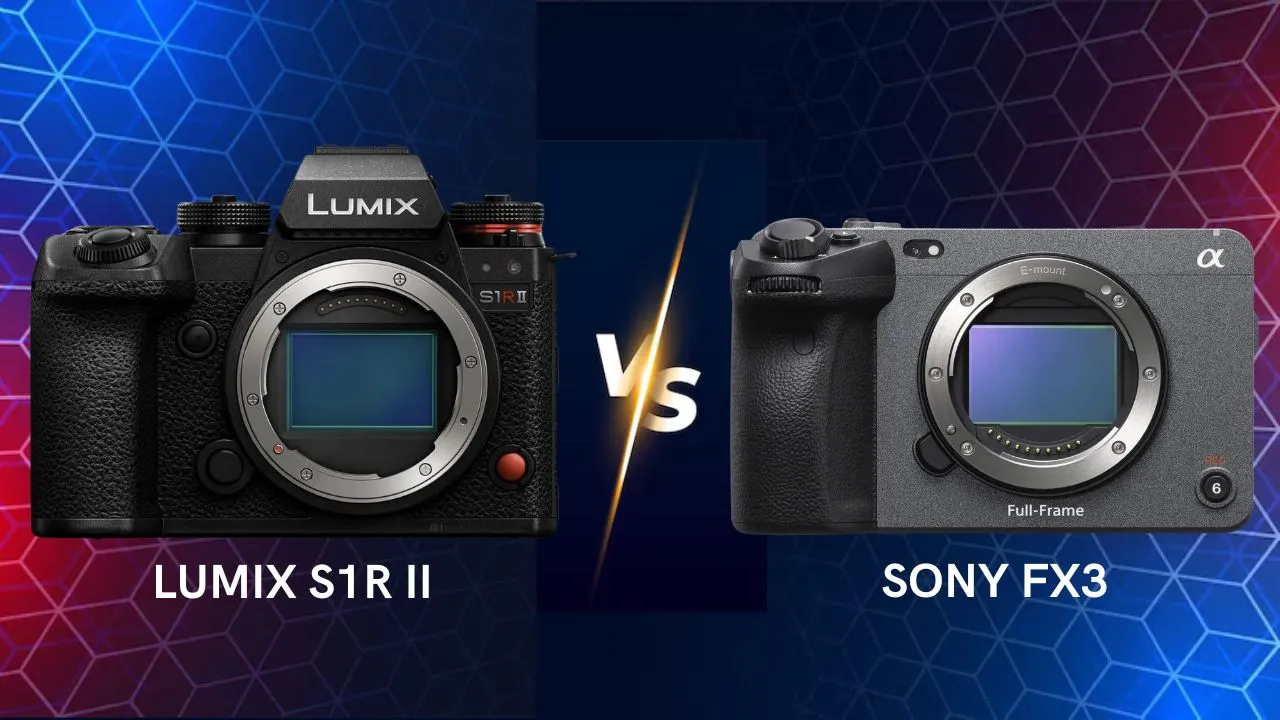
The Panasonic Lumix S1R II and Sony FX3 are two full-frame mirrorless cameras that target very different creators.
The S1R II is a high-resolution hybrid camera built for professional photography and detailed video, while the FX3 is a cinema-focused body designed specifically for filmmakers and video production.
Let’s compare them in detail to find out which one is right for you.
⚙️ Overview — Ultra-Resolution Hybrid vs Cinema-Ready Powerhouse
Panasonic Lumix S1R II:
A flagship full-frame camera offering 44.3 megapixels of resolution, 8K recording, and professional-grade image stabilization. It’s aimed at photographers who want maximum detail and hybrid creators who need strong video options.
Sony FX3:
Part of Sony’s Cinema Line, the FX3 is built primarily for filmmakers. It uses a 12.1 MP full-frame sensor optimized for low light and dynamic range, offering pro-level video formats and features like unlimited recording, cooling, and XLR audio support.
In short:
-
S1R II = Best for high-resolution photography and hybrid creators.
-
FX3 = Best for professional videographers and filmmakers.
📸 Specifications Comparison
| Feature | Panasonic Lumix S1R II | Sony FX3 |
|---|---|---|
| Release Date | 2025 | 2021 |
| Sensor | 44.3 MP Full-Frame BSI CMOS | 12.1 MP Full-Frame BSI CMOS |
| Processor | Venus Engine | BIONZ XR |
| Lens Mount | L-Mount | Sony E-Mount |
| In-Body Stabilization (IBIS) | ✅ Yes (up to 8 stops) | ✅ Yes (5-axis) |
| Autofocus System | Phase Hybrid AF (779 points) | Fast Hybrid AF (627 points) |
| Continuous Shooting | 15 fps mechanical / 60 fps electronic | 10 fps (still image mode) |
| Video Recording | 8.1K / 6K / 4K 120p 10-bit | 4K 120p 10-bit 4:2:2 / 16-bit RAW via HDMI |
| Log & Color Profiles | V-Log / LUT support | S-Cinetone / S-Log3 / HLG |
| Recording Limit | Unlimited | Unlimited (active cooling) |
| Screen | 3.2” Fully Articulating Touch LCD | 3.0” Vari-Angle Touch LCD |
| Audio Inputs | 3.5mm + optional XLR adapter | Dual XLR / 3.5mm (with handle) |
| Weight (Body Only) | 820 g | 715 g |
| Price (Body Only) | ~$3,999 (check on Amazon) | ~$3,900 (check on Amazon) |
🧱 Build and Handling
The S1R II is built like a professional stills camera — large, robust, and designed for high-end photography. It’s weather-sealed, well-balanced for handheld shooting, and ideal for studio or commercial use.
The FX3, on the other hand, features a compact, cage-ready design with multiple mounting points, making it perfect for gimbal or rig setups. Its built-in cooling fan allows long 4K recording sessions without overheating.
👉 Verdict:
-
S1R II: Ideal for photographers and hybrid creators who shoot handheld or in controlled environments.
-
FX3: Best for filmmakers who need a lightweight, rig-friendly camera for long video shoots.
🎯 Autofocus and Performance
The FX3 shares Sony’s advanced autofocus system with real-time eye and subject tracking, optimized for continuous video and cinematic use. It performs flawlessly in dynamic environments, even in low light.
The S1R II introduces Panasonic’s improved Phase Hybrid AF, which is a major leap forward for the brand. It’s fast and accurate but still slightly behind Sony’s system for video subject tracking.
👉 Verdict:
-
FX3: Superior autofocus for continuous video and subject tracking.
-
S1R II: Excellent performance for stills, very capable hybrid AF.
🎥 Video Capabilities
Here’s where these two cameras differ the most.
Panasonic Lumix S1R II
-
Records 8.1K, 6K, and 4K 120p video.
-
10-bit 4:2:2 internal recording with V-Log support.
-
Dual card slots and pro-grade stabilization.
-
Perfect for hybrid shooters needing high-resolution stills and video.
Sony FX3
-
4K up to 120p (10-bit 4:2:2).
-
16-bit RAW output via HDMI.
-
Exceptional low-light performance and 15+ stops of dynamic range.
-
Dedicated cooling system for unlimited recording.
-
Built for professional film workflows.
👉 Verdict:
-
S1R II: Great hybrid camera with ultra-high video resolution.
-
FX3: True cinema camera, optimized for long shoots and low-light video.
🧠 Image Quality
The S1R II delivers incredible detail with its 44.3 MP sensor, making it ideal for large prints, commercial photography, and ultra-sharp imagery. Its colors and dynamic range are outstanding.
The FX3 produces cleaner footage in low light, thanks to its 12.1 MP sensor and dual native ISO technology. However, it’s not designed for high-resolution stills — its strength lies entirely in video performance.
👉 Verdict:
-
S1R II: Best for high-resolution stills and mixed photo/video work.
-
FX3: Best for low-light, cinematic video production.
🔋 Workflow, Storage & Connectivity
The S1R II uses CFexpress and SD cards, ideal for heavy RAW and 8K video files. It’s compatible with professional workflows but requires more storage and faster cards.
The FX3 focuses on simplicity — it supports dual CFexpress Type A or SD cards, USB-C power delivery, and pro audio inputs. Its setup is ready for on-set production out of the box.
👉 Verdict:
-
S1R II: Better for hybrid creators with mixed workflows.
-
FX3: Better for pure video production and on-set efficiency.
💰 Price and Value
| Model | Approx. Price | Ideal For |
|---|---|---|
| Lumix S1R II | ~$3,999 | Hybrid creators, photographers, and content producers |
| Sony FX3 | ~$3,900 | Filmmakers, videographers, and professional video teams |
Both are premium tools but designed for different workflows. The S1R II is more versatile overall, while the FX3 is specialized for professional video.
👉 Verdict:
-
S1R II: Best value for hybrid creators who need high-resolution stills and pro video.
-
FX3: Best investment for dedicated filmmakers.
Check availability and price on Amazon 🛒
📷 Lumix S1R II — Amazon USA / Amazon Canada / Amazon UK / Amazon Australia
📷 Sony FX3 — Amazon USA / Amazon Canada / Amazon UK / Amazon Australia
Note: camerafight.com participates in the Amazon Associates Program. As an Amazon Associate, we earn from qualifying purchases.
🏁 Final Verdict — Panasonic Lumix S1R II vs Sony FX3
| Type of User | Recommended Camera |
|---|---|
| Professional Photographer | S1R II |
| Hybrid Creator (Photo + Video) | S1R II |
| Filmmaker / Cinematographer | FX3 |
| Documentary or Travel Videographer | FX3 |
| Studio Photographer | S1R II |
| Low-Light Shooter / Run & Gun Videographer | FX3 |
| Commercial Hybrid Producer | S1R II |
_
✅ In short:
Choose the Panasonic Lumix S1R II if you need ultra-high-resolution stills, professional hybrid features, and strong 8K video performance.
Choose the Sony FX3 if you’re a filmmaker who prioritizes cinematic video, low-light performance, and unlimited recording reliability.
🧠 Final Thoughts
The Panasonic Lumix S1R II is the better all-rounder, perfect for professionals who need top-quality stills and video in one body.
The Sony FX3, however, is a filmmaking tool — smaller, simpler, and laser-focused on video performance and reliability.
If your priority is photo + video flexibility, go for the S1R II.
If you’re a cinematographer or video-first creator, the FX3 is built for you.