Panasonic Lumix S1R II vs Nikon Z8 – Which one is better?
Panasonic Lumix S1R II vs Nikon Z8 — Which One Is Better?
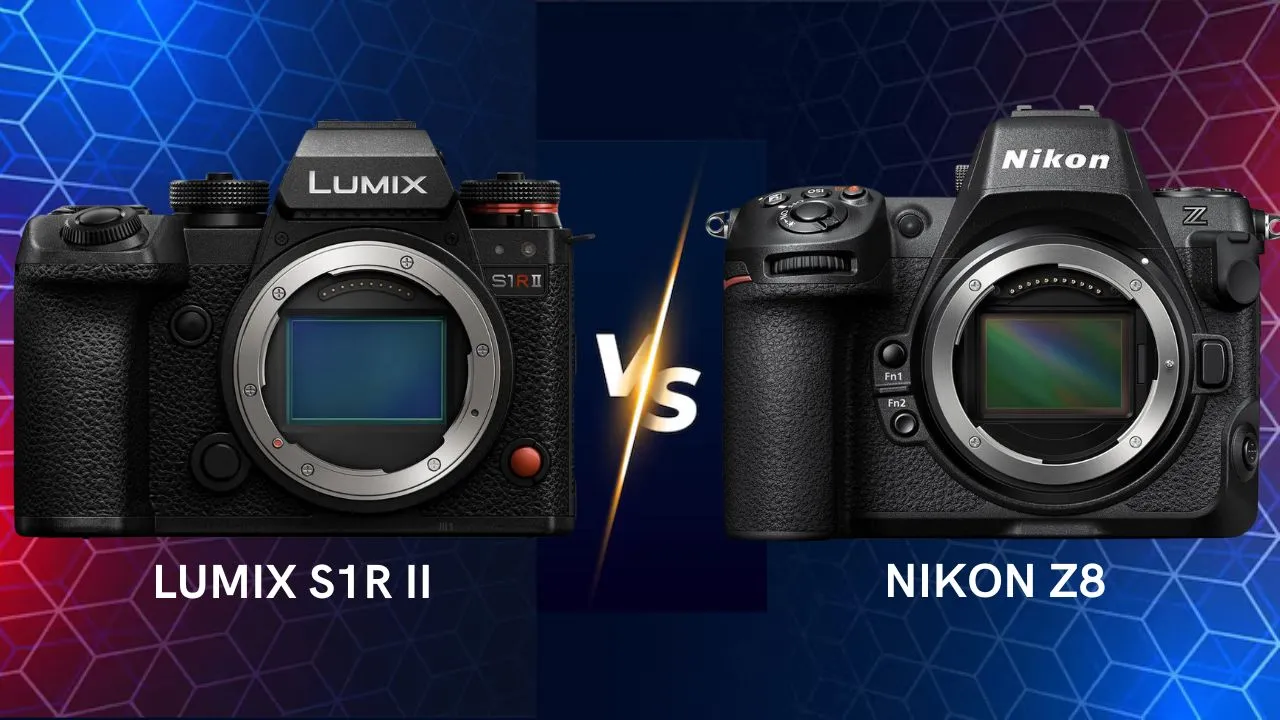
The Panasonic Lumix S1R II and Nikon Z8 are two of the most powerful full-frame mirrorless cameras available today, aimed at professional photographers and hybrid creators who need cutting-edge image quality, speed, and reliability.
While both deliver incredible performance, they have different philosophies: the S1R II focuses on ultra-high resolution and color accuracy, while the Z8 prioritizes speed, autofocus, and all-around versatility.
Let’s dive into a detailed comparison to help you decide which one is right for you.
⚙️ Overview — Resolution King vs Speed Monster
Panasonic Lumix S1R II:
A high-resolution full-frame mirrorless camera built for professional photographers who need maximum detail and dynamic range. It’s perfect for studio, landscape, and commercial work, featuring a new sensor, in-body stabilization, and refined color science.
Nikon Z8:
A professional hybrid camera that combines the power of the flagship Z9 in a smaller body. With its 45.7 MP stacked CMOS sensor, lightning-fast autofocus, and 8K video, it’s ideal for sports, wildlife, and professional filmmaking.
In short:
-
S1R II = Ultimate detail and color accuracy.
-
Z8 = Unmatched speed and autofocus performance.
📸 Specifications Comparison
| Feature | Panasonic Lumix S1R II | Nikon Z8 |
|---|---|---|
| Release Date | 2024 | 2023 |
| Sensor | 60.2 MP Full-Frame BSI CMOS | 45.7 MP Stacked Full-Frame CMOS |
| Processor | Latest Venus Engine | EXPEED 7 |
| Lens Mount | L-Mount | Nikon Z-Mount |
| In-Body Stabilization (IBIS) | ✅ Yes (up to 8 stops) | ✅ Yes (up to 6 stops) |
| Autofocus System | Phase Hybrid AF (779 points) | Advanced PDAF (493 points, 3D Tracking) |
| Continuous Shooting | 15 fps mechanical / 60 fps electronic | 20 fps RAW / 30 fps JPEG / 120 fps (11 MP) |
| Video Recording | 6K 30p / 4K 60p 10-bit internal | 8K 60p / 4K 120p 10-bit internal |
| Log & Color Profiles | V-Log / LUT support | N-Log / HLG / Flat profile |
| Screen | 3.2” Fully Articulating Touch LCD | 3.2” 4-axis Tilting LCD |
| Viewfinder | 9.44M-dot OLED EVF | 3.69M-dot OLED EVF (Blackout-free) |
| Storage | Dual CFexpress Type B + SD | Dual CFexpress Type B |
| Battery | DMW-BLJ31 | EN-EL15c |
| Weather Sealing | ✅ Yes (dust, splash, freeze-resistant) | ✅ Yes (dust, splash, freeze-resistant) |
| Weight (Body Only) | 820 g | 910 g |
| Price (Body Only) | ~$3,999 (check on Amazon) | ~$3,999 (check on Amazon) |
🧱 Build and Handling
Both cameras are built to professional standards — rugged, weather-sealed, and designed for demanding environments.
The S1R II has Panasonic’s signature ergonomic design: a deep grip, intuitive controls, and a large high-resolution EVF that’s one of the best in the industry. It’s slightly lighter than the Z8, making it easier to handle during long studio or landscape sessions.
The Nikon Z8 feels like a smaller version of the Z9. Its 4-axis tilting screen is great for both photo and video, and its weather sealing is top-tier. It’s heavier but balances well with professional telephoto lenses.
👉 Verdict:
-
S1R II: More comfortable for handheld and studio work.
-
Z8: More robust for sports, wildlife, and heavy lenses.
🎯 Autofocus and Performance
Autofocus is one of the key differences between these two cameras.
The S1R II introduces Panasonic’s improved Phase Hybrid AF system with 779 focus points and subject recognition for humans, animals, cars, and more. It’s fast, accurate, and a huge improvement over older Lumix models.
However, the Nikon Z8 is in another league when it comes to autofocus speed and tracking. It uses Nikon’s 3D Tracking system, borrowed from the Z9, and can shoot up to 120 fps for ultra-fast action. It’s one of the most reliable AF systems in any mirrorless camera today.
👉 Verdict:
-
Z8: Faster and more reliable autofocus for all types of subjects.
-
S1R II: Very capable, but slightly slower for high-speed action.
🎥 Video Capabilities
Both cameras are hybrid powerhouses, but the Z8 is the more advanced for video production.
Panasonic Lumix S1R II
-
6K 30p and 4K 60p 10-bit internal recording
-
Full V-Log recording and LUT preview
-
Unlimited recording time
-
In-body stabilization ideal for handheld video
-
Focus on color accuracy and cinematic workflow
Nikon Z8
-
8K 60p / 4K 120p internal recording
-
12-bit N-RAW and ProRes RAW recording
-
Advanced heat management (no recording limits)
-
Full-size HDMI, 10-bit Log and HLG profiles
-
Blackout-free EVF for smooth monitoring
The S1R II delivers beautiful cinematic color and stabilized footage, perfect for creative or commercial video. The Z8, however, is a true hybrid cinema camera, with superior frame rates, codec flexibility, and dynamic range.
👉 Verdict:
-
Z8: Better for serious filmmakers and hybrid professionals.
-
S1R II: Ideal for creative video and photography-first users.
🧠 Image Quality
The S1R II is a resolution monster — its 60 MP sensor produces breathtaking detail, incredible dynamic range, and rich color depth. It’s perfect for landscapes, commercial photography, and fine art prints.
The Z8, while slightly lower in megapixels (45.7 MP), still offers outstanding sharpness, with the added advantage of a stacked sensor for faster readout and minimal rolling shutter. Its files have excellent tonal balance and strong noise control at high ISOs.
👉 Verdict:
-
S1R II: Best for ultra-high-resolution photography.
-
Z8: Best for action, hybrid shooting, and versatility.
🔋 Battery, Storage, and Connectivity
Both cameras are well-equipped for professional workflows.
The S1R II supports dual CFexpress + SD cards, USB-C charging, and full-size HDMI. It also includes built-in Wi-Fi, Bluetooth, and tethering options for studio setups.
The Z8 uses dual CFexpress slots (no SD), ensuring maximum speed and reliability. It features a full range of professional ports — including microphone, headphone, and Ethernet — and can power via USB-C.
👉 Verdict:
-
S1R II: More flexible storage options.
-
Z8: More professional connectivity and faster data handling.
💰 Price and Value
| Model | Approx. Price | Ideal For |
|---|---|---|
| Lumix S1R II | ~$3,999 | High-resolution photography, studio, landscape, commercial work |
| Nikon Z8 | ~$3,999 | Professional hybrid shooters, sports, wildlife, video creators |
Both cameras are premium tools at the same price point. The S1R II is aimed at photographers who prioritize resolution and color depth, while the Z8 is better suited for professionals who need both speed and versatility.
👉 Verdict:
-
S1R II: Best for resolution-focused photographers.
-
Z8: Best for hybrid professionals and action shooters.
Check availability and price on Amazon 🛒
📷 Lumix S1R II — Amazon USA / Amazon Canada / Amazon UK / Amazon Australia
📷 Nikon Z8 — Amazon USA / Amazon Canada / Amazon UK / Amazon Australia
Note: camerafight.com participates in the Amazon Associates Program. As an Amazon Associate, we earn from qualifying purchases.
🏁 Final Verdict — Panasonic Lumix S1R II vs Nikon Z8
| Type of User | Recommended Camera |
|---|---|
| Landscape Photographer | S1R II |
| Studio / Commercial Photographer | S1R II |
| Wildlife / Sports Shooter | Z8 |
| Hybrid Photo + Video Creator | Z8 |
| Portrait Photographer | S1R II |
| Filmmaker / Videographer | Z8 |
| Travel Photographer | Z8 |
| Fine Art / Print Photographer | S1R II |
–
✅ In short:
Choose the Panasonic Lumix S1R II if you want ultimate resolution, superior color science, and the best image quality for high-end photography.
Choose the Nikon Z8 if you need professional speed, autofocus performance, and advanced video capabilities for hybrid or action work.
🧠 Final Thoughts
The Panasonic Lumix S1R II is a precision tool for photographers who demand maximum detail and color fidelity — a perfect match for studio, product, and fine art work.
The Nikon Z8, on the other hand, is one of the most capable hybrid cameras ever made, balancing stills and video performance with incredible autofocus and speed.
If your work revolves around resolution and image quality, the S1R II is the clear choice.
If you need speed, flexibility, and cutting-edge hybrid features, the Z8 is the ultimate all-rounder.