Panasonic Lumix G97 vs Canon R50 – Which one is better?
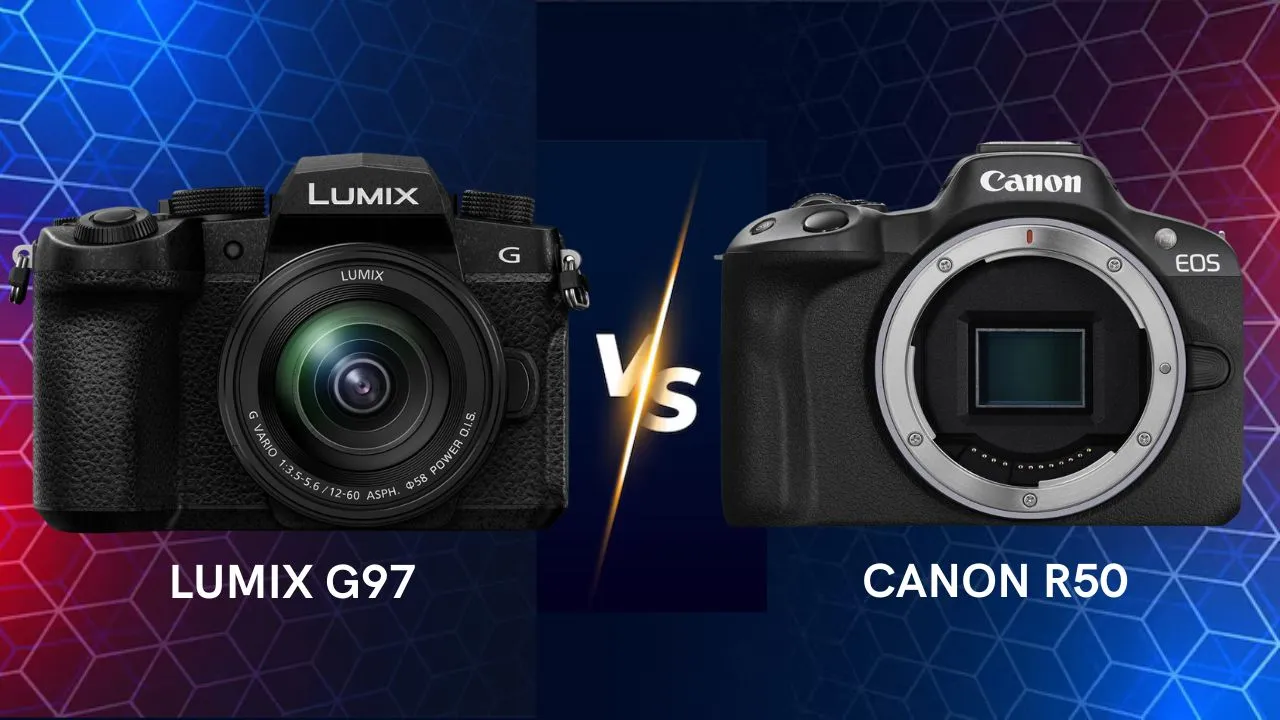
Panasonic Lumix G97 vs Canon EOS R50 – Which One Is Better?
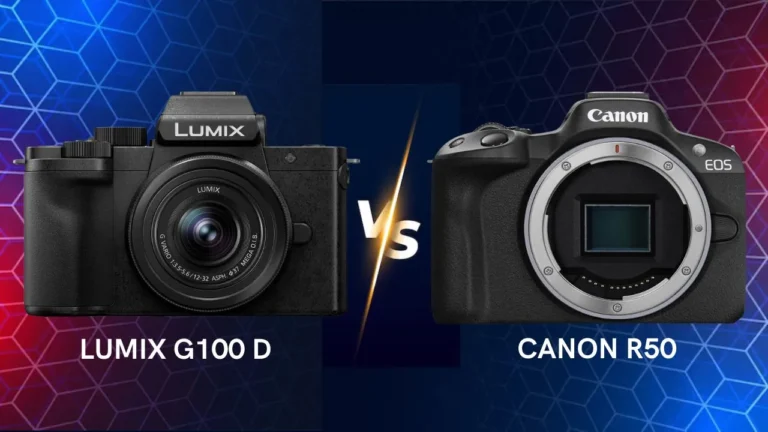
The Panasonic Lumix G97 and Canon EOS R50 are two excellent mirrorless cameras aimed at enthusiasts and creators. Both provide interchangeable lenses, 4K video, and solid photo capabilities — yet they differ significantly in sensor size, autofocus, system flexibility, and target user.
Here’s a detailed look to help determine which one suits you better.
⚙️ Overview – Compact MFT Hybrid vs APS-C Creator Camera
Panasonic Lumix G97:
A Micro Four Thirds (MFT) mirrorless camera designed for hybrid use (photo + video) with features like 20.3 MP sensor, 5-axis Dual I.S.2 stabilization, USB-C, and articulating screen. It’s built for creators who want good performance in a relatively compact body.
Canon EOS R50:
An APS-C format mirrorless camera from Canon’s EOS R line, with a 24.2 MP sensor, Dual Pixel CMOS AF II, strong autofocus subject detection, and a lightweight build. It’s tailored for creators and photographers who want system growth and modern AF/video features.
In short:
-
G97 = Micro Four Thirds hybrid, compact, stabilized, versatile.
-
R50 = APS-C creator camera, strong AF, system growth, broader lens options.
📸 Specifications Comparison
| Feature | Panasonic Lumix G97 | Canon EOS R50 |
|---|---|---|
| Release Date | January 2024 | February 2023 |
| Camera Type | Mirrorless (Micro Four Thirds, Photo-oriented Hybrid) | Mirrorless (Entry-level APS-C, Hybrid) |
| Sensor | Micro Four Thirds 20.3 MP Live MOS | APS-C 24.2 MP CMOS |
| Image Processor | Venus Engine | DIGIC X |
| Lens Mount | Micro Four Thirds | Canon RF / RF-S |
| ISO Range | 200–25,600 (expandable to 100) | 100–32,000 (expandable to 51,200) |
| In-Body Image Stabilization (IBIS) | Yes, 5-axis (up to 5 stops) | No |
| Autofocus System | Contrast-detection AF (49 areas, DFD) | Dual Pixel CMOS AF II (651 zones) |
| AF Subject Recognition | Face & Eye detection (humans) | Humans, animals, birds |
| Continuous Shooting Speed | Up to 9 fps (AF-S), 6 fps (AF-C) | Up to 12 fps (electronic), 15 fps (electronic shutter) |
| Video Recording | Up to 4K 30p | Up to 4K 30p (oversampled from 6K) |
| Video Bit Depth / Color | 8-bit internal | 10-bit via HDMI, 8-bit internal |
| Color Profiles | Standard / Cinelike D | Canon Log 3 (via HDMI), HDR PQ |
| RAW Video Output | No | No |
| Recording Limit | No recording limit | No recording limit (thermal dependent) |
| Viewfinder | 2.36M-dot OLED EVF | None |
| LCD Screen | 3.0″ vari-angle touchscreen (1.84M dots) | 3.0″ fully articulating touchscreen (1.62M dots) |
| Touch Functions | Yes (AF, menus) | Yes (AF, tracking, menus) |
| Product Showcase Mode | No | No |
| Background Defocus Button | No | No |
| Body Material | Magnesium alloy front plate | Polycarbonate |
| Weather Sealing | Yes | No |
| Audio Options | Mic input, headphone via USB-C | Mic input |
| Connectivity | Wi-Fi, Bluetooth, USB-C, HDMI | Wi-Fi, Bluetooth, USB-C, HDMI |
| Battery Type | DMW-BLG10 | LP-E17 |
| Battery Life (CIPA) | Approx. 290 shots | Approx. 440 shots |
| Dimensions (W × H × D) | 130 × 93.5 × 77.4 mm | 116.3 × 85.5 × 68.8 mm |
| Weight (Body Only) | Approx. 536 g | Approx. 329 g |
| Price (Body Only) | Approx. USD 750 (check on Amazon) | Approx. USD 680 (Check on Amazon) |
🧱 Build and Handling
The Lumix G97 is praised for its compact, lightweight body and hybrid friendly features. It retains a familiar DSLR-style layout, has a free-angle touchscreen, USB-C connectivity, and built-in image stabilization — making it a solid all-rounder.
The Canon EOS R50 is even more compact in many ways. It emphasizes ease of use, modern autofocus, flip-out screen, and simplicity for creators. Its build caters to content creation and hybrid photo/video.
👉 Verdict:
-
G97: Better for those who prioritize stabilization and compact versatility.
-
R50: Better for those who prioritize autofocus performance, system growth, and simplicity.
🎯 Autofocus and Performance
Autofocus is a key differentiator.
The Canon EOS R50 uses Canon’s Dual Pixel CMOS AF II with subject detection (people, animals, vehicles) and covers a wide area of the frame, making it highly capable in both stills and video.
The Panasonic Lumix G97 uses contrast-based DFD autofocus, which works well in many scenarios but is typically not as fast or advanced in subject detection/tracking as phase-detect AF systems. Reviewers emphasise this as a weaker point.
👉 Verdict:
-
R50: Clear advantage in autofocus/tracking.
-
G97: Functional AF, but less advanced for moving subjects/tracking.
🎥 Video Capabilities
Video performance is important for modern creators.
Panasonic Lumix G97:
-
Offers 4K 30p video, Full HD up to 60p, no time limit reported in some markets.
-
Has built-in 5-axis stabilization (Dual I.S.2) which helps for handheld video.
-
Hybrid design enables both photo and video features in an MFT body.
Canon EOS R50:
-
Offers 4K 30p uncropped, Full HD up to 120p depending on mode.
-
Strong autofocus during video, helping creators.
-
Lack of IBIS means relying on stabilized lenses or gimbals for handheld smooth footage.
👉 Verdict:
-
G97: Better handheld video stability out of the box (thanks to IBIS).
-
R50: Better overall video workflow (AF, system flexibility) but needs gear for stabilized handheld.
🧠 Image Quality and Sensor Considerations
Sensor size matters. The Canon EOS R50’s APS-C sensor gives it an advantage in low light, dynamic range, and depth of field control when compared to the smaller Micro Four Thirds sensor of the G97.
The Panasonic Lumix G97’s MFT sensor is still very capable, especially for well-lit conditions, travel, hybrid use — and benefits from smaller/lighter lenses. But the APS-C sensor tends to edge ahead in more demanding scenarios.
👉 Verdict:
-
R50: Better image quality potential especially in low light and for DOF control.
-
G97: Great image quality for its class, with the added benefit of stabilization and lens compactness.
🔋 Connectivity, Ecosystem and Longevity
The Canon EOS R50 offers access to Canon’s RF-mount ecosystem (including full-frame compatibility), giving long-term upgrade potential. The autofocus/AF system also positions it well for future content creation.
The Panasonic Lumix G97 offers access to the Micro Four Thirds ecosystem (Panasonic + Olympus/OM System lenses) which is very mature, especially if you value smaller lenses and portability. The built-in IBIS adds to lifespan for handheld users.
👉 Verdict:
-
R50: Best if you plan to invest long-term in a system and prioritize AF/expansion.
-
G97: Best if you value compact lenses, portability, stabilization, and immediate versatility.
💰 Price and Value
Both cameras offer great value, but for slightly different priorities.
The Panasonic Lumix G97 appears positioned as a cost-effective hybrid MFT camera with solid specs and built-in IBIS. The Canon EOS R50 is slightly more premium in features (especially autofocus) and gives a strong platform for creators.
👉 Verdict:
-
G97: Best value for hybrid users who value stabilization and compactness.
-
R50: Best value for creators who prioritize autofocus, video/stills flexibility, and system growth.
Check availability and price on Amazon 🛒
📷 Canon R50 — Amazon USA / Amazon Canada / Amazon UK / Amazon Australia
📷 Panasonic Lumix G97 — Amazon USA / Amazon Canada / Amazon UK / Amazon Australia
Note: camerafight.com participates in the Amazon Associates Program. As an Amazon Associate, we earn from qualifying purchases.
🏁 Final Verdict — Panasonic Lumix G97 vs Canon EOS R50
| Type of User | Recommended Camera |
|---|---|
| Travel / Lightweight Hybrid Setup | Lumix G97 |
| Vlogger / Social Media Creator | Canon EOS R50 |
| Hybrid Photo + Video Enthusiast | Canon EOS R50 |
| Handheld Video / Stabilized Shooting | Lumix G97 |
| System Builder / Future Upgrade | Canon EOS R50 |
| Budget-Driven Beginner Photographer | Both are strong – decide on priorities |
| Low Light / Portrait DOF Emphasis | Canon EOS R50 |
| Smaller/Lighter Lens Preference | Lumix G97 |
_
✅ In short:
Choose the Panasonic Lumix G97 if you want a camera that’s compact, stabilized, versatile for both photo and video, and you value built-in stabilization and portability.
Choose the Canon EOS R50 if you care deeply about autofocus performance, system expandability, low-light/image quality headroom, and a strong hybrid platform for photo + video.
🧠 Final Thoughts
The Panasonic Lumix G97 is a very strong hybrid camera in the Micro Four Thirds format — especially attractive for those who prioritize portability, lens compactness, and stabilization.
Meanwhile, the Canon EOS R50 delivers excellence in autofocus, sensor size, and system flexibility, making it a strong choice for creators and future-minded photographers.
Decide based on what you shoot, how you shoot, and how far you plan to grow your system — and you’ll end up with the camera that’s better for you.