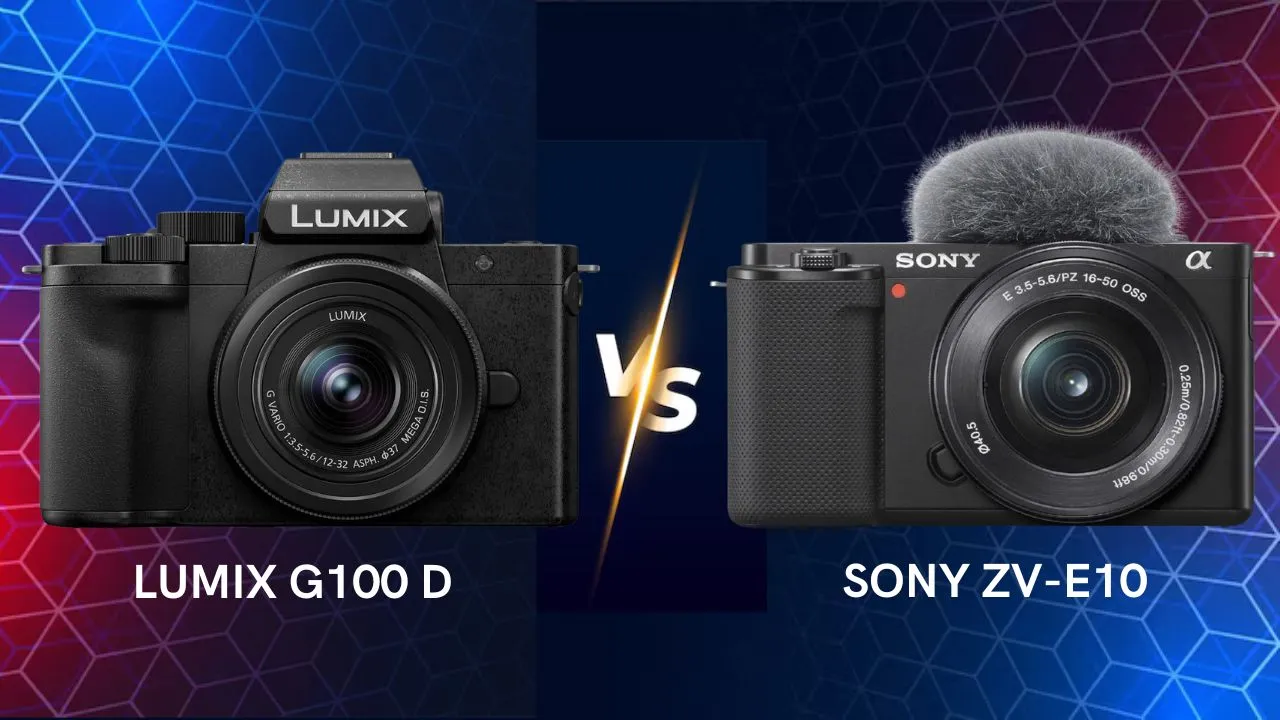
Panasonic Lumix G100D vs Sony ZV-E10 – Which one is better?
Panasonic Lumix G100D vs Sony ZV-E10 – Which One Is Better?
The Panasonic Lumix G100D and Sony ZV-E10 are two of the most popular mirrorless cameras designed for creators, vloggers, and hybrid shooters. Both deliver 4K video, interchangeable lenses, and compact designs — but they target slightly different audiences.
If you’re wondering which camera offers the best mix of performance, portability, and value, this detailed comparison will help you decide.
⚙️ Overview — Compact Vlogger vs Hybrid Creator
Panasonic Lumix G100D:
A lightweight Micro Four Thirds camera aimed at vloggers, travelers, and content creators who want excellent image quality in a portable body. It features a 20.3 MP sensor, a fully articulating touchscreen, and Panasonic’s directional “OZO Audio” microphones — perfect for easy, handheld content creation.
Sony ZV-E10:
An APS-C mirrorless camera built for hybrid creators who shoot both stills and video. With a 24.2 MP sensor, fast autofocus, and the power of Sony’s E-mount system, the ZV-E10 is one of the most capable mid-range cameras for YouTube, social media, and creative projects.
In short:
-
Lumix G100D = Compact, travel-friendly, and creator-focused.
-
Sony ZV-E10 = Larger sensor, powerful autofocus, and system flexibility.
📸 Specifications Comparison
| Specification | Panasonic Lumix G100D | Sony ZV-E10 |
|---|---|---|
| Release Date | 2020 | 2021 |
| Camera Type | Mirrorless interchangeable-lens | Mirrorless interchangeable-lens |
| Sensor | ~20.3 MP Micro Four Thirds Live MOS | 24 MP APS-C Exmor CMOS |
| Image Processor | Panasonic Venus Engine | Sony BIONZ X |
| Lens Mount | Micro Four Thirds | Sony E-mount |
| ISO Range | ~200–25 600 (extended to ISO100) | ISO 100–32 000 (expandable to 51 200) |
| In-Body Image Stabilization (IBIS) | No (digital/ lens-dependent) | No (lens-dependent / Active SteadyShot) |
| Autofocus System | Contrast-based AF | Fast Hybrid AF with phase-detect |
| AF Subject Recognition | Basic face/eye | Advanced face/eye & subject tracking |
| Continuous Shooting Speed | ~6 fps | ~11 fps |
| Video Recording | 4K 30p; Full HD up to 60p | 4K 30p; Full HD up to 120p |
| Video Bit Depth / Color | Standard 8-bit | Standard 8-bit |
| Color Profiles | Standard profiles | Picture Profiles + S-Log2/3 (via menus) |
| RAW Video Output | No | No (external RAW requires recorder) |
| Recording Limit | ~30 min cap typical | ~30 min cap typical |
| Viewfinder | EVF (~3.68 M dots) | None (LCD-only) |
| LCD Screen | 3.0″ fully articulating (~1.84 M dots) | 3.0″ fully articulating (~0.92 M dots) |
| Touch Functions | Full touchscreen | Full touchscreen |
| Product Showcase Mode | Yes (Panasonic video-oriented) | Yes (Sony vlog-oriented) |
| Background Defocus Button | No | Yes (Physical Bokeh switch) |
| Body Material | Lightweight polycarbonate | Lightweight polycarbonate |
| Weather Sealing | No official sealing | No official sealing |
| Audio Options | Mic input | Mic input & headphone jack |
| Connectivity | Wi-Fi, Bluetooth, USB-C, micro-HDMI | Wi-Fi, Bluetooth, USB-C, micro-HDMI |
| Battery Type | Panasonic DMW-BLG10 | Sony NP-FZ100 |
| Battery Life (CIPA) | ~270–280 shots | ~440 shots |
| Dimensions (W × H × D) | ~116 × 83 × 54 mm | ~115.2 × 64.2 × 44.8 mm |
| Weight (Body Only) | ~352 g | ~343 g |
| Approx. Price (Body Only) | Budget-friendly / entry vlogging (check on Amazon) | Mid-range content creator (check on Amazon) |
🧱 Build and Handling
The Lumix G100D is built for portability. Its lightweight body and compact Micro Four Thirds lenses make it an ideal travel or everyday camera. The fully articulating screen is perfect for vlogging and selfie recording, while the built-in OZO Audio system intelligently adapts microphone direction based on subject position.
The Sony ZV-E10 is slightly larger but still highly portable. Its grip is more ergonomic, and the overall build feels a bit more robust. It’s optimized for handheld video shooting, with easy one-touch background defocus and product-showcase modes that appeal to YouTubers and reviewers.
👉 Verdict:
-
G100D: Best for lightweight, travel-friendly setups.
-
ZV-E10: Best for creators who want better grip, longer shoots, and more advanced controls.
🎯 Autofocus and Performance
Autofocus is where the Sony ZV-E10 pulls ahead. It features Sony’s class-leading Real-Time Eye AF and Real-Time Tracking, making it one of the fastest and most reliable AF systems in any APS-C camera. Whether you’re recording yourself, filming moving subjects, or capturing portraits, the focus locks on instantly and stays there.
The Panasonic Lumix G100D uses contrast-detect AF with Depth-from-Defocus (DFD) technology. It’s fast for stills and casual video but can struggle slightly with continuous AF when subjects move quickly or lighting changes.
👉 Verdict:
-
ZV-E10: Far superior autofocus and subject tracking.
-
G100D: Good for static scenes, travel, and simple vlogs.
🎥 Video Capabilities
Both cameras offer strong video features, but they’re optimized for different styles of creators.
Panasonic Lumix G100D
-
4K 30p / Full HD 60p
-
Compact and easy to use for travel vlogs
-
Intelligent OZO Audio for clear sound pickup
-
Fully articulating touchscreen for solo creators
-
Digital stabilization (lens dependent)
Sony ZV-E10
-
4K 30p (oversampled from 6K for sharper detail)
-
Full HD 120p slow-motion
-
S-Log2 / S-Log3 / HLG profiles for color grading
-
Excellent continuous AF during recording
-
Optional GP-VPT2BT Bluetooth grip for one-hand vlogging
👉 Verdict:
-
G100D: Best for casual vloggers and travelers who want simplicity.
-
ZV-E10: Best for serious creators and hybrid shooters who want professional-grade video tools.
🧠 Image Quality
The Sony ZV-E10’s larger APS-C sensor gives it a natural advantage in sharpness, detail, and low-light performance. Its files offer more dynamic range and editing flexibility.
The Lumix G100D, with its 20.3 MP Micro Four Thirds sensor, produces vibrant colors and excellent JPEGs straight out of the camera — a classic Panasonic strength. It’s ideal if you prefer minimal editing and travel-ready results.
👉 Verdict:
-
ZV-E10: Better for RAW shooters and low-light photography.
-
G100D: Great color rendering for everyday creators.
🔋 Battery Life and Connectivity
Battery endurance clearly favors the Sony ZV-E10 (around 440 shots) over the G100D (around 270 shots). Both offer Wi-Fi and Bluetooth connectivity, but Sony’s Imaging Edge app allows advanced remote control and live view, which is useful for solo content creators.
👉 Verdict:
-
ZV-E10: Better battery life and remote functionality.
-
G100D: Sufficient for short shoots and travel use.
💰 Price and Value
Both cameras are priced around $700 USD (body only), but the value depends on your shooting style.
The Panasonic Lumix G100D offers unbeatable portability and built-in vlogger features, while the Sony ZV-E10 delivers stronger overall performance and a larger sensor that gives it more long-term flexibility.
👉 Verdict:
-
G100D: Best for creators who prioritize size, simplicity, and travel use.
-
ZV-E10: Best for those who want more power, autofocus, and system expansion.
Check availability and price on Amazon 🛒
📷 Sony ZV-E10 — Amazon USA / Amazon Canada / Amazon UK / Amazon Australia
📷 Lumix G100D — Amazon USA / Amazon Canada / Amazon UK / Amazon Australia
Note: camerafight.com participates in the Amazon Associates Program. As an Amazon Associate, we earn from qualifying purchases.
🏁 Final Verdict — Panasonic Lumix G100D vs Sony ZV-E10
| Type of User | Recommended Camera |
|---|---|
| Beginner Photographer | G100D |
| Enthusiast / Hybrid Creator | ZV-E10 |
| Travel Photographer | G100D |
| Street Photographer | G100D |
| Portrait Shooter | ZV-E10 |
| Vlogger / YouTuber | ZV-E10 |
| Content Creator on the Go | G100D |
| Low-Light / Studio Shooter | ZV-E10 |
| Budget Buyer | Both (tie) |
✅ In short:
-
Choose the Panasonic Lumix G100D if you want a lightweight, creator-friendly camera that’s easy to carry and ready to film anywhere.
-
Choose the Sony ZV-E10 if you want faster autofocus, better low-light performance, and room to grow with Sony’s extensive E-mount lens lineup.
🛒 Check Prices on Amazon
(As an Amazon Associate, I earn from qualifying purchases — at no extra cost to you.)
🧠 Final Thoughts
The Panasonic Lumix G100D is the perfect travel companion for vloggers and everyday creators who want simplicity and style in a small package.
The Sony ZV-E10, on the other hand, is the more powerful hybrid camera — with a larger sensor, superior autofocus, and stronger video features for serious content creation.
If portability is your top priority, go for the Lumix G100D.
If performance and long-term flexibility matter most, the Sony ZV-E10 is the clear winner.