Panasonic Lumix G100D vs Sony A6400 – Which one is better?
Panasonic Lumix G100D vs Sony Alpha A6400 – Which One Is Best for You?
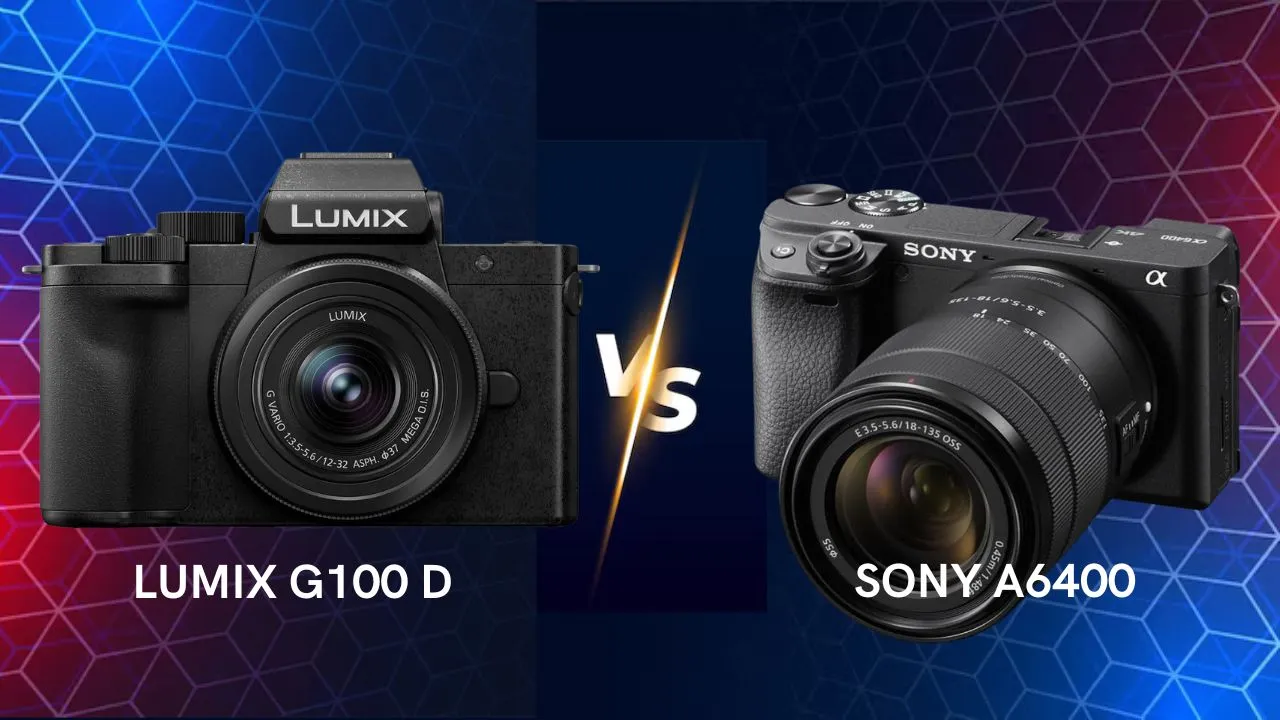
The Panasonic Lumix G100D and Sony Alpha A6400 are two very capable mirrorless cameras, each with its own strengths and trade-offs.
Both offer 4K video, interchangeable lenses, and mirrorless flexibility — but they’re built for slightly different needs. Let’s dig into how they compare, and help you pick which one makes the most sense.
⚙️ Overview – Compact Creator vs Autofocus Powerhouse
Panasonic Lumix G100D: A compact Micro Four Thirds system camera designed with vloggers and content-creators in mind. Lightweight, easy to carry, made for travel and handheld use.
Sony Alpha A6400: An APS-C system camera that emphasizes high performance: excellent autofocus, strong image quality, and a more “enthusiast” toolset.
In short:
-
G100D = Lightweight, creator-friendly, compact system.
-
A6400 = Fast autofocus, larger sensor, more performance potential.
📸 Specifications Comparison
Here are some of the key specs side by side:
| Specification | Panasonic Lumix G100D | Sony Alpha 6400 |
|---|---|---|
| Release Date | 2020 (Lumix DC-G100 / G110 family) | 2019 (Sony A6400) |
| Camera Type | Mirrorless interchangeable lens | Mirrorless interchangeable lens |
| Sensor | 20.3 MP Four-Thirds Live MOS (MFT) | 24.2 MP APS-C CMOS |
| Image Processor | Panasonic Venus Engine | Sony BIONZ X |
| Lens Mount | Micro Four Thirds | Sony E-mount |
| ISO Range | ~200–25,600 | ~100–32,000 (expandable to ~102,400) |
| In-Body Image Stabilization (IBIS) | No (digital/5-axis on some modes only) | No (relies on lens or Active SteadyShot on some lenses) |
| Autofocus System | Contrast-based AF | Fast Hybrid AF with phase detect (strong, fast) |
| AF Subject Recognition | Basic face/eye detection | Advanced eye, face, animal tracking |
| Continuous Shooting Speed | ~10 fps | ~11 fps |
| Video Recording | 4K 30p / 1080p60 | 4K 30p (no crop) / 1080p120 |
| Video Bit Depth / Color | 8-bit 4:2:0 internal (MP4) | 8-bit internal (advanced codec options) |
| Color Profiles | Standard, L-Monochrome | Standard + Picture Profiles (S-Log2/3 with mods) |
| RAW Video Output | No | No (external RAW via HDMI require recorder + settings) |
| Recording Limit | ~30 min 4K cap | ~30 min typical (varies w/ settings) |
| Viewfinder | Electronic EVF (~3.68-M-dot) | Electronic EVF (~2.36-M-dot) |
| LCD Screen | 3.0″ fully articulating touchscreen (~1.84 M dots) | 3.0″ tilting touchscreen |
| Touch Functions | Full touchscreen | Full touchscreen |
| Product Showcase Mode | Yes (video-friendly) | No |
| Background Defocus Button | Yes (video-centric) | No |
| Body Material | Lightweight polycarbonate | Robust magnesium composite |
| Weather Sealing | No official sealing | Yes (some resistance) |
| Audio Options | Mic input | Mic input & headphone jack |
| Connectivity | Wi-Fi, Bluetooth, USB-C, micro-HDMI | Wi-Fi, Bluetooth, USB-C, micro-HDMI |
| Battery Type | Panasonic DMW-BLG10 | Sony NP-FZ100 |
| Battery Life (CIPA) | ~270 shots | ~410 shots |
| Dimensions (W × H × D) | ~116 × 83 × 54 mm | ~120 × 67 × 50 mm |
| Weight (Body Only) | ~352 g | ~403 g |
| Approx. Price (Body Only) | Lower / budget-friendly (check on Amazon) | Mid-range for enthusiast APS-C (check on Amazon) |
🧱 Build and Handling
The Lumix G100D shines for its compact, travel-friendly design. Its size makes it ideal for handheld use, vlogging, walking around, and lightweight setups. A user said:
“Wanted something smaller … the 20mp sensor instead of the 16mp. Paired with … it handles almost all of my photo/video needs.”
Because of its Micro Four Thirds mount and compact lenses, it’s easier to carry a full kit.
The Sony A6400, meanwhile, has a more traditional enthusiast body for an APS-C camera. It gives you more room for controls, a more serious grip for longer shoots, and a larger sensor (which often means better image quality in many conditions). But the trade-off is slightly more weight/size and perhaps more complexity if you’re primarily looking for casual use.
👉 Verdict:
-
If portability, travel, vlogging matter: go with G100D.
-
If you want more manual control, longer sessions, bigger sensor: go with A6400.
🎯 Autofocus and Performance
This is a major distinction area.
Sony A6400: A standout here. With its 425-point phase-detect AF system, Real-Time Eye AF and Real-Time Tracking, it’s among the best autofocus systems in this class. If you shoot moving subjects, video with tracking, portraits with eye-focus — the A6400 has strong advantages.
Panasonic G100D: While respectable, the autofocus is not quite at the same level, especially for fast motion or tracking. Reviewers note it’s more than adequate for many uses, but slower or less refined for challenging AF tasks.
👉 Verdict:
-
A6400: Big advantage in autofocus/tracking.
-
G100D: Fine for casual shooting, travel, vlogging, less for fast action.
🎥 Video Capabilities
Both cameras support 4K video, which is great. But their video-strengths differ:
Panasonic G100D: Designed with creators in mind. It offers features like flip screen, mic input, vlogging-friendly layout, digital/microphone audio, compact handling. Great for YouTube, travel video, handheld clips. Reviewers highlight its suitability as a content-creator tool.
Sony A6400: Offers strong video specs too (4K, internal recording) and robust autofocus, but fewer of the specialized “vlog” features built-in (depending on how you set it up). Also, lens stabilisation may become more important since body lacks IBIS. Review: “the a6400 remains an excellent option for a variety of types of photography.”
👉 Verdict:
-
G100D: Best for vloggers, travel, content creators looking for lightweight video capability.
-
A6400: More of a hybrid photo/video tool, but to fully excel at handheld video you might pair it with stabilized lenses or rigs.
🧠 Image Quality
Sensor size and ecosystem matter here.
-
The A6400 has the advantage of an APS-C sensor, which generally gives better signal-to-noise, dynamic range, and depth of field control compared to the smaller Micro Four Thirds sensor in the G100D.
-
The G100D’s 20.3 MP Micro Four Thirds sensor (≈17.3×13mm) is smaller than APS-C (≈23.5×15.6mm) in A6400.
-
In good light, both will deliver excellent images. In lower light, or if you do heavy editing/cropping, the A6400 may have the edge.
👉 Verdict:
-
A6400: Slightly better image quality potential especially in more demanding conditions.
-
G100D: Very good image quality for its class; very good if you prioritise portability and ease-of-use.
🔋 Battery, Connectivity & Ecosystem
-
The G100D offers modern connectivity features (WiFi, Bluetooth) and is designed for mobile-friendly use.
-
The A6400 has a very mature lens ecosystem (Sony E-mount APS-C), more third-party options, adapt-options, etc.
-
Battery life may favour the A6400 somewhat (depending on lens and usage), though this will vary.
👉 Verdict:
-
If you plan to build a lens kit, adapt lenses, invest in future upgrades: A6400 gives more flexibility.
-
If you want a grab-and-go set-up with minimal fuss: G100D is very compelling.
💰 Price and Value
Both cameras represent strong value, but the positioning differs.
The G100D targets creators who want compact, modern, video-friendly mirrorless. If you’re primarily doing content, travel, vlogging, this might tick more boxes.
The A6400 is slightly older (launched earlier) but continues to offer excellent performance, especially considering the autofocus and sensor size. If you find a deal, it can be fantastic value.
👉 Verdict:
-
If budget is moderate and portability is key: G100D likely better.
-
If you can invest a bit more (or want longer-term flexibility/performance): A6400 may be the smarter buy.
Check availability and price on Amazon 🛒
📷 Sony A6400 — Amazon USA / Amazon Canada / Amazon UK / Amazon Australia
📷 Lumix G100D — Amazon USA / Amazon Canada / Amazon UK / Amazon Australia
Note: camerafight.com participates in the Amazon Associates Program. As an Amazon Associate, we earn from qualifying purchases.
🏁 Final Verdict — G100D vs A6400
| Type of User | Recommended Camera |
|---|---|
| Travel / lightweight setup | G100D |
| Vlogger / YouTuber / handheld video | G100D |
| Hybrid photo/video enthusiast | A6400 |
| Portrait / moving subjects / autofocus depends | A6400 |
| Budget-conscious & first mirrorless | G100D (If less priority on AF) |
| Lens system flexibility / upgrade potential | A6400 |
✅ In short:
Choose the Panasonic Lumix G100D if you value portability, ease-of-use, a camera that’s ready for vlogging/travel, and you’re okay trading some autofocus/sensor advantage for convenience.
Choose the Sony Alpha A6400 if you want the stronger sensor size, best-in-class autofocus, a system that can grow with you, and maybe less concerned about size/weight.
🧠 Final Thoughts
If you’re primarily creating video content, travel videos, vlogs, or want a camera you can easily carry everywhere, the Lumix G100D is a compelling pick. It’s geared toward modern mobile creators and offers a superb balance of features, portability, and usability.
However, if your focus is more photography, you shoot dynamic subjects, want the best autofocus, plan to build a lens kit, or want a camera that gives you headroom for growth, the Sony A6400 stands out. It’s a more “serious” tool in many respects.
Whichever you choose, you’ll be getting a capable mirrorless system. It comes down to what you shoot, how you shoot, and how much you carry. Choose based on your priorities — portability vs performance — and you’ll be well served.