Panasonic Lumix G100D vs Canon R50 – Which one is better?
Panasonic Lumix G100D vs Canon R50 – Which One Is Better?
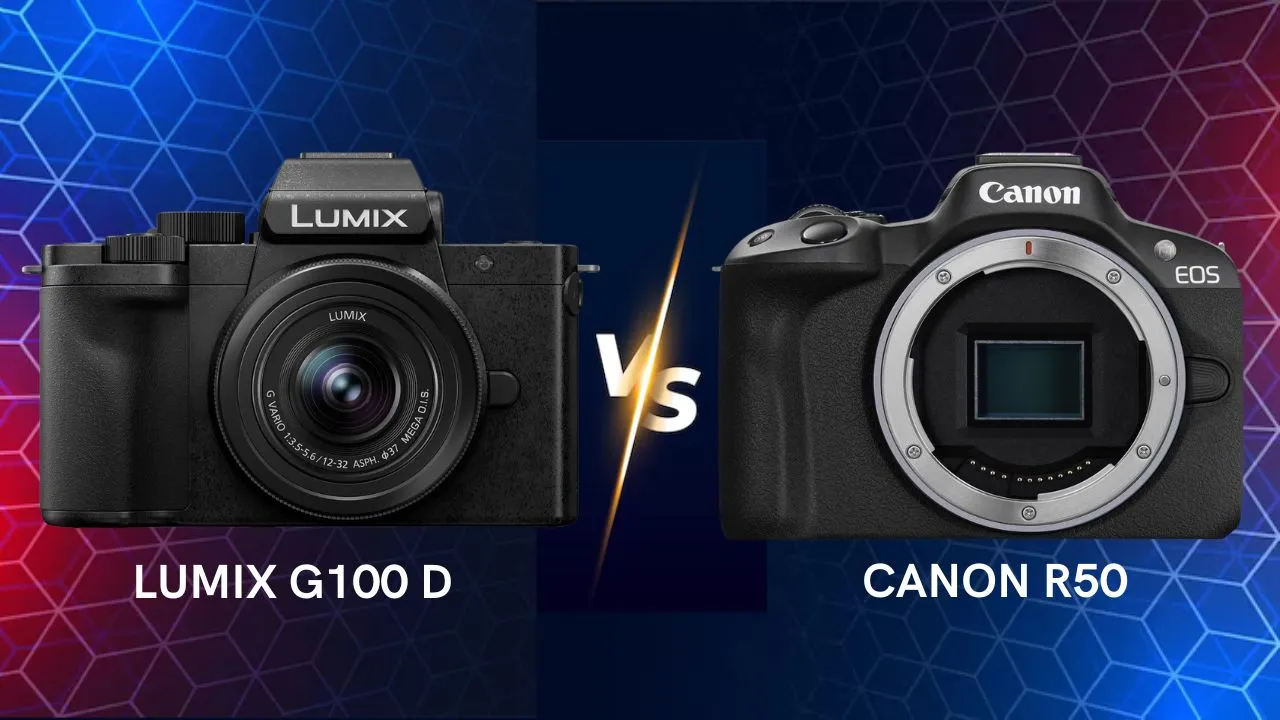
If you’re starting out in photography or YouTube, two cameras that stand out for beginners are the Panasonic Lumix G100D and the Canon EOS R50.
Both are compact, affordable, and built for creators who want to upgrade from their smartphone without spending a fortune.
But which one is better — the Micro Four Thirds Lumix G100D or Canon’s APS-C R50?
Let’s find out.
⚙️ Overview – Vlogger’s Dream vs Hybrid All-Rounder
Panasonic Lumix G100D: A compact Micro Four Thirds mirrorless camera designed primarily for vloggers and travelers. It offers strong stabilization, excellent color science, and a lightweight build.
Canon EOS R50: A newer APS-C mirrorless camera that combines fast autofocus, oversampled 4K video, and Canon’s signature usability.
In short:
-
G100D = Best for simple vlogging and portability.
-
R50 = Best for hybrid creators who want both strong photo and video performance.
📸 Specifications Comparison
| Feature | Panasonic Lumix G100D | Canon EOS R50 |
|---|---|---|
| Release Date | January 2024 | February 2023 |
| Camera Type | Mirrorless (Micro Four Thirds, Vlogging-focused) | Mirrorless (Entry-level APS-C, Hybrid) |
| Sensor | Micro Four Thirds 20.3 MP Live MOS | APS-C 24.2 MP CMOS |
| Image Processor | Venus Engine | DIGIC X |
| Lens Mount | Micro Four Thirds | Canon RF / RF-S |
| ISO Range | 200–25,600 (expandable to 100) | 100–32,000 (expandable to 51,200) |
| In-Body Image Stabilization (IBIS) | No (Electronic IS for video) | No |
| Autofocus System | Contrast-detection AF (49 areas, DFD) | Dual Pixel CMOS AF II (651 zones) |
| AF Subject Recognition | Face & Eye detection (humans) | Humans, animals, birds |
| Continuous Shooting Speed | Up to 10 fps (AF-S), 6 fps (AF-C) | Up to 12 fps (electronic), 15 fps (electronic shutter) |
| Video Recording | Up to 4K 30p | Up to 4K 30p (oversampled from 6K) |
| Video Bit Depth / Color | 8-bit internal | 10-bit via HDMI, 8-bit internal |
| Color Profiles | Standard profiles | Canon Log 3 (via HDMI), HDR PQ |
| RAW Video Output | No | No |
| Recording Limit | 10 min (4K), unlimited in Full HD | No recording limit (thermal dependent) |
| Viewfinder | 3.68M-dot OLED EVF | None |
| LCD Screen | 3.0″ fully articulating touchscreen (1.84M dots) | 3.0″ fully articulating touchscreen (1.62M dots) |
| Touch Functions | Yes (AF, menus) | Yes (AF, tracking, menus) |
| Product Showcase Mode | No | No |
| Background Defocus Button | No | No |
| Body Material | Polycarbonate | Polycarbonate |
| Weather Sealing | No | No |
| Audio Options | Built-in OZO Audio (no mic input) | Mic input |
| Connectivity | Wi-Fi, Bluetooth, USB-C, HDMI | Wi-Fi, Bluetooth, USB-C, HDMI |
| Battery Type | DMW-BLG10 | LP-E17 |
| Battery Life (CIPA) | Approx. 270 shots | Approx. 440 shots |
| Dimensions (W × H × D) | 115.6 × 82.5 × 54.2 mm | 116.3 × 85.5 × 68.8 mm |
| Weight (Body Only) | Approx. 304 g | Approx. 329 g |
| Price (Body Only) | Approx. USD 750 (Check on Amazon) | Approx. USD 680 (Check on Amazon) |
🧱 Build and Handling
Both cameras are designed for beginners and content creators, with compact, lightweight builds that are easy to carry anywhere.
The Lumix G100D is slightly smaller and has a better electronic viewfinder, which feels premium for its price. It also includes Panasonic’s unique OZO Audio system, which automatically adjusts mic direction based on where you’re speaking from — perfect for vlogging.
The Canon R50 feels a bit more modern, with a deeper grip and intuitive button layout. It’s built around Canon’s RF system, giving you access to a much broader range of lenses.
👉 Verdict:
-
G100D: Better built-in audio and EVF quality.
-
R50: Better ergonomics and lens ecosystem.
🎯 Autofocus and Performance
Here’s the big difference.
The Canon R50 uses Canon’s Dual Pixel CMOS AF II, with AI subject detection that tracks people, animals, and vehicles effortlessly — one of the best systems in its class.
The Lumix G100D, however, relies on Panasonic’s older contrast-based DFD AF (Depth from Defocus), which is slower and can hunt during continuous video.
👉 Verdict:
-
R50: Clearly faster and more reliable autofocus.
-
G100D: Decent for stills, but less effective for moving subjects.
🎥 Video Capabilities
Both cameras are marketed toward content creators, but the Canon R50 wins again in terms of flexibility.
Panasonic Lumix G100D
-
4K 30p with a slight crop
-
Full HD 60p recording
-
Directional OZO Audio built-in
-
Excellent color and face detection
-
No mic jack needed for simple vlogging setups
Canon EOS R50
-
4K 30p oversampled from 6K (no crop)
-
Full HD 120p for slow motion
-
External mic input
-
Dual Pixel AF II for smooth focus transitions
-
Clean HDMI output
👉 Verdict:
-
R50: Best for hybrid creators and long-term use.
-
G100D: Best for travel vloggers who value simplicity and portability.
🧠 Image Quality
The Canon R50’s larger APS-C sensor delivers better dynamic range, cleaner low-light performance, and more detail overall.
The G100D, while smaller in sensor size, produces excellent JPEGs with warm Panasonic colors and great skin tones — ideal for quick, unedited content.
👉 Verdict:
-
R50: Sharper, cleaner images with more depth.
-
G100D: Beautiful color science and natural tones.
🔋 Battery and Connectivity
The Canon R50 offers noticeably better battery life at around 440 shots, compared to just 270 on the Lumix G100D.
Both support Wi-Fi and Bluetooth for easy file transfers, but the R50’s Canon Camera Connect app is more polished and reliable for remote control.
👉 Verdict:
-
R50: Better endurance and app experience.
-
G100D: Shorter battery life, but USB charging helps on the go.
💰 Price and Value
While both are budget-friendly hybrid cameras, the Canon R50 delivers superior autofocus, sensor performance, and future expandability at a lower price.
The Lumix G100D, however, remains a solid option for those who prioritize compactness and built-in audio.
👉 Verdict:
-
G100D: Best for vloggers and travel simplicity.
-
R50: Best all-rounder for beginners and hybrid creators.
Check availability and price on Amazon 🛒
📷 Canon R50 — Amazon USA / Amazon Canada / Amazon UK / Amazon Australia
📷 Lumix G100D — Amazon USA / Amazon Canada / Amazon UK / Amazon Australia
Note: camerafight.com participates in the Amazon Associates Program. As an Amazon Associate, we earn from qualifying purchases.
🏁 Final Verdict — Panasonic Lumix G100D vs Canon R50
| Type of User | Recommended Camera |
|---|---|
| Beginner Photographer | Canon R50 |
| Enthusiast Photographer | Canon R50 |
| Portrait Photographer | Canon R50 |
| Travel Photographer | Lumix G100D |
| Vlogger / YouTuber | Lumix G100D |
| Hybrid Creator | Canon R50 |
| Low-Light Shooter | Canon R50 |
| Budget Buyer | Canon R50 |
✅ In short:
-
Choose the Panasonic Lumix G100D if you want a compact, audio-friendly camera for travel vlogs and handheld shooting.
-
Choose the Canon R50 if you want better autofocus, image quality, and future-proof performance.
🛒 Check the Panasonic Lumix G100D price on Amazon
🛒 Check the Canon EOS R50 price on Amazon
🧠 Final Thoughts
The Panasonic Lumix G100D is a great entry point for vloggers who value simplicity, portability, and good built-in audio. It’s perfect for handheld videos, travel, and lifestyle content.
The Canon R50, however, represents the next generation of beginner mirrorless cameras — faster, smarter, and more capable in both photography and video.
Its Dual Pixel AF, oversampled 4K, and stronger lens ecosystem make it the better long-term choice for creators who plan to grow their skills.
If your focus is vlogging and simplicity, get the G100D.
If you want hybrid power and future flexibility, go with the Canon R50 — it’s the better overall camera for most people.