Nikon Z6 III vs Z5 II | Which One Is Best For You?
Nikon Z6 III vs Nikon Z5 II – Which One Is Best for You?
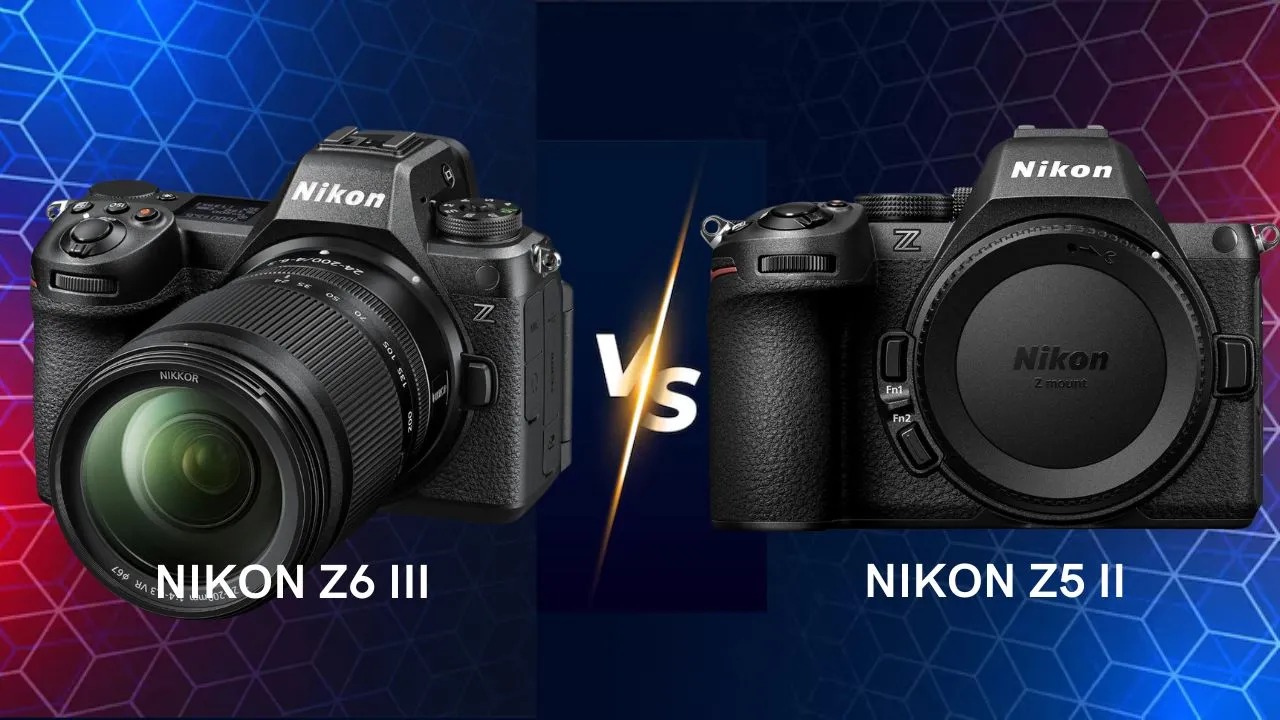
If you’re looking for a Nikon full-frame mirrorless camera, two names will definitely come up — the Nikon Z5 II and the Nikon Z6 III.
At first glance, both cameras look similar and share Nikon’s excellent design language. But under the hood, they serve very different users.
The Z5 II is a fantastic entry-level full-frame option, while the Z6 III is a powerful hybrid tool with professional-grade performance.
So, which one should you buy? Let’s find out.
⚙️ Overview — Entry-Level Excellence vs Next-Gen Power
-
Nikon Z5 II: The affordable gateway into Nikon’s full-frame lineup, designed for photographers who want premium image quality and easy handling at a great price.
-
Nikon Z6 III: A true hybrid camera that brings cutting-edge technology — including a partially stacked sensor, 6K video, and advanced AI autofocus — to Nikon’s mid-range lineup.
In short:
-
Z5 II = Affordable, simple, and reliable for everyday photography.
-
Z6 III = Professional-level performance in a compact, modern body.
📸 Specifications Comparison
| Feature | Nikon Z5 II | Nikon Z6 III |
|---|---|---|
| Sensor | 24.3MP Full-Frame CMOS | 24.5MP Partially Stacked BSI CMOS |
| Processor | EXPEED 7 | EXPEED 7 |
| Autofocus System | 273-point Hybrid AF with AI Subject Detection | 299-point Hybrid AF with Deep-Learning AI |
| Continuous Shooting | 7 fps | 20 fps RAW / 60 fps JPEG |
| In-Body Stabilization (IBIS) | ✅ Yes (up to 6 stops) | ✅ Yes (up to 8 stops) |
| Video Recording | 4K 60p / 10-bit N-Log | 6K 60p / 4K 120p / 10-bit 4:2:2 internal |
| Log / 10-bit Output | ✅ N-Log / HLG via HDMI | ✅ N-Log / HLG / N-RAW / ProRes RAW internal |
| ISO Range | 100–102,400 | 100–204,800 |
| Viewfinder | 3.69M-dot OLED EVF | 5.76M-dot OLED EVF (120Hz) |
| Screen | 3.2” Tilting Touch LCD | 3.2” Fully Articulating 2.1M-dot LCD |
| Card Slots | 2 × SD UHS-II | 1 × CFexpress Type B + 1 × SD UHS-II |
| Battery Life (CIPA) | ~500 shots | ~440 shots |
| Body Build | Magnesium Alloy (Weather-Sealed) | Magnesium Alloy (Weather-Sealed) |
| Weight | ~675 g | 740 g |
| Price (Body Only) | ~$1,499 (check on Amazon) | ~$2,499 (check on Amazon) |
🧱 Build and Handling
Both cameras share Nikon’s signature design — solid, weather-sealed magnesium alloy bodies and an ergonomic grip that feels great in the hand.
The Z5 II is lighter, simpler, and easier to handle for casual or travel photography.
The Z6 III, on the other hand, is built with professional needs in mind — more customizable buttons, a higher-quality EVF, and better cooling for video recording.
👉 Verdict:
-
Z5 II: Easier to carry and use for beginners.
-
Z6 III: More premium handling and display quality for pros.
🎯 Autofocus and Performance
The Z5 II features a reliable hybrid AF system suitable for portraits, landscapes, and travel shots. It performs well in most conditions, but its tracking isn’t as advanced as Nikon’s latest models.
The Z6 III, with its EXPEED 7 processor and AI-based AF, tracks people, animals, vehicles, and more with exceptional accuracy. The partially stacked sensor also delivers faster readout speeds and reduced rolling shutter — a big advantage for sports, wildlife, and action photography.
👉 Verdict:
-
Z5 II: Great AF for general use.
-
Z6 III: Flagship-level autofocus for demanding creators.
🎥 Video Capabilities
This is where the Z6 III completely outshines the Z5 II.
Nikon Z5 II
-
4K 60p (full sensor)
-
10-bit N-Log and HLG via HDMI
-
Ideal for casual video or YouTube content
Nikon Z6 III
-
6K 60p internal recording (N-RAW / ProRes RAW)
-
4K 120p oversampled from 6K
-
10-bit 4:2:2 internal recording
-
Waveform, zebra, and false color tools
If video is part of your workflow, the Z6 III is the clear winner — it’s one of the best hybrid video cameras in its class.
👉 Verdict:
-
Z5 II: Great for occasional video.
-
Z6 III: A serious filmmaking tool.
🧠 Image Quality
Both cameras use similar full-frame sensors, but the Z6 III’s partially stacked design gives it faster readout speeds, improved dynamic range, and slightly better low-light performance.
The Z5 II still delivers excellent image quality for its price — crisp, detailed, and rich in color — but the Z6 III has the edge in shadow detail and processing power.
👉 Verdict:
-
Z5 II: Excellent value and clarity.
-
Z6 III: Superior dynamic range and tonal depth.
🔋 Battery and Storage
The Z5 II wins slightly in efficiency, offering around 500 shots per charge, and its dual SD card slots make it convenient and cost-effective.
The Z6 III, however, includes a CFexpress slot, which is much faster — ideal for 6K recording and continuous RAW bursts.
👉 Verdict:
-
Z5 II: More efficient and cheaper to run.
-
Z6 III: Faster media and better suited for heavy workflows.
💰 Price and Value
The Z5 II is perfect for beginners stepping into the full-frame world — it delivers excellent results without breaking the bank.
The Z6 III, though more expensive, brings a massive leap in performance, video features, and autofocus precision — making it ideal for professionals and hybrid creators.
👉 Verdict:
-
Z5 II: Best for budget-conscious photographers.
-
Z6 III: Best for professionals and content creators.
Check availability and price on Amazon 🛒
📷 Nikon Z6 III — Amazon USA / Amazon Canada / Amazon UK / Amazon Australia
📷 Nikon Z5 II — Amazon USA / Amazon Canada / Amazon UK / Amazon Australia
Note: camerafight.com participates in the Amazon Associates Program. As an Amazon Associate, we earn from qualifying purchases.
🏁 Final Verdict — Nikon Z5 II vs Nikon Z6 III
| Type of User | Recommended Camera |
|---|---|
| Beginner Full-Frame Photographer | Nikon Z5 II |
| Enthusiast Photographer | Nikon Z5 II |
| Professional Photographer | Nikon Z6 III |
| Portrait Photographer | Both (tie) |
| Landscape Photographer | Nikon Z6 III |
| Sports / Wildlife Shooter | Nikon Z6 III |
| Hybrid Creator (Photo + Video) | Nikon Z6 III |
| Travel Photographer | Nikon Z5 II |
| Budget-Conscious Buyer | Nikon Z5 II |
✅ In short:
-
Choose the Nikon Z5 II if you want an affordable, easy-to-use full-frame camera with excellent image quality and dual SD slots.
-
Choose the Nikon Z6 III if you want pro-level performance, 6K RAW video, and cutting-edge autofocus in a single hybrid body.
🧠 Final Thoughts
The Nikon Z5 II and Nikon Z6 III share the same DNA — elegant design, great handling, and Nikon’s natural color science.
But they’re built for different audiences.
If you’re entering full-frame photography or want a dependable travel camera, the Z5 II offers unbeatable value.
If you need next-generation autofocus, professional video tools, and speed for demanding work, the Z6 III is worth every extra dollar.
Either way, both cameras show just how far Nikon’s mirrorless system has come — reliable, powerful, and ready for any creative challenge.