Nikon Z6 III vs Sony A7 IV | Which One Is Best For You?
Nikon Z6 III vs Sony A7 IV – Which One Is Best for You?
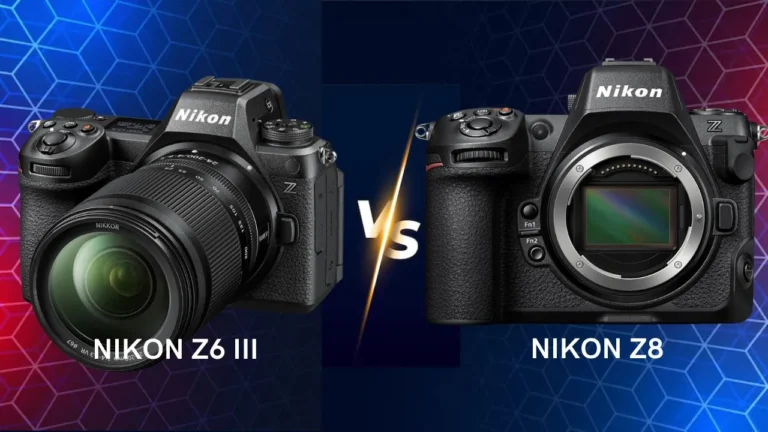
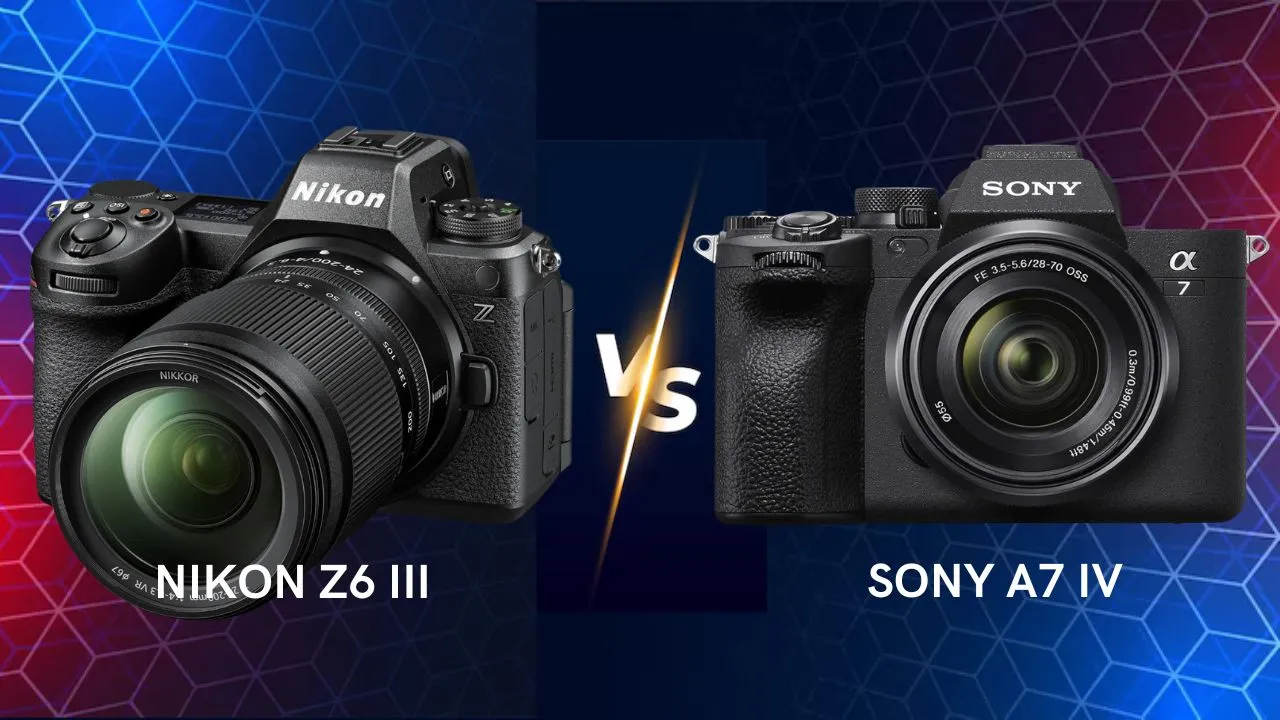
Two of the best mid-range full-frame cameras on the market are the Nikon Z6 III and the Sony A7 IV.
Both offer incredible image quality, advanced autofocus, and powerful video tools — all in compact, professional designs.
If you’re a hybrid creator trying to choose between these two, this detailed comparison will help you decide which one is truly the better fit for your workflow.
⚙️ Overview — Two Hybrid Powerhouses
- Nikon Z6 III: Nikon’s latest hybrid camera with a new 24.5MP partially stacked sensor, EXPEED 7 processor, 6K RAW recording, and high-speed AI autofocus — bringing flagship-level features to a smaller body.
- Sony A7 IV: Sony’s all-purpose mirrorless workhorse with a 33MP sensor, 10-bit 4K video, reliable autofocus, and access to the industry’s largest lens ecosystem.
In short:
- Z6 III = Next-gen hybrid with advanced video and lightning-fast AF.
-
A7 IV = Proven all-rounder with excellent resolution and unbeatable ecosystem.
📸 Specifications Comparison
| Specification | Sony A7 IV | Nikon Z6 III |
|---|---|---|
| Release Date | October 2021 | June 2024 |
| Camera Type | Full-Frame Mirrorless | Full-Frame Mirrorless |
| Sensor | 33 MP BSI-CMOS full-frame | 24.5 MP partially stacked CMOS full-frame |
| Image Processor | BIONZ XR | EXPEED 7 |
| Lens Mount | Sony E-mount | Nikon Z-mount |
| ISO Range | Approx. 100–51,200 (expandable) | Approx. 100–64,000 (expandable) |
| In-Body Image Stabilization (IBIS) | Yes (5-axis) | Yes (5-axis) |
| Autofocus System | Hybrid AF with advanced subject detection | Hybrid AF with enhanced tracking |
| AF Subject Recognition | People, Animals, Vehicles | People, Animals, Vehicles |
| Continuous Shooting Speed | Up to ~10 fps | Up to ~20 fps (RAW) / 120 fps (JPG crop) |
| Video Recording | 4K up to 60p | 6K up to 60p, 4K up to 120p |
| Video Bit Depth / Color | 10-bit color (via S-Log3) | 10-bit with N-Log / ProRes options |
| Color Profiles | S-Log3, S-Cinetone | N-Log, Flat, Standard |
| RAW Video Output | Yes (external) | Yes (internal + external support) |
| Recording Limit | Standard limits (varies by settings) | Extended record times |
| Viewfinder | Built-in EVF (~3.69M dots) | Built-in EVF (~5.76M dots) |
| LCD Screen | 3.0″ fully articulating touchscreen | 3.2″ fully articulating touchscreen |
| Touch Functions | Full touch support | Full touch support |
| Product Showcase Mode | No specific mode (photo/video profiles) | No dedicated showcase |
| Background Defocus Button | No dedicated button | No dedicated button |
| Body Material | Magnesium alloy framework | Magnesium alloy framework |
| Weather Sealing | Yes (robust sealing) | Yes (pro-grade sealing) |
| Audio Options | Mic input, headphone jack | Mic input, headphone jack |
| Connectivity | Wi-Fi, Bluetooth, USB-C, HDMI | Wi-Fi, Bluetooth, USB-C, HDMI |
| Battery Type | NP-FZ100 | EN-EL15c |
| Battery Life (CIPA) | ~580–600 shots | ~380–450 shots |
| Dimensions (W × H × D) | ~131 × 96 × 80 mm | ~138 × 101 × 74 mm |
| Weight (Body Only) | ~658 g | ~750 g |
| Approx. Price (Body Only) | ~€1,838 – €1,999 (check on Amazon) | ~€2,341 – €2,494 (check on Amazon) |
🧱 Build and Handling
Both cameras feel premium, professional, and extremely solid.
The Nikon Z6 III offers a deeper grip, larger buttons, and an exceptional 5.76M-dot EVF — among the best in its class. It’s a little heavier, but the handling feels perfectly balanced, even with large lenses.
The Sony A7 IV is slightly lighter and more compact. Its ergonomics are much improved over the A7 III, and the fully articulated screen makes it ideal for vlogging and creative angles.
👉 Verdict:
- Z6 III: More robust and better EVF.
- A7 IV: Lighter and slightly more compact for travel.
🎯 Autofocus and Performance
Both cameras are incredibly capable in autofocus, but they take slightly different approaches.
The Sony A7 IV uses 759 phase-detect points with Sony’s famous Real-time Tracking and Eye AF system. It’s one of the most consistent AF systems available, especially for portraits, events, and fast-moving subjects.
The Nikon Z6 III, however, introduces AI-powered subject detection that rivals Sony’s system — tracking humans, animals, vehicles, and more. The new partially stacked sensor also enables faster readout speeds, giving the Nikon a clear edge in responsiveness and blackout-free bursts.
👉 Verdict:
- Z6 III: Faster readout and better tracking intelligence.
- A7 IV: More refined AF consistency across genres.
🎥 Video Capabilities
This is where the Z6 III takes the lead.
Nikon Z6 III
- 6K 60p internal recording (N-RAW / ProRes RAW)
- 4K 120p oversampled from 6K
- 10-bit 4:2:2 internal with waveform, zebras, and false color tools
- Excellent dynamic range and rolling shutter control
Sony A7 IV
- 4K 30p full-frame / 4K 60p (1.5x Super 35 crop)
- 10-bit 4:2:2 internal
- S-Log3 and S-Cinetone for cinematic looks
- Great color and strong heat management
While the A7 IV remains a strong video performer, the Z6 III’s 6K internal RAW recording puts it in a different league for professionals who want maximum flexibility.
👉 Verdict:
- Z6 III: Best for advanced video creators and filmmakers.
- A7 IV: Best for hybrid users who prioritize ease and color workflow.
🧠 Image Quality
The Sony A7 IV delivers slightly more resolution (33MP vs 24.5MP), giving it an edge in cropping and detail for landscape or commercial photographers.
The Nikon Z6 III counters with a partially stacked BSI sensor, offering cleaner shadows, faster processing, and improved dynamic range.
Both produce stunning color and tone, though Canon’s and Nikon’s color profiles are generally more natural, while Sony’s are slightly cooler out of the box.
👉 Verdict:
- Z6 III: Better dynamic range and low-light performance.
- A7 IV: More resolution for detailed work.
🔋 Battery and Storage
The A7 IV leads in battery life, rated at around 580 shots per charge versus 440 shots on the Z6 III.
Both offer dual card slots, but Nikon’s CFexpress Type B is faster and better suited for 6K recording.
👉 Verdict:
- Z6 III: Faster media and better for 6K workflows.
- A7 IV: Longer battery life and more efficient for all-day shoots.
💰 Price and Value
Both cameras sit at roughly the same price — around $2,499 body only — making this a fair, feature-for-feature comparison.
The Z6 III offers newer technology, faster burst rates, 6K RAW video, and one of the best EVFs in its class.
The A7 IV, meanwhile, gives you slightly higher resolution, excellent color profiles, and access to Sony’s massive E-mount ecosystem, which remains a huge advantage for lens variety and third-party support.
👉 Verdict:
- Z6 III: Best for creators who need power, speed, and flexibility.
-
A7 IV: Best for those who value lens options, reliability, and color workflow.
Check availability and price on Amazon 🛒
📷 Sony A7 IV — Amazon USA / Amazon Canada / Amazon UK / Amazon Australia
📷 Nikon Z6 III — Amazon USA / Amazon Canada / Amazon UK / Amazon Australia
Note: camerafight.com participates in the Amazon Associates Program. As an Amazon Associate, we earn from qualifying purchases.
🏁 Final Verdict — Nikon Z6 III vs Sony A7 IV
| Type of User | Recommended Camera |
|---|---|
| Beginner Full-Frame Photographer | Sony A7 IV |
| Enthusiast Photographer | Sony A7 IV |
| Professional Photographer | Both (tie) |
| Sports / Wildlife Shooter | Nikon Z6 III |
| Portrait Photographer | Sony A7 IV |
| Hybrid Creator (Photo + Video) | Nikon Z6 III |
| Travel Photographer | Sony A7 IV |
| Filmmaker / YouTuber | Nikon Z6 III |
| Studio / Commercial Photographer | Sony A7 IV |
✅ In short:
-
Choose the Nikon Z6 III if you want next-generation hybrid performance, 6K RAW video, and cutting-edge autofocus.
- Choose the Sony A7 IV if you want superb color science, higher resolution, and the unmatched Sony lens ecosystem.
🧠 Final Thoughts
Both the Nikon Z6 III and Sony A7 IV represent the best of modern full-frame mirrorless design — versatile, reliable, and ready for both photography and filmmaking.
The Z6 III pushes boundaries with 6K internal recording, faster processing, and class-leading EVF performance, making it ideal for professionals and hybrid creators.
The A7 IV, on the other hand, remains a benchmark for reliability and image quality, with unbeatable lens choice and color science that many creators still prefer.
If you’re a filmmaker or hybrid shooter, go with the Z6 III.
If you’re a photographer who values consistency, flexibility, and lens variety, the A7 IV remains one of the best investments in the industry.