Nikon Z6 II vs Z8 | Which One Is Best For You?
Nikon Z6 II vs Nikon Z8 – Which One Is Best for You?
The Nikon Z6 II has been one of the most balanced full-frame cameras on the market — fast, affordable, and reliable.
Then came the Nikon Z8, a professional-grade hybrid powerhouse that borrows much of its technology from the flagship Z9.
But do you really need the Z8’s pro-level performance, or is the Z6 II still the smarter choice for most photographers and creators?
Let’s compare them side by side to find out.
⚙️ Overview — Mid-Range Hybrid vs Professional Powerhouse
-
Nikon Z6 II: A 24.5MP full-frame hybrid that offers excellent image quality, dual processors, and strong 4K video features in a compact, affordable package.
-
Nikon Z8: A true professional mirrorless camera with a 45.7MP stacked sensor, lightning-fast autofocus, blackout-free shooting, and 8K video recording — all at a lower price than the flagship Z9.
In short:
-
Z6 II = Efficient, versatile, and great value for hybrid creators.
-
Z8 = Top-tier Nikon technology built for professionals who need speed and power.
📸 Specifications Comparison
| Feature | Nikon Z6 II | Nikon Z8 |
|---|---|---|
| Sensor | 24.5MP Full-Frame BSI CMOS | 45.7MP Full-Frame Stacked BSI CMOS |
| Processor | Dual EXPEED 6 | Dual EXPEED 7 |
| Autofocus System | 273-point Hybrid AF | 493-point AF with Deep-Learning AI Detection |
| Continuous Shooting | 14 fps (mechanical) | 20 fps RAW / 120 fps JPEG (no blackout) |
| In-Body Stabilization (IBIS) | ✅ Yes (up to 5 stops) | ✅ Yes (up to 6 stops) |
| Video Recording | 4K 60p (1.5x crop) / 4K 30p (no crop) | 8K 60p / 4K 120p / 10-bit internal / N-RAW / ProRes RAW |
| Log / 10-bit Output | ✅ N-Log / HLG via HDMI | ✅ N-Log / HLG / 10-bit internal recording |
| ISO Range | 100–51,200 | 64–25,600 (expandable 32–102,400) |
| Viewfinder | 3.69M-dot OLED EVF | 3.69M-dot Quad VGA EVF (Blackout-Free, 120Hz) |
| Screen | 3.2” Tilting Touch LCD | 3.2” 4-axis Tilting Touch LCD |
| Card Slots | 1 × CFexpress Type B + 1 × SD UHS-II | 2 × CFexpress Type B |
| Battery Life (CIPA) | ~410 shots | ~330 shots |
| Body Build | Magnesium Alloy (Weather-Sealed) | Magnesium Alloy + Carbon Fiber (Pro Build, Fully Sealed) |
| Weight | 705 g | 910 g |
| Price (Body Only) | ~$1,999 (check on Amazon) | ~$3,999 (check on Amazon) |
🧱 Build and Handling
The Z6 II is lighter, simpler, and much easier to handle for long shoots or travel. It’s built solidly, with Nikon’s excellent ergonomics and weather sealing, but it’s designed for portability and balance.
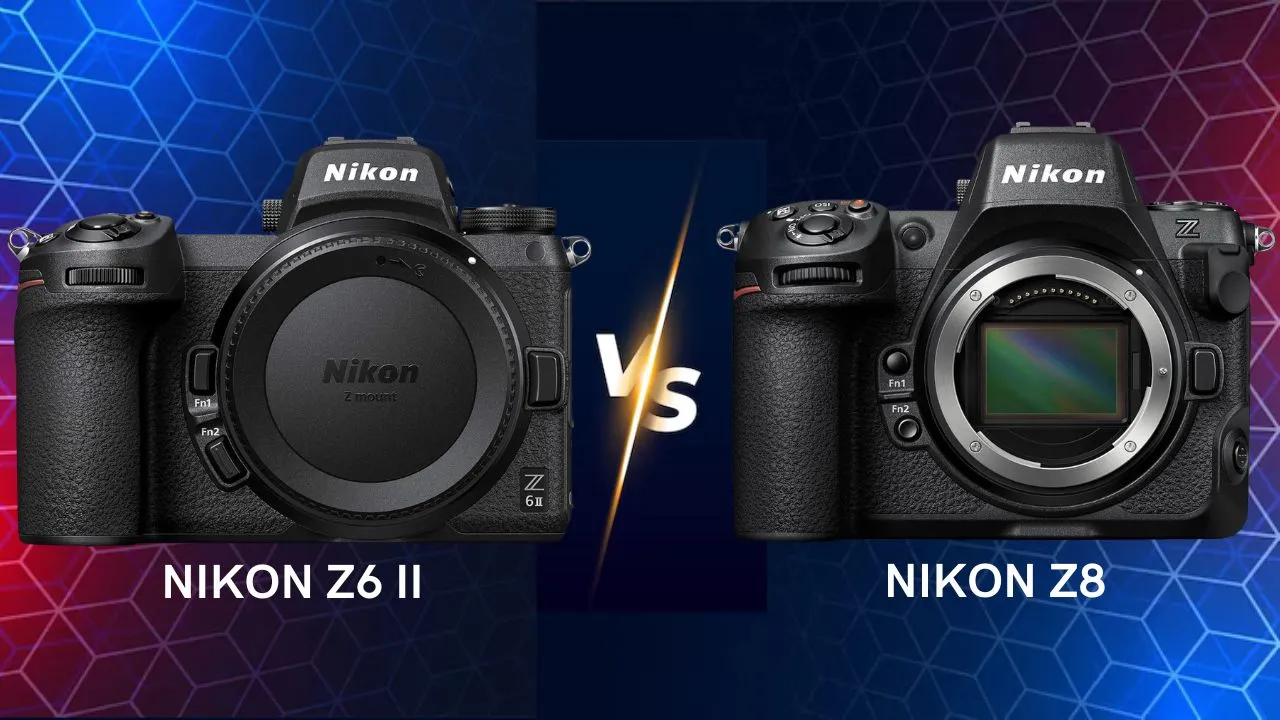
The Z8, on the other hand, feels like a professional tool — robust, slightly heavier, and built for serious field use. Its carbon fiber and magnesium alloy chassis is fully weather-sealed, and the grip design is nearly identical to the Z9.
The Z8 also includes advanced ports (full-size HDMI, LAN connectivity, dual CFexpress slots) and a blackout-free electronic viewfinder that delivers a true “what-you-see-is-what-you-get” experience.
👉 Verdict:
-
Z6 II: Compact and travel-friendly.
-
Z8: Professional-grade build with more connectivity and durability.
🎯 Autofocus and Performance
This is one of the biggest differences between the two.
The Z6 II’s autofocus system is very capable, with 273 points and solid eye and animal detection. It’s fast, accurate, and reliable for general use.
But the Z8 operates on a completely different level — powered by the EXPEED 7 processor, it delivers real-time subject tracking powered by deep-learning AI.
The Z8 can recognize people, animals, vehicles, planes, and even insects, locking on instantly and maintaining perfect focus during bursts or video.
It also shoots 20 fps RAW with full resolution and 120 fps JPEGs with zero viewfinder blackout — making it a true professional sports and wildlife camera.
👉 Verdict:
-
Z6 II: Great AF for most users.
-
Z8: Elite performance for demanding pros.
🎥 Video Capabilities
If video is part of your workflow, the Z8 is in a completely different league.
Nikon Z6 II
-
4K 30p (full sensor) / 4K 60p (1.5x crop)
-
10-bit N-Log / HLG output via HDMI
-
Optional external RAW via Ninja V recorder
Nikon Z8
-
8K 60p (N-RAW / ProRes RAW internal)
-
4K 120p oversampled from 8K
-
Full 10-bit 4:2:2 internal recording
-
N-Log, HLG, and ProRes HQ formats
-
Waveform, zebras, and false color tools
-
Active cooling system for long recording sessions
The Z6 II is great for content creators and hybrid photographers, but the Z8 is a professional cinema-grade tool capable of delivering broadcast-quality results — without any external recorder.
👉 Verdict:
-
Z6 II: Perfect for hybrid creators and YouTubers.
-
Z8: Ideal for professional filmmakers and videographers.
🧠 Image Quality
Both cameras produce stunning results, but they differ in intent.
The Z6 II’s 24.5MP sensor offers excellent low-light performance, dynamic range, and color accuracy — ideal for weddings, events, and general photography.
The Z8’s 45.7MP stacked sensor, however, delivers double the resolution with faster readout, superior detail, and cleaner tones.
The stacked design also nearly eliminates rolling shutter, giving the Z8 a huge advantage for sports, wildlife, and video work.
👉 Verdict:
-
Z6 II: Best for low-light and everyday photography.
-
Z8: Best for high-resolution work and professional production.
🔋 Battery and Storage
The Z6 II offers better endurance — around 410 shots per charge — and uses affordable SD + CFexpress cards.
The Z8, while more power-hungry, supports dual CFexpress slots to handle massive RAW and 8K video files.
Both can charge and operate via USB-C, but the Z8’s power draw is much higher under heavy video or burst use.
👉 Verdict:
-
Z6 II: More efficient and affordable to run.
-
Z8: Built for professional workloads and large data handling.
💰 Price and Value
The Z6 II remains one of the best-value full-frame hybrid cameras in Nikon’s lineup.
The Z8, while twice the price, gives you performance nearly identical to the flagship Z9 in a smaller, more manageable body.
If you shoot fast-moving subjects, high-end video, or commercial work, the Z8 justifies every dollar. For most creators, however, the Z6 II still hits the perfect balance between performance and price.
👉 Verdict:
-
Z6 II: Best value for hybrid and everyday professionals.
-
Z8: Best long-term investment for serious pros.
Check availability and price on Amazon 🛒
📷 Nikon Z6 II — Amazon USA / Amazon Canada / Amazon UK / Amazon Australia
📷 Nikon Z8 — Amazon USA / Amazon Canada / Amazon UK / Amazon Australia
Note: camerafight.com participates in the Amazon Associates Program. As an Amazon Associate, we earn from qualifying purchases.
🏁 Final Verdict — Nikon Z6 II vs Nikon Z8
| Type of User | Recommended Camera |
|---|---|
| Beginner Full-Frame Photographer | Nikon Z6 II |
| Enthusiast Photographer | Nikon Z6 II |
| Professional Photographer | Nikon Z8 |
| Landscape Photographer | Nikon Z8 |
| Sports / Wildlife Photographer | Nikon Z8 |
| Hybrid Creator (Photo + Video) | Nikon Z8 |
| Travel Photographer | Nikon Z6 II |
| Budget-Conscious Buyer | Nikon Z6 II |
✅ In short:
-
Choose the Nikon Z6 II if you want a compact, affordable hybrid camera with great image quality and performance for everyday use.
-
Choose the Nikon Z8 if you want pro-level speed, autofocus, and 8K video power — everything Nikon can offer in one body.
🧠 Final Thoughts
The Nikon Z6 II and Nikon Z8 may share the same DNA, but they’re made for entirely different photographers.
The Z6 II remains the perfect all-rounder — lightweight, reliable, and budget-friendly.
The Z8, however, represents Nikon’s full creative potential — combining Z9 performance with a smaller, more flexible design.
If you want a full-frame hybrid that does everything well, the Z6 II is still one of the smartest choices in Nikon’s lineup.
If you want uncompromising power and professional results, the Z8 is easily one of the best cameras Nikon has ever made.