Nikon Z50 vs Canon R50 | Which One Is Best For You?
Nikon Z50 vs Canon R50: Which One Is Best for You?
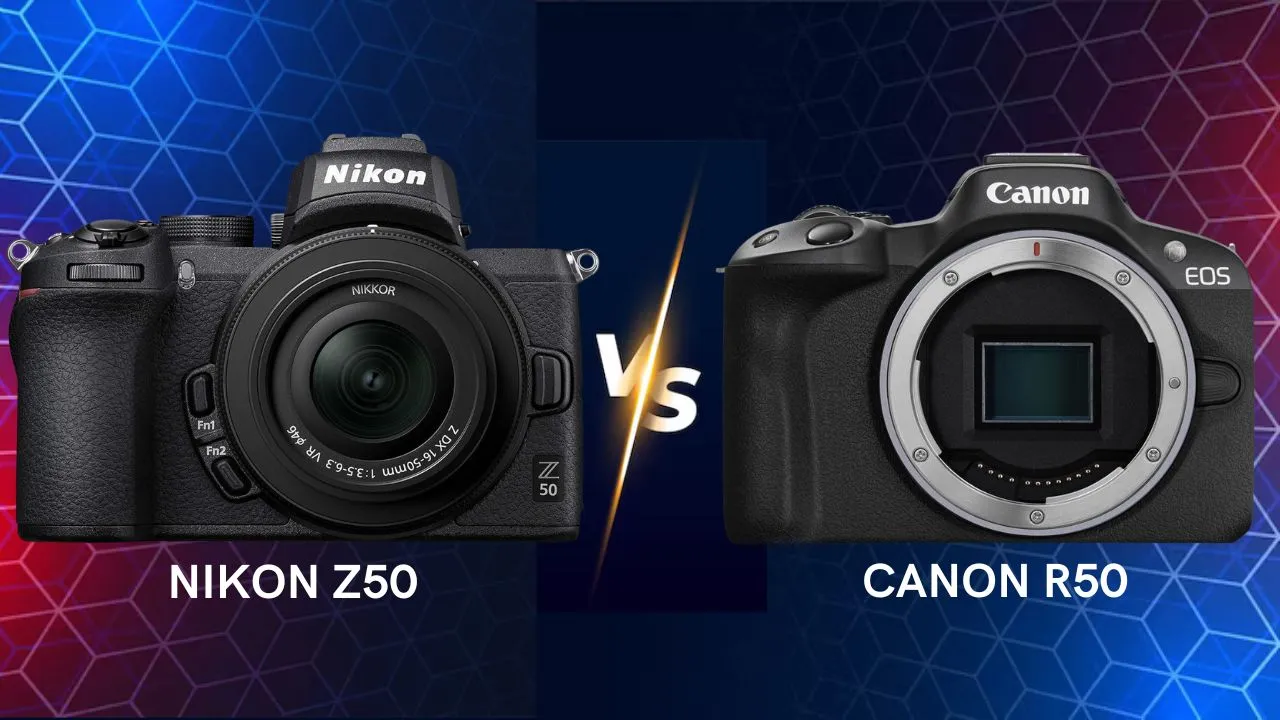
The Nikon Z50 and Canon EOS R50 are two excellent APS-C mirrorless cameras that appeal to beginner and enthusiast photographers alike.
Both offer high image quality, lightweight designs, and strong 4K video performance — but they have very different strengths.
The Nikon Z50 focuses on ergonomics and build quality, while the Canon R50 delivers smarter autofocus and hybrid performance for creators.
So, which one should you buy? Let’s take a closer look.
⚙️ Overview – Classic Handling vs Smart Hybrid Tech
-
Nikon Z50: Compact, well-built camera with fantastic ergonomics and Nikon’s classic photo-focused design.
-
Canon R50: Smart, lightweight, and ideal for vloggers and hybrid creators who want fast autofocus and high-quality 4K video.
In short:
-
Z50 = Great ergonomics and stills performance.
-
R50 = Better autofocus and video flexibility.
📸 Specifications Comparison
| Feature | Nikon Z50 | Canon EOS R50 |
|---|---|---|
| Release Date | August 2019 | February 2023 |
| Camera Type | Mirrorless (APS-C, Hybrid) | Mirrorless (Entry-level APS-C, Hybrid) |
| Sensor | APS-C 20.9 MP CMOS | APS-C 24.2 MP CMOS |
| Image Processor | EXPEED 6 | DIGIC X |
| Lens Mount | Nikon Z-mount | Canon RF / RF-S |
| ISO Range | 100–51,200 (expandable to 204,800) | 100–32,000 (expandable to 51,200) |
| In-Body Image Stabilization (IBIS) | No | No |
| Autofocus System | Hybrid phase-detection AF (209 points) | Dual Pixel CMOS AF II (651 zones) |
| AF Subject Recognition | Humans, animals (Eye AF via firmware) | Humans, animals, birds |
| Continuous Shooting Speed | Up to 11 fps | Up to 12 fps (electronic), 15 fps (electronic shutter) |
| Video Recording | Up to 4K 30p | Up to 4K 30p (oversampled from 6K) |
| Video Bit Depth / Color | 8-bit internal | 10-bit via HDMI, 8-bit internal |
| Color Profiles | Flat profile | Canon Log 3 (via HDMI), HDR PQ |
| RAW Video Output | No | No |
| Recording Limit | No recording limit | No recording limit (thermal dependent) |
| Viewfinder | 2.36M-dot OLED EVF | None |
| LCD Screen | 3.2″ tilting touchscreen (1.04M dots) | 3.0″ fully articulating touchscreen (1.62M dots) |
| Touch Functions | Yes (AF, menus) | Yes (AF, tracking, menus) |
| Product Showcase Mode | No | No |
| Background Defocus Button | No | No |
| Body Material | Magnesium alloy | Polycarbonate |
| Weather Sealing | No | No |
| Audio Options | Mic input | Mic input |
| Connectivity | Wi-Fi, Bluetooth, USB-C, HDMI | Wi-Fi, Bluetooth, USB-C, HDMI |
| Battery Type | EN-EL25 | LP-E17 |
| Battery Life (CIPA) | Approx. 320 shots | Approx. 440 shots |
| Dimensions (W × H × D) | 126.5 × 93.5 × 60 mm | 116.3 × 85.5 × 68.8 mm |
| Weight (Body Only) | Approx. 450 g | Approx. 329 g |
| Price (Body Only) | Approx. USD 860 (used market) | Approx. USD 680 (Check on Amazon) |
🧱 Build and Handling
The Nikon Z50 stands out immediately for its excellent handling and robust build.
It features a deep, comfortable grip and weather-sealed magnesium alloy construction — something rarely seen in its price range.
The Canon R50 is smaller, lighter, and designed with portability in mind.
It’s built mostly from polycarbonate, but feels solid enough for everyday use. The fully articulating touchscreen makes it much better for vlogging or filming yourself.
👉 Verdict:
-
Z50: Best ergonomics and durability.
-
R50: Best portability and screen flexibility.
🎯 Autofocus and Performance
This is where the Canon R50 pulls ahead.
Powered by the DIGIC X processor and Canon’s Dual Pixel CMOS AF II, it offers lightning-fast autofocus with eye, animal, and vehicle tracking, all inherited from Canon’s high-end R6 Mark II and R7.
The Nikon Z50, while reliable, uses an older 209-point AF system. It’s accurate for stills but not as fast or advanced when tracking moving subjects.
👉 Verdict:
-
Z50: Reliable but basic autofocus.
-
R50: Class-leading AF for its price.
🎥 Video Capabilities
Both cameras shoot excellent 4K video, but the Canon R50 offers more flexibility for creators.
Nikon Z50
-
4K 30p (no crop)
-
Full HD 120p
-
20-minute recording limit
-
Tilting screen (not side-flip)
Canon R50
-
4K 30p oversampled from 6K (very sharp)
-
Full HD 120p slow motion
-
No recording limit
-
C-Log 3 and HDR PQ for professional color grading
-
Fully articulating touchscreen
The R50 is the clear choice for vloggers, YouTubers, and anyone shooting cinematic content.
The Z50 is great for casual clips and travel videos but lacks log profiles and long-recording flexibility.
👉 Verdict:
-
Z50: Simpler video setup for travel and casual users.
-
R50: Better overall hybrid and video performance.
🧠 Image Quality
Both cameras produce excellent results, but the Canon R50’s 24.2MP sensor offers more resolution and slightly better dynamic range.
The Z50’s 20.9MP sensor, however, delivers Nikon’s signature color science — rich, natural tones that many photographers prefer straight out of camera.
👉 Verdict:
-
Z50: Beautiful color rendering and tonality.
-
R50: Sharper detail and more editing flexibility.
🔋 Battery and Storage
The Canon R50 has better endurance, averaging 440 shots per charge, while the Z50 manages around 320 shots.
Storage-wise, the R50 supports UHS-II SD cards, which are faster for continuous shooting and 4K video.
The Z50 uses slower UHS-I cards, but it still handles burst shooting efficiently.
👉 Verdict:
-
Z50: Decent battery life for photography.
-
R50: Better endurance and faster card support.
💰 Price and Value
The Z50 costs a bit more but offers better build quality and ergonomics, making it a long-lasting camera body.
The R50, however, delivers incredible performance for its price — especially for creators who need Canon’s autofocus and video power.
👉 Verdict:
-
Z50: Best for photographers who value handling and durability.
-
R50: Best all-round value for creators and beginners.
Check availability and price on Amazon 🛒
📷 Canon R50 — Amazon USA / Amazon Canada / Amazon UK / Amazon Australia
📷 Nikon Z50 — Amazon USA / Amazon Canada / Amazon UK / Amazon Australia
Note: camerafight.com participates in the Amazon Associates Program. As an Amazon Associate, we earn from qualifying purchases.
🏁 Final Verdict — Nikon Z50 vs Canon R50
| Type of User | Recommended Camera |
|---|---|
| Beginner Photographer | Canon R50 |
| Travel / Street Photographer | Nikon Z50 |
| Portrait / Lifestyle Shooter | Canon R50 |
| Hybrid Creator (Photo + Video) | Canon R50 |
| YouTuber / Vlogger | Canon R50 |
| Enthusiast Photographer | Nikon Z50 |
| Budget-Conscious Buyer | Canon R50 |
✅ In short:
-
Choose the Nikon Z50 if you want a solid, durable camera with excellent ergonomics and classic Nikon color science.
-
Choose the Canon R50 if you want a faster, smarter, and more affordable hybrid camera with next-gen autofocus and sharp oversampled 4K.
🧠 Final Thoughts
Both the Nikon Z50 and Canon R50 are outstanding APS-C cameras that deliver excellent image quality and modern performance.
The Z50 remains a top choice for photographers who care about handling, build quality, and shooting comfort — it feels like a mini DSLR in the best way.
The R50, on the other hand, is Canon’s compact hybrid gem — small, fast, and perfect for creators who want to shoot, vlog, and edit without limits.
If you’re primarily a photographer, you’ll love the Nikon Z50.
If you’re a content creator or hybrid shooter, the Canon R50 is clearly the better all-round choice — and one of the best budget mirrorless cameras available today.