Nikon Z50 II vs Canon R7 | Which One Is Best For You?
Nikon Z50 II vs Canon R7: Which One Is Best for You?
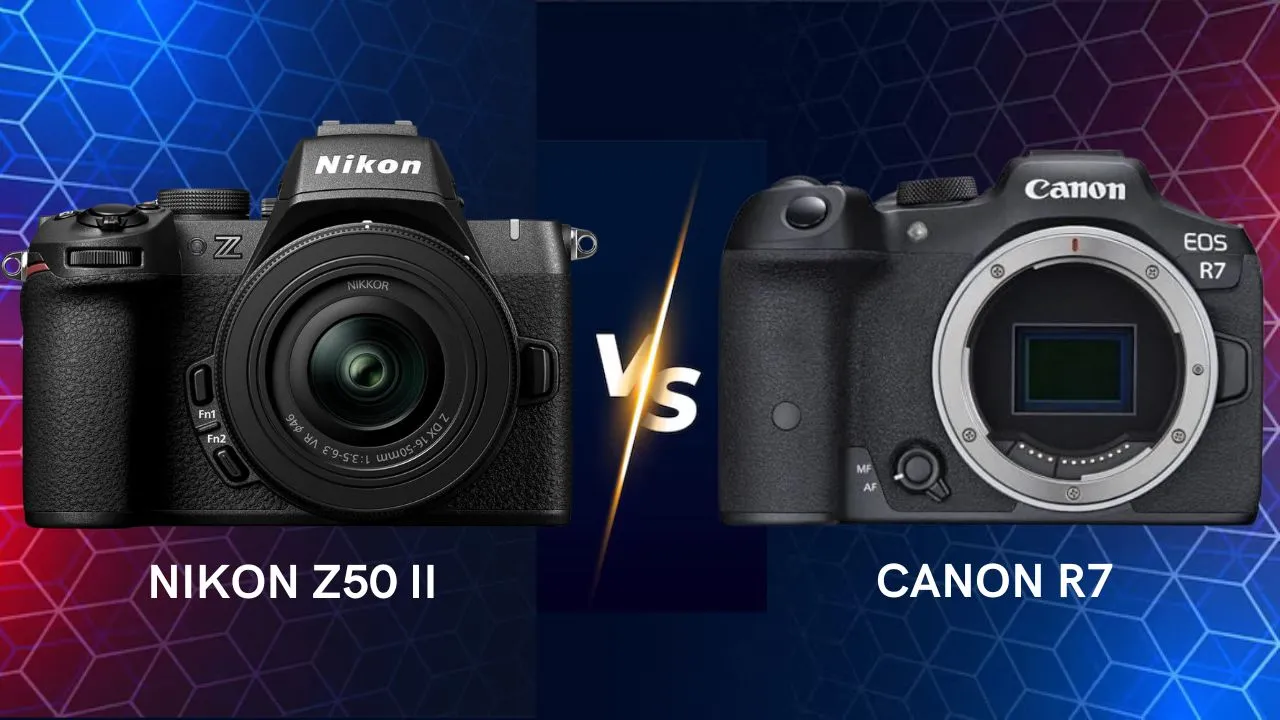
The Nikon Z50 II represents Nikon’s latest step forward in APS-C mirrorless cameras, focusing on smarter autofocus, improved video features, and a more creator-friendly experience.
On the other side, the Canon EOS R7 is Canon’s high-performance APS-C flagship — built for speed, resolution, and advanced hybrid shooting.
Both cameras target enthusiasts and advanced users, but they are designed with very different priorities. Let’s break down how they compare and which one is right for you.
⚙️ Overview — Smart All-Rounder vs High-Performance APS-C
Nikon Z50 II
A modern APS-C mirrorless camera with AI-powered autofocus, solid video tools, and a compact, travel-friendly design.
Canon EOS R7
A performance-oriented APS-C powerhouse with high resolution, class-leading burst speeds, and in-body image stabilization.
In short:
-
Z50 II = Balanced, compact, and creator-friendly
-
R7 = Fast, powerful, and performance-driven
📸 Specifications Comparison
| Specification | Nikon Z50 II | Canon EOS R7 |
|---|---|---|
| Release date | October 2024 | June 2022 |
| Camera type | Mirrorless | Mirrorless |
| Sensor format | APS-C / DX (23.5 × 15.7 mm) | APS-C (22.3 × 14.8 mm) |
| Sensor type | CMOS | CMOS |
| Resolution | 20.9 MP | 32.5 MP |
| Image processor | EXPEED 7 | DIGIC X |
| ISO range | 100–51,200 (expandable to 204,800) | 100–32,000 (expandable to 51,200) |
| Autofocus system | Hybrid AF with AI subject detection (209 points) | Dual Pixel CMOS AF II (651 zones) |
| Continuous shooting | Up to 11 fps | 15 fps (mechanical), 30 fps (electronic) |
| Video recording | 4K up to 60p (10-bit via HDMI, 8-bit internal) | 4K up to 60p (oversampled from 7K, 10-bit internal) |
| Viewfinder | 2.36M-dot OLED EVF | 2.36M-dot OLED EVF |
| LCD screen | 3.2″ vari-angle touchscreen, 1.62M dots | 3.0″ vari-angle touchscreen, 1.62M dots |
| IBIS | No | Yes, 5-axis (up to 7 stops) |
| Memory card slots | 1× SD (UHS-II) | 2× SD (UHS-II) |
| Battery life (CIPA) | Approx. 450 shots | Approx. 660 shots |
| Weight (with battery & card) | Approx. 525 g | Approx. 612 g |
| Launch price (body only) | Approx. USD 1,100 (check on Amazon) | Approx. USD 1,500 (check on Amazon) |
🧱 Build and Handling
The Z50 II is compact and lightweight, making it ideal for travel and everyday shooting. Its fully vari-angle screen and simplified controls clearly target hybrid shooters and content creators.
The R7 feels more like a professional tool. It’s larger, more robust, weather-sealed, and designed for long sessions with heavier lenses. The additional control dials and deeper customization options appeal to experienced photographers.
👉 Verdict:
-
Z50 II: Portable and creator-focused
-
R7: More robust and professional
🎯 Autofocus and Performance
Both cameras offer excellent autofocus, but their strengths differ.
-
Z50 II: AI subject detection for people, animals, and birds, with smooth tracking and reliable Eye AF
-
R7: Industry-leading Dual Pixel AF II with extremely fast subject acquisition and tracking
When it comes to speed, the R7 clearly leads with higher burst rates, making it a favorite for sports and wildlife photographers.
👉 Verdict:
-
Z50 II: Smart and reliable AF
-
R7: Faster and more powerful AF for action
🎥 Video Capabilities
Video is where the two cameras diverge in philosophy.
The Z50 II offers strong hybrid features with 4K 60p, clean HDMI output, and excellent AF tracking — ideal for YouTubers and casual filmmakers.
The R7, however, adds:
-
Oversampled 4K from 7K
-
Internal 10-bit recording
-
IBIS for smoother handheld footage
This gives the R7 a clear advantage for serious video creators.
👉 Verdict:
-
Z50 II: Great for hybrid creators
-
R7: Better for advanced video production
🧠 Image Quality
The R7’s 32.5 MP sensor delivers significantly more detail, making it ideal for wildlife, sports, and cropping-heavy workflows.
The Z50 II’s 20.9 MP sensor still produces excellent image quality with cleaner high-ISO performance and smaller file sizes.
👉 Verdict:
-
Z50 II: Balanced image quality and efficiency
-
R7: Higher resolution and more detail
🔋 Battery and Storage
The R7 wins clearly here with:
-
Longer battery life
-
Dual UHS-II card slots for redundancy
The Z50 II improves over previous Nikon APS-C models but remains more limited for long professional shoots.
👉 Verdict:
-
Z50 II: Adequate for daily use
-
R7: Better for demanding workflows
💰 Price and Value
The Z50 II offers excellent value for money and modern features at a lower price point.
The R7 costs more but delivers flagship-level APS-C performance.
👉 Verdict:
-
Z50 II: Best value and portability
-
R7: Best performance regardless of price
Check availability and price on Amazon 🛒
📷 Canon R7 — Amazon USA / Amazon Canada / Amazon UK / Amazon Australia
📷 Nikon Z50 II — Amazon USA / Amazon Canada / Amazon UK / Amazon Australia
Note: camerafight.com participates in the Amazon Associates Program. As an Amazon Associate, we earn from qualifying purchases.
🏁 Final Verdict — Nikon Z50 II vs Canon R7
| Type of User | Recommended Camera |
|---|---|
| Beginner / Enthusiast | Nikon Z50 II |
| Travel / Street Photographer | Nikon Z50 II |
| Hybrid Creator (Photo + Video) | Nikon Z50 II |
| Sports / Wildlife Photographer | Canon EOS R7 |
| Professional Photographer | Canon EOS R7 |
| YouTuber / Vlogger | Nikon Z50 II |
| Long-Term System Builder | Canon EOS R7 |
✅ In short:
-
Choose the Nikon Z50 II if you want a compact, affordable APS-C camera with modern autofocus and strong hybrid features.
-
Choose the Canon EOS R7 if you need maximum speed, resolution, IBIS, and professional-grade performance.
🧠 Final Thoughts
The Nikon Z50 II is a smart, modern APS-C camera that excels in everyday photography and content creation.
The Canon EOS R7, on the other hand, is a no-compromise APS-C powerhouse — closer to a mini professional camera than an entry-level model.
If portability, value, and hybrid shooting matter most, the Z50 II is the better choice.
If performance, speed, and advanced features are your priority, the Canon EOS R7 stands clearly on top.