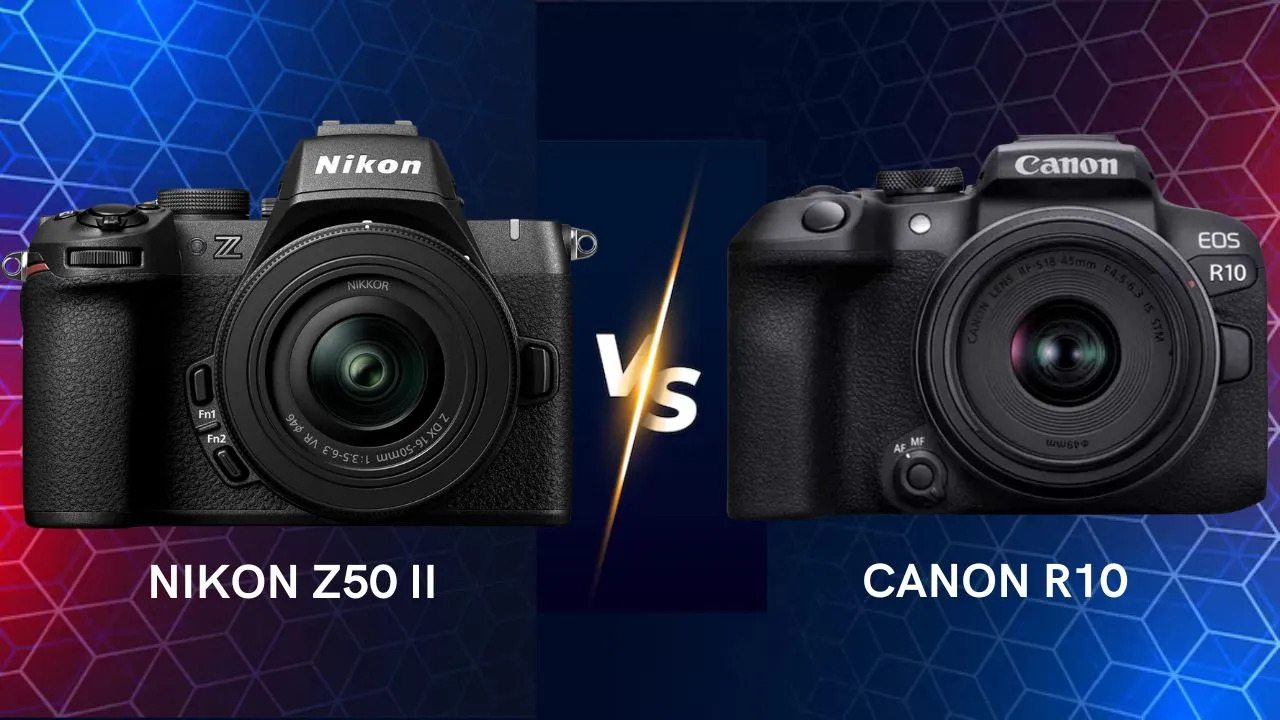
Nikon Z50 II vs Canon R10 | Which One Is Best For You?
Nikon Z50 II vs Canon R10: Which One Is Best for You?
Nikon and Canon both have compelling entry-level APS-C mirrorless cameras aimed at beginners and serious hobbyists who want speed, great autofocus and solid 4K video – without full-frame prices.
On Nikon’s side, the Z50 II is a 2024 refresh of the original Z50, adding Nikon’s latest EXPEED 7 processor, subject-detection autofocus, 4K/60p video and a much better handling experience, while keeping the proven 20.9 MP sensor.
Canon’s EOS R10, launched in 2022, is positioned as the natural successor to the Rebel/xxxD DSLRs: a compact 24.2 MP body with fast bursts (up to 23 fps), oversampled 4K, and Canon’s excellent Dual Pixel AF II.
Both can shoot action, travel, family moments and YouTube-style video. But they don’t excel in the same areas. Let’s break it down.
(This article contains affiliate links to Amazon)
⚙️ Overview – Two Takes on the “Enthusiast APS-C” Camera
Nikon Z50 II
-
20.9 MP APS-C sensor (DX)
-
EXPEED 7 processor with advanced subject-detection AF
-
Up to 30 fps electronic (JPEG) and 11 fps mechanical (RAW) bursts
-
Full-width 4K/30p + 4K/60p with 1.5x crop, 10-bit N-Log and HLG options
-
Good weather-sealing and improved grip, EVF and fully-articulating screen
Canon EOS R10
-
24.2 MP APS-C sensor
-
DIGIC X processor with Dual Pixel CMOS AF II
-
15 fps mechanical, 23 fps electronic; 30 fps RAW burst mode with pre-shooting
-
Oversampled 4K/30p (from 6K) + 4K/60p with ~1.5x crop
-
Ultra-light body, vari-angle screen, built-in flash
In short:
-
Z50 II = newer body with stronger video tools, subject-detection AF, weather-sealing and pre-release capture at a sharp price.
-
R10 = slightly higher resolution, extremely compact, very fast bursts and great Canon color/AF for stills and 4K.
📊 Key Specs Compared
| Feature | Nikon Z50 II | Canon EOS R10 |
|---|---|---|
| Sensor | 20.9 MP APS-C (DX) BSI CMOS | 24.2 MP APS-C CMOS |
| Processor | EXPEED 7 | DIGIC X |
| Native ISO | 100–51,200 (expandable) | 100–32,000 (51,200 expanded) |
| AF system | Hybrid PDAF + contrast, subject detection (people, animals, vehicles etc.) | Dual Pixel CMOS AF II, subject detection (people, animals, vehicles) |
| AF coverage | Nearly full-frame coverage | Up to 100% x 100% (auto) |
| Burst (mech.) | 11 fps (RAW) | 15 fps (RAW) |
| Burst (elec.) | 30 fps JPEG, pre-release capture up to 1s | 23 fps + 30 fps RAW Burst with 0.5s pre-shooting |
| IBIS | ❌ (no in-body) | ❌ (no in-body) |
| 4K video | 4K/30 full-width; 4K/60 with 1.5x crop; 10-bit, N-Log/HLG | 4K/30 oversampled from 6K (no crop); 4K/60 with ~1.56x crop; 10-bit HDR PQ |
| FHD video | Up to 120p | Up to 120p |
| EVF | 2.36M-dot OLED, brighter than original Z50 (~1000 nits) | 2.36M-dot OLED, up to 120 Hz |
| LCD | 3.2″ fully-articulated, ~1.04M dots | 3.0″ fully-articulated, 1.04M dots |
| Card slots | 1× SD UHS-II | 1× SD UHS-II |
| Audio | Mic in + headphone out | Mic in, no headphone out |
| Weather-sealing | Yes (basic but real sealing) | No real weather-sealing (basic protection only) |
| Weight (with battery/card) | ~550 g (varies by source) | ~429 g / 382–429 g depending on region listing |
| Price (body) | Check on Amazon | Check on Amazon |
🧱 Build & Handling
Nikon Z50 II
-
More substantial grip and a magnesium-alloy chassis that feels closer to mid-range bodies than “cheap beginner” cameras.
-
Proper weather-sealing against light rain and dust – rare at this price.
-
Fully-articulating side-hinged screen (fixing the awkward “flip-down” design of the original Z50), brighter EVF, and improved button layout.
Canon EOS R10
-
Much lighter and slightly smaller – ideal if you value portability above all.
-
Vari-angle screen is great for vlogging and selfies.
-
Built-in pop-up flash, which the Z50 II lacks, is handy for casual low-light shooting or fill light.
-
No meaningful weather-sealing; better to be cautious in rain or dust.
Verdict – Handling:
-
Choose Z50 II if you like a more solid, weather-sealed body with a deeper grip and “mini-Z8” vibes.
-
Choose R10 if you want the lightest possible package for travel, hiking, or all-day carry and you appreciate a built-in flash.
🎯 Autofocus & Performance
Both cameras punch way above “entry-level” in autofocus.
Nikon Z50 II AF & Speed
-
EXPEED 7 brings Nikon’s modern subject-detection algorithms: people, animals, vehicles, and more, with 3D tracking.
-
AF is described in reviews as “predictable and quick,” essentially feeling like a cut-down Z8 in everyday use, including low-light performance.
-
11 fps mechanical with full-quality RAW and 30 fps JPEG with pre-release capture buffering up to 1 second before you fully press the shutter – great for birds, sports and “blink-and-you-miss-it” moments.
Canon R10 AF & Speed
-
Dual Pixel CMOS AF II covers the frame broadly and tracks people, animals and vehicles very confidently; borrowed from higher-end Canon bodies.
-
Up to 15 fps mechanical and 23 fps electronic with AF/AE – faster RAW bursts than the Z50 II on paper.
-
A dedicated RAW Burst mode offers 30 fps with pre-shooting (0.5s), similar in spirit to Nikon’s pre-release capture.
Verdict – AF & Speed:
-
Sports / wildlife RAW bursts: R10 has the edge in max RAW fps (15 vs 11) and 23 fps e-shutter, though rolling shutter can be a factor.
-
“Never miss the moment” JPEG shooters: Z50 II’s 30 fps + 1s pre-release is extremely forgiving and works brilliantly for casual action and wildlife.
-
AF intelligence overall is excellent on both; Nikon’s improved subject detection closes the gap with Canon.
🎥 Video: Hybrid Shooters’ Showdown
Nikon Z50 II Video
-
Full-width 4K/30p with no crop – great for getting the full field of view from wide-angle lenses.
-
4K/60p available with a 1.5x crop (so total crop is effectively ~2.25x vs full-frame), plus Full HD up to 120p.
-
Internal 10-bit recording with N-Log and HLG profiles gives much more grading flexibility than 8-bit only cameras and is a big deal at this level.
-
Mic and headphone jacks for proper audio monitoring – something many budget Canons skip.
Canon R10 Video
-
Oversampled 4K/30p from 6K readout (no crop) – exceptionally sharp and detailed.
-
4K/60p with ~1.5x crop, plus Full HD 120p; HDR PQ 10-bit available for high-dynamic-range workflows.
-
Reliable Dual Pixel AF II for video, excellent face/eye tracking, and Canon’s popular color science.
-
Mic input but no headphone jack, so you’re relying on meters rather than monitoring.
Verdict – Video:
-
Choose Z50 II if you care about:
-
10-bit N-Log/HLG for serious color grading
-
Headphone monitoring
-
Full-width 4K/30 for vlogs and talking-heads
-
-
Choose R10 if your priority is:
-
The sharpest possible 4K/30 straight out of camera (oversampled from 6K)
-
Super-light kit for run-and-gun work
-
Canon color and DPAF reliability
-
Both are very capable for YouTube, travel films and family video. The Z50 II leans more toward “budget cine-tool,” the R10 toward “sharp and simple all-rounder.”
🧠 Image Quality
Resolution & Detail
-
R10’s 24.2 MP gives you a bit more cropping flexibility than the Z50 II’s 20.9 MP, useful if you often shoot distant subjects and crop heavily.
-
In practice, image quality from both is excellent for APS-C: good dynamic range, pleasing color, and plenty of detail for prints and social media. Reviews consistently praise both for overall IQ at their price points.
High ISO & Dynamic Range
-
The Z50 II inherits a proven 20.9 MP sensor used in several Nikon DX bodies (and descended from the D500 era), which has strong high-ISO performance and dynamic range; the EXPEED 7 processor further improves noise handling.
-
The R10’s newer 24 MP sensor also performs well; its native ISO tops at 32,000 (51,200 expanded), and it balances noise vs detail nicely for an entry-level mirrorless.
Verdict – Image Quality:
-
If you constantly crop and want a little extra resolution, R10 has a slight edge.
-
If you like Nikon’s files, dynamic range and are happy at ~21 MP, the Z50 II is absolutely competitive – differences are small in real-world use.
🔍 Lenses & System Considerations
Nikon Z50 II (Z-mount DX)
-
Native Z DX lens lineup is still relatively small (16-50, 18-140, 50-250 etc.), but you can use all full-frame Z lenses, and third-party Z-mount lenses are expanding rapidly.
-
F-mount DSLR lenses adapt well via FTZ adapter if you already own Nikon glass.
Canon R10 (RF / RF-S)
-
Native RF-S lenses are still limited (e.g., 18-45, 18-150, 10-18 etc.), but you can use full-frame RF glass – though some lenses are quite expensive.
-
EF and EF-S lenses adapt excellently with Canon’s EF-RF adapters, giving you access to a huge used-lens ecosystem at good prices.
Verdict – System:
-
If you already have Nikon F or Z lenses, the Z50 II slots in perfectly.
-
If you come from Canon EF/EF-S or want the widest choice of inexpensive used glass, the R10 + EF adapter is very attractive.
💰 Price & Value
Check availability and price on Amazon 🛒
📷 Canon R10 — Amazon USA / Amazon Canada / Amazon UK / Amazon Australia
📷 Nikon Z50 II — Amazon USA / Amazon Canada / Amazon UK / Amazon Australia
Note: camerafight.com participates in the Amazon Associates Program. As an Amazon Associate, we earn from qualifying purchases.
Street prices and kit deals vary a lot by region and time, so it’s worth checking current promotions. In many markets, R10 kits can be very aggressively priced, while Nikon often bundles the Z50 II with the 16-50mm kit zoom.
Value takeaways:
-
Z50 II offers outstanding value if you want: weather-sealing, 10-bit log video, subject-detection AF and 30 fps bursts under $1,000.
-
R10 is tremendous bang-for-buck if you prioritize: smallest/lightest body, oversampled 4K, very fast bursts and the huge Canon EF ecosystem via adapter.
🏁 Final Verdict – Which One Should You Buy?
Recommended Camera by User Type
| Type of User | Recommended Camera | Why |
|---|---|---|
| Beginner on a tight budget | Either – whichever kit is cheaper locally | Both are very capable; go with the best deal + kit lens in your area. |
| Travel / everyday shooter | Canon R10 | Lighter body, built-in flash, excellent 4K/30 and AF, great for “throw in the bag and go”. |
| Wildlife / sports (JPEG, social media) | Nikon Z50 II | 30 fps with 1s pre-release capture + solid AF makes catching the decisive moment easier. |
| Wildlife / sports (RAW bursts) | Canon R10 | 15 fps mechanical and 23 fps electronic RAW give you more frames to choose from. |
| Hybrid creator (photo + serious video) | Nikon Z50 II | 10-bit N-Log/HLG, headphone jack, full-width 4K/30 make it the more flexible video tool. |
| You already own Nikon F/Z lenses | Nikon Z50 II | Best integration and value; simple transition. |
| You already own Canon EF/EF-S lenses | Canon R10 | EF-RF adapter + R10 is a natural upgrade path. |
| Often shoot in bad weather | Nikon Z50 II | Real weather-sealing and more robust feel. |
| Want the smallest, lightest setup | Canon R10 | Noticeably lighter and more compact. |
In Short
-
Pick the Nikon Z50 II if you want a tougher, more video-savvy APS-C body with modern subject-detection AF, 10-bit log recording, weather-sealing and clever pre-release capture – all at a very aggressive price.
-
Pick the Canon EOS R10 if you want the smallest and lightest camera, slightly more resolution, very fast bursts, oversampled 4K, Canon’s AF and colors, and you like the idea of tapping into Canon’s vast EF lens ecosystem.
You really can’t go wrong with either – it’s more about which system and strengths line up better with how you shoot. If you tell me what you mainly photograph (travel, sports, wildlife, family, YouTube, etc.), I can suggest a body + lens combo for your use case.