Nikon Z30 vs Sony ZV-E10 | Which One Is Best For You?
Nikon Z30 vs Sony ZV-E10 : Which One Is Best for You?
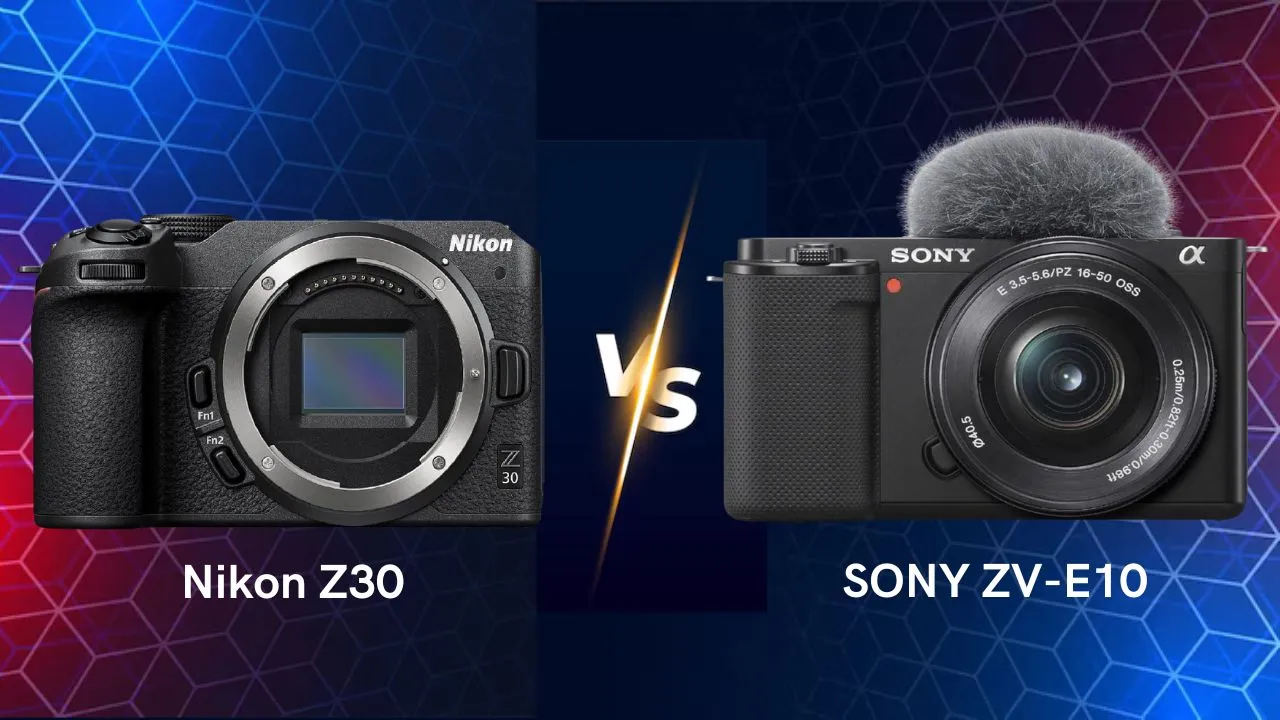
The Nikon Z30 and Sony ZV-E10 are two of the most popular entry-level mirrorless cameras made for vloggers, YouTubers, and creators.
Both offer flip-out screens, 4K video, and compact bodies — but their approach is very different.
The Sony ZV-E10 is part of Sony’s creator-focused ZV lineup, built specifically for video and hybrid content creation, while the Nikon Z30 is Nikon’s answer for vloggers wanting simplicity and great ergonomics at a low price.
So which one is right for you? Let’s find out.
⚙️ Overview — Simplicity vs Versatility
-
Nikon Z30: A beginner-friendly, budget vlogging camera with excellent ergonomics and no recording limits.
-
Sony ZV-E10: A more advanced hybrid camera with better autofocus, external mic support, and flexible lens options.
In short:
-
Z30 = Simpler and more comfortable for handheld vloggers.
-
ZV-E10 = Smarter and more advanced for hybrid creators.
📸 Specifications Comparison
| Feature | Nikon Z30 | Sony ZV-E10 |
|---|---|---|
| Release Date | June 2022 | August 2021 |
| Camera Type | Mirrorless (APS-C, Vlogging-focused) | Mirrorless (APS-C, Vlogging-focused) |
| Sensor | APS-C 20.9 MP CMOS | APS-C 24.2 MP CMOS |
| Image Processor | EXPEED 6 | BIONZ X |
| Lens Mount | Nikon Z-mount | Sony E-mount |
| ISO Range | 100–51,200 (expandable to 204,800) | 100–32,000 (expandable to 51,200) |
| In-Body Image Stabilization (IBIS) | No | No (electronic IS for video) |
| Autofocus System | Hybrid phase-detection AF (209 points) | Hybrid phase-detection AF (425 points) |
| AF Subject Recognition | Humans, animals (Eye AF via firmware) | Humans, animals (Real-time Eye AF) |
| Continuous Shooting Speed | Up to 11 fps | Up to 11 fps |
| Video Recording | Up to 4K 30p | Up to 4K 30p |
| Video Bit Depth / Color | 8-bit internal | 8-bit internal |
| Color Profiles | Flat profile | S-Log2, S-Log3, HLG |
| RAW Video Output | No | No |
| Recording Limit | No recording limit | No recording limit |
| Viewfinder | None | None |
| LCD Screen | 3.0″ fully articulating touchscreen (1.04M dots) | 3.0″ fully articulating touchscreen (921k dots) |
| Touch Functions | Yes (AF, menus) | Limited (AF only) |
| Product Showcase Mode | No | Yes |
| Background Defocus Button | No | Yes |
| Body Material | Polycarbonate | Polycarbonate |
| Weather Sealing | No | No |
| Audio Options | Mic input | Mic input, digital audio via MI shoe |
| Connectivity | Wi-Fi, Bluetooth, USB-C, HDMI | Wi-Fi, Bluetooth, USB-C, HDMI |
| Battery Type | EN-EL25 | NP-FW50 |
| Battery Life (CIPA) | Approx. 330 shots | Approx. 440 shots |
| Dimensions (W × H × D) | 128 × 73.5 × 59.5 mm | 115.2 × 64.2 × 44.8 mm |
| Weight (Body Only) | Approx. 350 g | Approx. 343 g |
| Price (Body Only) | Approx. USD 710 (check on Amazon) | Approx. USD 700 (check on Amazon) |
🧱 Build and Handling
The Nikon Z30 has one of the most comfortable grips in this category. It feels solid in hand and is easy to hold for long handheld sessions — a huge advantage for vloggers shooting without a gimbal.
The Sony ZV-E10 is lighter and more compact, making it perfect for travel, but it feels less ergonomic when paired with larger lenses. Sony also includes a “Product Showcase” button, ideal for quickly refocusing between faces and products — a major plus for YouTubers.
👉 Verdict:
-
Z30: Best grip and handling for vloggers.
-
ZV-E10: Best compact design for travel creators.
🎯 Autofocus and Performance
Autofocus is where Sony dominates.
The ZV-E10 uses Sony’s famous Real-Time Eye AF and subject tracking, which locks onto faces instantly and tracks movement flawlessly — even when recording video. It’s the same system used in higher-end models like the A6400 and A7C.
The Nikon Z30’s autofocus is solid and accurate, but it’s not as sticky or fast when tracking subjects in motion, especially in low light.
👉 Verdict:
-
ZV-E10: Best-in-class autofocus for both photo and video.
-
Z30: Good AF, but not as advanced.
🎥 Video Capabilities
Both are designed with creators in mind, but the Sony ZV-E10 offers more control and flexibility.
Nikon Z30
-
4K 30p (no crop)
-
Full HD 120p
-
No time limit for video recording
-
Clean HDMI output
-
Fully articulating screen
-
Excellent heat management for long sessions
Sony ZV-E10
-
4K 30p (no crop)
-
Full HD 120p
-
10-bit via external HDMI (8-bit internal)
-
Eye AF and Product Showcase mode for perfect focus transitions
-
Background Defocus shortcut for quick bokeh
-
30-minute recording limit per clip
The Z30 wins for continuous recording and simplicity — you can film indefinitely without overheating or stopping.
The ZV-E10, however, offers better autofocus, color control, and pro-level features for creators who want flexibility in post-production.
👉 Verdict:
-
Z30: Best for long-form YouTube videos and live streaming.
-
ZV-E10: Best for cinematic creators and professionals.
🧠 Image Quality
Both cameras deliver excellent image quality, but the Sony ZV-E10’s 24.2MP sensor captures more detail and dynamic range.
Skin tones are natural, colors are vibrant, and low-light performance is strong thanks to Sony’s larger ISO sensitivity range.
The Nikon Z30’s 20.9MP sensor produces lovely tones straight out of camera and maintains Nikon’s signature warm color science — ideal for natural light or travel shooting.
👉 Verdict:
-
ZV-E10: Slightly sharper and more detailed images.
-
Z30: Great color science and tonality.
🔊 Audio and Connectivity
Both include a 3.5mm microphone input, but the Sony ZV-E10 also features a headphone jack for audio monitoring and a multi-interface shoe compatible with Sony’s digital mics.
The Z30 works well with external mics and supports USB-C streaming, but you’ll need to monitor audio via your computer or external device.
👉 Verdict:
-
ZV-E10: More complete audio setup for creators.
-
Z30: Great for simple setups.
🔋 Battery and Storage
Battery life is similar, but the Sony ZV-E10 lasts a bit longer at around 440 shots (vs 330 on the Z30).
Both charge via USB-C and can be powered during recording, which is great for streaming and long shoots.
👉 Verdict:
-
ZV-E10: Slightly longer battery life.
-
Z30: Still solid for continuous video.
💰 Price and Value
The Nikon Z30 is slightly cheaper, making it a better choice for creators on a budget.
The ZV-E10, however, justifies its higher price with superior autofocus, better audio options, and a more flexible lens ecosystem.
👉 Verdict:
-
Z30: Best value for beginners and vloggers.
-
ZV-E10: Best overall tool for serious creators.
Check availability and price on Amazon 🛒
📷 Sony ZV-E10 — Amazon USA / Amazon Canada / Amazon UK / Amazon Australia
📷 Nikon Z30 — Amazon USA / Amazon Canada / Amazon UK / Amazon Australia
Note: camerafight.com participates in the Amazon Associates Program. As an Amazon Associate, we earn from qualifying purchases.
🏁 Final Verdict — Nikon Z30 vs Sony ZV-E10
| Type of User | Recommended Camera |
|---|---|
| Beginner / Vlogger | Nikon Z30 |
| YouTuber / Influencer | Sony ZV-E10 |
| Photographer / Hybrid Creator | Sony ZV-E10 |
| Travel / Lifestyle Shooter | Nikon Z30 |
| Filmmaker / Streamer | Sony ZV-E10 |
| Budget-Conscious Buyer | Nikon Z30 |
✅ In short:
-
Choose the Nikon Z30 if you want a simple, affordable, long-recording camera for YouTube and travel content.
-
Choose the Sony ZV-E10 if you want better autofocus, superior audio options, and more control for hybrid creation.
🧠 Final Thoughts
Both the Nikon Z30 and Sony ZV-E10 are excellent cameras for creators who want to level up from smartphones or compact cameras.
The Z30 focuses on simplicity — no time limits, great grip, and intuitive menus. It’s perfect for beginners who just want to hit record and create.
The ZV-E10, meanwhile, offers a more advanced toolkit — faster autofocus, better audio options, and more lens flexibility — ideal for those growing into professional-level production.
If you’re just starting your YouTube or travel vlogging journey, the Nikon Z30 is a fantastic value.
But if you want to future-proof your content creation setup, the Sony ZV-E10 is the smarter investment.