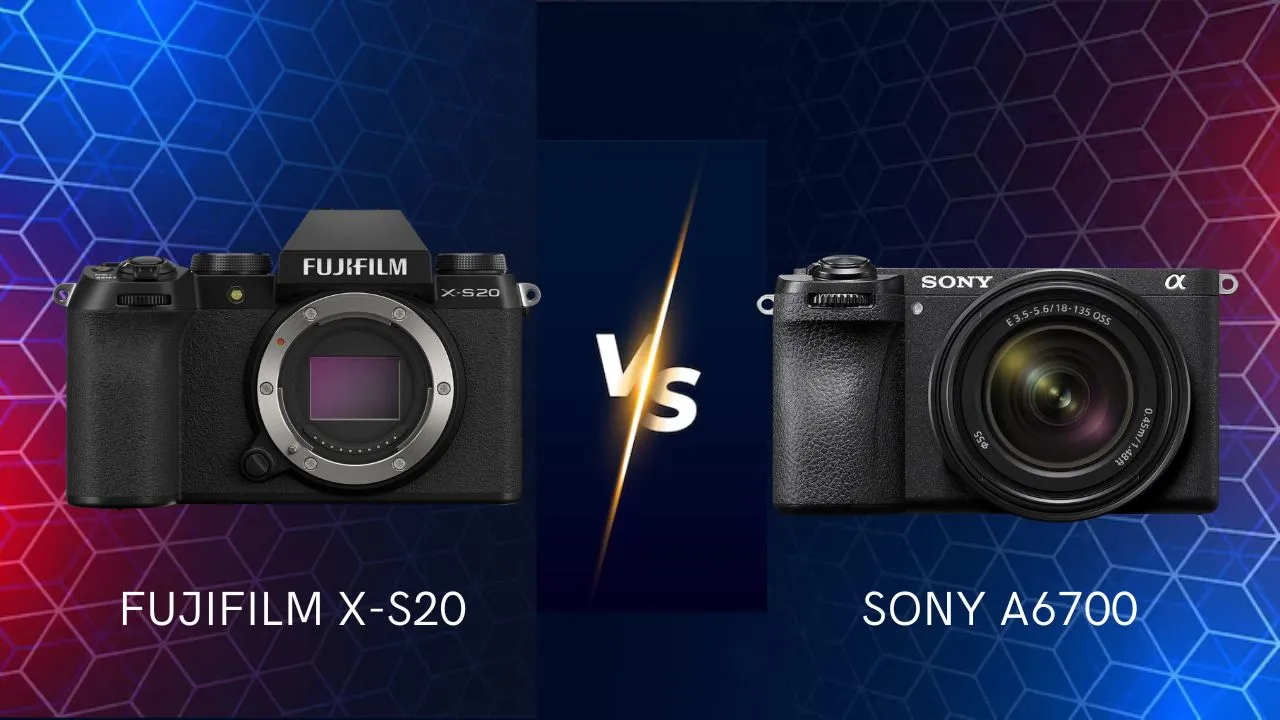
Fujifilm X-S20 vs Sony A6700 | Which One Is Best For You?
Fujifilm X-S20 vs Sony A6700 – Which One Is Best for You?
The Fujifilm X-S20 and Sony A6700 are two of the best hybrid APS-C cameras available today.
Both deliver incredible photo and video performance in compact bodies, but they approach creativity in different ways.
The X-S20 offers Fujifilm’s signature color science and user-friendly design, while the A6700 focuses on next-level AI autofocus and full-frame-grade processing power.
So, which one should you buy? Let’s break down the differences.
⚙️ Overview – Fuji Creativity vs Sony Intelligence
-
Fujifilm X-S20: A compact, stabilized hybrid camera that combines Fuji’s famous color science with improved AI autofocus and 6.2K recording.
-
Sony A6700: A professional APS-C powerhouse with deep-learning autofocus, 4K 120p video, and cutting-edge processing borrowed from Sony’s flagship models.
In short:
-
X-S20 = Beautiful color, balance, and user-friendly versatility.
-
A6700 = Smart autofocus, 4K 120p, and pro-level reliability.
📸 Specifications Comparison
| Feature | Fujifilm X-S20 | Sony A6700 |
|---|---|---|
| Release Date | May 2023 | July 2023 |
| Camera Type | Mirrorless (Hybrid APS-C) | Mirrorless (Hybrid APS-C) |
| Sensor | APS-C 26.1 MP X-Trans CMOS 4 | APS-C 26.0 MP BSI-CMOS |
| Image Processor | X-Processor 5 | BIONZ XR + AI Processing Unit |
| Lens Mount | Fujifilm X-mount | Sony E-mount |
| ISO Range | 160–12,800 (expandable to 80–51,200) | 100–32,000 (expandable to 102,400) |
| In-Body Image Stabilization (IBIS) | Yes, 5-axis (up to 7 stops) | Yes, 5-axis |
| Autofocus System | Hybrid phase-detection AF (425 points) | Hybrid phase-detection AF (759 points) |
| AF Subject Recognition | Humans, animals, birds, vehicles | Humans, animals, birds, insects, vehicles, aircraft |
| Continuous Shooting Speed | Up to 8 fps (mechanical), 20 fps (electronic, crop) | Up to 11 fps |
| Video Recording | Up to 6.2K 30p, 4K 60p | Up to 4K 120p |
| Video Bit Depth / Color | 10-bit 4:2:2 internal | 10-bit 4:2:2 internal |
| Color Profiles | F-Log2, Film Simulations | S-Log3, S-Cinetone, HLG |
| RAW Video Output | Yes, 12-bit via HDMI | Yes, 16-bit via HDMI |
| Recording Limit | No recording limit (thermal dependent) | No recording limit (thermal dependent) |
| Viewfinder | None | 2.36M-dot OLED EVF |
| LCD Screen | 3.0″ fully articulating touchscreen (1.84M dots) | 3.0″ fully articulating touchscreen (1.03M dots) |
| Touch Functions | Yes (AF, tracking, menus) | Yes (AF, tracking, menus) |
| Product Showcase Mode | No | No |
| Background Defocus Button | No | No |
| Body Material | Magnesium alloy | Magnesium alloy |
| Weather Sealing | No | Yes (basic sealing) |
| Audio Options | Mic input, headphone via USB-C | Mic input, headphone out, digital MI shoe |
| Connectivity | Wi-Fi, Bluetooth, USB-C, HDMI | Wi-Fi, Bluetooth, USB-C, HDMI |
| Battery Type | NP-W235 | NP-FZ100 |
| Battery Life (CIPA) | Approx. 750 shots | Approx. 570 shots |
| Dimensions (W × H × D) | 127.7 × 85.1 × 65.4 mm | 122 × 69 × 75.1 mm |
| Weight (Body Only) | Approx. 491 g | Approx. 409 g |
| Price (Body Only) | Approx. USD 1,300 | Approx. USD 1,399 (check on Amazon) |
🧱 Build and Handling
Both cameras are small, robust, and travel-friendly, but they offer very different experiences in hand.
The X-S20 feels like a compact DSLR — deep grip, simple control layout, and intuitive menus. It’s designed for hybrid creators who want stability and comfort.
The A6700 is slightly more angular but extremely well-built, featuring Sony’s modern touchscreen interface and excellent customization options.
👉 Verdict:
-
X-S20: Best ergonomics and simplicity.
-
A6700: Best for customizable, professional control.
🎯 Autofocus and Performance
Here’s where Sony takes the crown.
The A6700 features Sony’s 759-point AI-driven autofocus, inherited from its flagship Alpha series. It can identify humans, animals, birds, insects, cars, trains, and even aircraft — tracking them effortlessly during photo or video.
The X-S20 also offers AI-based autofocus, but it’s a newer implementation that’s very good, just slightly less refined than Sony’s real-time tracking.
In burst speed, both cameras are fast — 20 fps for Fuji (electronic) vs 11 fps for Sony — though the A6700 handles continuous tracking more intelligently.
👉 Verdict:
-
A6700: Industry-leading autofocus and subject recognition.
-
X-S20: Excellent, but a step behind in advanced tracking.
🎥 Video Capabilities
Both cameras are powerful hybrid tools, but their video priorities differ.
Fujifilm X-S20
-
6.2K 30p internal 10-bit 4:2:2
-
4K 60p (no crop)
-
Full HD 240p slow motion
-
F-Log2 support for wide dynamic range
-
“Vlog Mode” with easy exposure and mic settings
-
IBIS for handheld shooting
Sony A6700
-
4K 120p for incredible slow motion
-
4K 60p oversampled from 6K
-
10-bit 4:2:2 internal recording
-
S-Log3 and S-Cinetone color profiles
-
AI-assisted subject tracking for video
-
Excellent rolling shutter control
If you value Fuji’s color science and want a cinematic workflow, the X-S20 is outstanding.
If you need professional-level autofocus and high frame rates, the A6700 is unbeatable in this price range.
👉 Verdict:
-
X-S20: Best for creative filmmakers and vloggers.
-
A6700: Best for fast-paced, professional video work.
🧠 Image Quality
Both cameras use 26MP APS-C sensors, but the color philosophy differs.
The X-S20’s X-Trans sensor produces rich, filmic tones straight out of camera, with Fuji’s legendary film simulations (Velvia, Classic Chrome, Eterna, etc.).
The A6700’s Exmor R BSI sensor delivers cleaner results at higher ISOs and offers more neutral, flexible files for editing — ideal for commercial work or color grading.
👉 Verdict:
-
X-S20: Best for natural, artistic colors.
-
A6700: Best for low-light and professional post-production.
🔋 Battery and Storage
The X-S20 wins easily on battery life, with around 750 shots per charge using the NP-W235 — double the endurance of the X-S10.
The A6700 uses the same NP-FZ100 battery as Sony’s full-frame models, giving about 570 shots, still excellent.
Both support USB-C PD charging and use one SD UHS-II slot.
👉 Verdict:
-
X-S20: Better endurance for travel and vlogging.
-
A6700: Still strong, but shorter runtime.
💰 Price and Value
-
Fujifilm X-S20: ~$1,299
-
Sony A6700: ~$1,399
The X-S20 is slightly cheaper yet offers a more approachable shooting experience, better battery life, and Fuji’s gorgeous film simulations.
The A6700 justifies its higher cost with industry-leading AF, 4K 120p, and professional workflow options.
👉 Verdict:
-
X-S20: Best value for hybrid creators and vloggers.
-
A6700: Best long-term tool for professionals and action shooters.
Check availability and price on Amazon 🛒
📷 Fuji X-S20 — Amazon USA / Amazon Canada / Amazon UK / Amazon Australia
📷 Sony A6700 — Amazon USA / Amazon Canada / Amazon UK / Amazon Australia
Note: camerafight.com participates in the Amazon Associates Program. As an Amazon Associate, we earn from qualifying purchases.
🏁 Final Verdict — Fujifilm X-S20 vs Sony A6700
| Type of User | Recommended Camera |
|---|---|
| Portrait Photographer | Fujifilm X-S20 |
| Travel / Street Photographer | Fujifilm X-S20 |
| Sports / Wildlife Shooter | Sony A6700 |
| Filmmaker / Videographer | Sony A6700 |
| YouTuber / Vlogger | Fujifilm X-S20 |
| Hybrid Photo + Video Creator | Both — depends on priorities |
| Professional / Commercial User | Sony A6700 |
✅ In short:
-
Choose the Fujifilm X-S20 if you want stunning color science, great ergonomics, and unbeatable battery life in a compact body.
-
Choose the Sony A6700 if you want AI autofocus, 4K 120p, and professional-level hybrid performance.
🛒 Check the Fujifilm X-S20 price on Amazon
🛒 Check the Sony A6700 price on Amazon
🧠 Final Thoughts
Both the Fujifilm X-S20 and Sony A6700 represent the pinnacle of APS-C mirrorless technology — compact, powerful, and incredibly versatile.
The X-S20 shines for creators who love Fuji’s color science, film simulations, and all-day battery life in a beautifully simple design.
The A6700, on the other hand, is a technical marvel — the smartest APS-C camera on the market, ideal for professionals who demand speed, accuracy, and consistency.
Either way, you’re getting a camera capable of professional-level photos and video — proof that APS-C systems are stronger than ever.