Canon RF 50mm f/1.8 vs Sigma 50mm f/1.4 DG DN Art | Which One Should You Buy?
Canon RF 50mm f/1.8 vs Sigma 50mm f/1.4 DG DN Art – Which One Should You Buy?
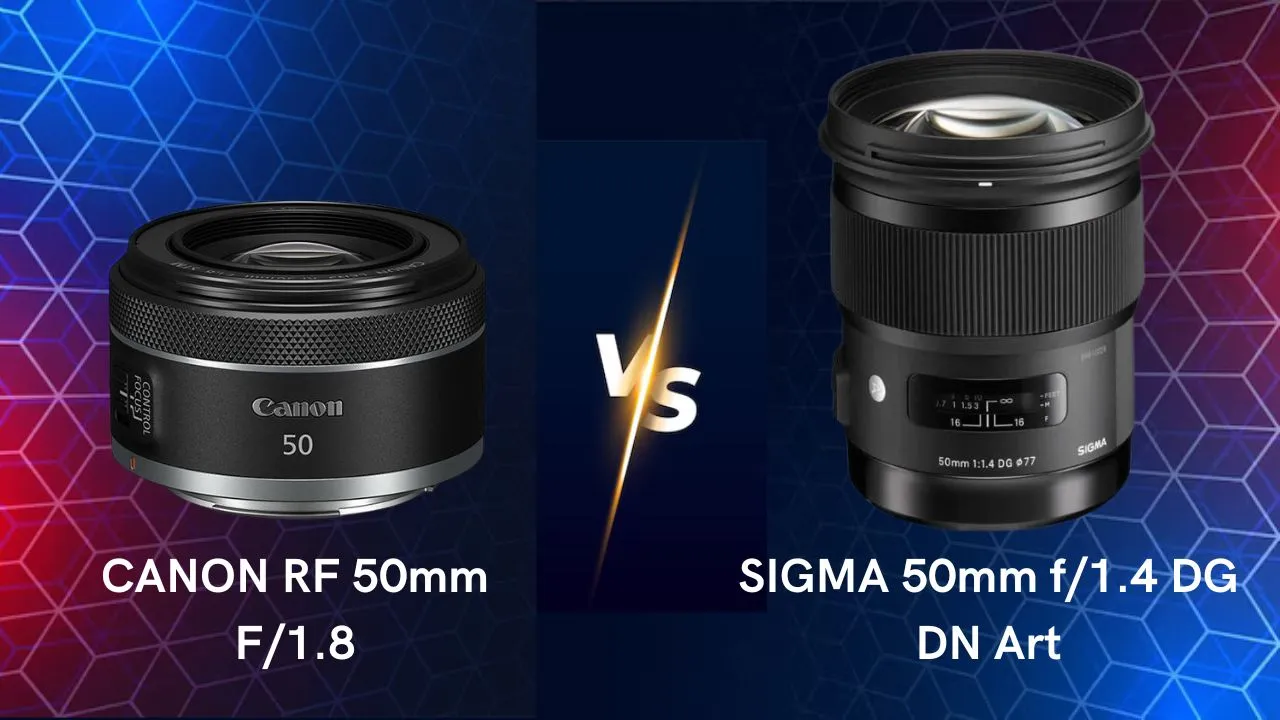
The Canon RF 50mm f/1.8 STM and Sigma 50mm f/1.4 DG DN Art target very different audiences. One is a compact, affordable lens made for beginners and travel photographers, while the other is a high-end, professional-grade prime built for ultimate optical performance.
With Sigma’s Art series now available for multiple mounts (and expected for RF soon), many Canon shooters are asking: Is it worth spending more for a fast f/1.4 lens like the Sigma Art — or does Canon’s budget-friendly RF 50mm f/1.8 already do enough?
Let’s break it down and find out.
⚙️ Overview – Lightweight Everyday Lens vs Premium Optical Power
Canon RF 50mm f/1.8 STM
Canon’s most affordable full-frame lens, the RF 50mm f/1.8 offers great sharpness, smooth background blur, and reliable autofocus — all in a tiny, 160g package. It’s ideal for beginners, hybrid shooters, and creators looking for a simple, high-quality 50mm for their mirrorless camera.
Sigma 50mm f/1.4 DG DN Art
Sigma’s latest 50mm Art lens is designed for professionals who demand perfection. It’s incredibly sharp, beautifully built, and optimized for mirrorless performance, delivering outstanding clarity and bokeh — rivaling even Canon’s premium RF 50mm f/1.2L.
In short:
-
RF 50mm f/1.8: Lightweight, affordable, and great for everyday photography.
-
Sigma 50mm f/1.4 DG DN Art: Premium performance, bright f/1.4 aperture, and professional build.
📊 Specifications Comparison
| Feature | Canon RF 50mm f/1.8 STM | Sigma 50mm f/1.4 DG DN Art |
|---|---|---|
| Mount Type | Canon RF | Sony E / L-Mount (RF expected soon) |
| Focal Length | 50mm | 50mm |
| Maximum Aperture | f/1.8 | f/1.4 |
| Minimum Aperture | f/22 | f/16 |
| Optical Design | 6 elements in 5 groups (1 Aspherical) | 14 elements in 11 groups (1 SLD, 3 Aspherical) |
| Aperture Blades | 7 (rounded) | 11 (rounded) |
| Minimum Focus Distance | 0.3 m (11.8 in) | 0.45 m (17.7 in) |
| Maximum Magnification | 0.25x | 0.16x |
| Autofocus Motor | STM (Stepping Motor) | HLA (High-response Linear Actuator) |
| Focus Type | Focus-by-wire | Linear, internal focusing |
| Image Stabilization | ❌ No | ❌ No |
| Filter Size | 43mm | 72mm |
| Build Quality | Plastic body, metal mount | Metal barrel, weather-sealed |
| Custom Buttons | ❌ None | ✅ AFL button + Aperture ring (de-clickable) |
| Weather Sealing | ❌ No | ✅ Yes (dust and splash-resistant) |
| Dimensions (DxL) | 69.2 × 40.5 mm | 78.2 × 110.5 mm |
| Weight | 160 g (5.6 oz) | 670 g (1.48 lb) |
| Launch Price | ~$150 (check on Amazon) | ~$849 (check on Amazon) |
| Best For | Beginners, vloggers, travel photographers | Portrait photographers, professionals, filmmakers |
🧱 Build and Handling
The Canon RF 50mm f/1.8 is one of the smallest full-frame lenses you can buy. It’s light, compact, and fits easily in any camera bag — perfect for travel or casual shooting. The plastic build feels minimal but solid enough for everyday use.
The Sigma 50mm f/1.4 DG DN Art is in another league — it’s larger, heavier, and feels absolutely premium. Its metal barrel, aperture control ring, and weather sealing make it a professional tool for demanding environments. The tactile controls (especially the aperture ring and AFL button) give it a cinematic feel.
Verdict:
-
RF 50mm f/1.8: Portable and minimalist.
-
Sigma 50mm f/1.4 Art: Premium construction and pro-level ergonomics.
🎯 Autofocus and Performance
The RF 50mm f/1.8 uses an STM motor — quiet and accurate, but not blazing fast. It’s ideal for stills and video but can hesitate slightly in low light or during continuous tracking.
The Sigma 50mm f/1.4 Art, with its HLA (High-response Linear Actuator) motor, offers exceptional autofocus speed and precision, rivaling native lenses from Canon and Sony. It’s virtually silent and locks onto subjects instantly, even in challenging light.
Verdict:
-
RF 50mm f/1.8: Smooth and reliable for most situations.
-
Sigma 50mm f/1.4 Art: Ultra-fast and professional-grade AF performance.
🧠 Image Quality
Sharpness
The RF 50mm f/1.8 is sharp in the center even wide open, improving across the frame at f/2.8 and beyond. For everyday use, it performs impressively well.
The Sigma 50mm f/1.4 Art, however, is razor-sharp edge-to-edge — even at f/1.4. It delivers outstanding resolution and contrast, making it suitable for high-resolution sensors like the Canon R5 or R6 Mark III.
Bokeh and Depth of Field
No contest here: the f/1.4 aperture of the Sigma produces creamier, smoother bokeh with more subject separation. Its 11 rounded blades create a perfectly circular background blur. The RF 50mm f/1.8, while pleasing, shows more defined edges in out-of-focus highlights.
Chromatic Aberration and Flare
The Sigma Art lens uses multiple aspherical and SLD elements, minimizing aberrations and fringing effectively. The RF 50mm f/1.8, though good, can show some color fringing in high-contrast situations.
Verdict:
-
RF 50mm f/1.8: Excellent optical quality for the price.
-
Sigma 50mm f/1.4 Art: Industry-leading sharpness and bokeh.
🎥 Video Performance
Both lenses perform well for video, but again, the Sigma pulls ahead in flexibility.
The RF 50mm f/1.8 is small and easy to balance on a gimbal — great for travel filmmakers and vloggers. However, it lacks a de-clickable aperture ring and can exhibit slight focus breathing.
The Sigma 50mm f/1.4 DG DN Art was clearly built with hybrid creators in mind: it features minimal focus breathing, de-clickable aperture control, and quiet AF, making it ideal for professional video production.
Verdict:
-
RF 50mm f/1.8: Perfect for casual video work.
-
Sigma 50mm f/1.4 Art: Designed for pro filmmaking and hybrid shooting.
💰 Price and Value
| Lens | Approx. Price | Best For |
|---|---|---|
| Canon RF 50mm f/1.8 STM | ~$150 (check on Amazon) | Beginners, vloggers, travel photographers |
| Sigma 50mm f/1.4 DG DN Art | ~$849 (check on Amazon) | Professional photographers, filmmakers, hybrid creators |
–
The Canon RF 50mm f/1.8 offers unbeatable value — it’s sharp, lightweight, and costs less than most filters. For beginners or creators who don’t need ultra-thin depth of field, it’s the perfect starter lens.
The Sigma 50mm f/1.4 Art, though far pricier, delivers performance close to Canon’s RF 50mm f/1.2L at less than half the cost. For professionals who demand perfect sharpness, creamy bokeh, and reliability, it’s worth every dollar.
🏁 Final Verdict — Canon RF 50mm f/1.8 vs Sigma 50mm f/1.4 Art
| Type of User | Recommended Lens |
|---|---|
| Beginner Photographer | Canon RF 50mm f/1.8 |
| Travel or Street Photographer | Canon RF 50mm f/1.8 |
| Portrait Photographer | Sigma 50mm f/1.4 DG DN Art |
| Filmmaker / Hybrid Creator | Sigma 50mm f/1.4 DG DN Art |
| Budget Buyer | Canon RF 50mm f/1.8 |
| Professional / Commercial Photographer | Sigma 50mm f/1.4 DG DN Art |
–
✅ In short:
The Canon RF 50mm f/1.8 STM remains the best value 50mm lens for RF shooters — small, sharp, and affordable.
But the Sigma 50mm f/1.4 DG DN Art is in a different class entirely: brighter, sharper, and built for professionals who want the best optical quality without jumping to Canon’s $2,000 RF 50mm f/1.2L.
If budget and portability matter most — go for the Canon RF 50mm F1.8.
If you crave flawless image quality and cinematic bokeh — the Sigma 50mm f/1.4 Art is worth the investment.
💡 Pro tip:
Many hybrid shooters pair both lenses — the RF 50mm f/1.8 for travel and light setups, and the Sigma 50mm f/1.4 Art for professional portrait or video work.
Check availability and price on Amazon 🛒
📷 Canon RF 50mm f/1.8 — Amazon USA / Amazon Canada / Amazon UK / Amazon Australia
📷 Sigma 50mm f/1.4 DG DN Art — Amazon USA / Amazon Canada / Amazon UK / Amazon Australia
Note: camerafight.com participates in the Amazon Associates Program. As an Amazon Associate, we earn from qualifying purchases.