Canon RF 50mm 1.8 vs EF 50mm 1.4 – Which One Should You Buy?
Canon RF 50mm f/1.8 vs EF 50mm f/1.4 – Which One Should You Buy?
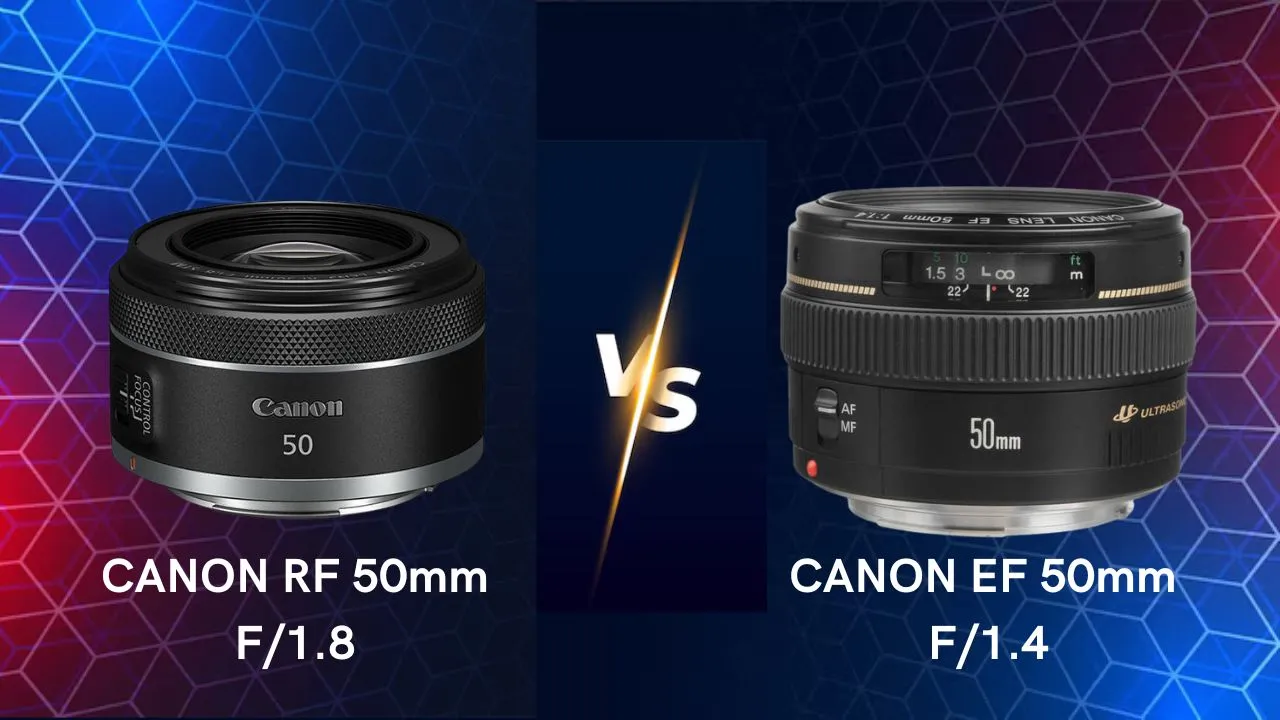
The Canon RF 50mm f/1.8 STM and Canon EF 50mm f/1.4 USM are two affordable prime lenses that appeal to very different photographers. One is modern, compact, and mirrorless-native, while the other is a classic DSLR-era lens known for its brighter aperture and creamy bokeh.
With Canon’s RF system now fully established, many photographers are wondering: Is it worth paying more for the older but faster EF 50mm f/1.4 — or does the newer RF 50mm f/1.8 make more sense today?
Let’s compare these two 50mm lenses in depth to find out.
⚙️ Overview – Modern Simplicity vs Classic Speed
Canon RF 50mm f/1.8 STM
A small, lightweight, and budget-friendly lens built for Canon’s mirrorless RF system. It delivers sharp images, smooth autofocus, and solid performance for both photo and video — all at an incredibly low price.
Canon EF 50mm f/1.4 USM
A long-standing favorite among DSLR shooters, this lens offers a faster maximum aperture (f/1.4), a slightly more robust build, and smoother bokeh. However, it’s an older optical design dating back to the 1990s and shows its age when compared to newer RF lenses.
In short:
-
RF 50mm f/1.8: Affordable, sharp, and ideal for mirrorless shooters.
-
EF 50mm f/1.4: Brighter, older design with more character but less precision.
📊 Specifications Comparison
| Feature | Canon RF 50mm f/1.8 STM | Canon EF 50mm f/1.4 USM |
|---|---|---|
| Mount Type | Canon RF | Canon EF |
| Camera Compatibility | EOS R-Series (Mirrorless) | Canon DSLRs or Mirrorless (with adapter) |
| Focal Length | 50mm | 50mm |
| Maximum Aperture | f/1.8 | f/1.4 |
| Minimum Aperture | f/22 | f/22 |
| Optical Design | 6 elements in 5 groups (1 Aspherical) | 7 elements in 6 groups |
| Coatings | Super Spectra Coating | Super Spectra Coating |
| Aperture Blades | 7 (rounded) | 8 (rounded) |
| Minimum Focus Distance | 0.3 m (11.8 in) | 0.45 m (17.7 in) |
| Maximum Magnification | 0.25x | 0.15x |
| Autofocus Motor | STM (Stepping Motor) | Micro USM (Ultrasonic Motor) |
| Focus Drive | Electronic (focus-by-wire) | Mechanical AF with manual override |
| Image Stabilization | ❌ No | ❌ No |
| Filter Size | 43mm | 58mm |
| Build Material | Plastic body, metal mount | Plastic and metal construction |
| Control Ring | Yes (customizable) | No |
| Weather Sealing | ❌ No | ❌ No |
| Dimensions (DxL) | 69.2 × 40.5 mm | 73.8 × 50.5 mm |
| Weight | 160 g (5.6 oz) | 290 g (10.2 oz) |
| Launch Price | ~$150 (check on Amazon) | ~$399 (check on Amazon) |
🧱 Build and Handling
The RF 50mm f/1.8 is smaller, lighter, and more modern. It includes a customizable control ring, allowing you to adjust aperture, ISO, or exposure directly on the lens — something the EF 50mm f/1.4 lacks.
The EF 50mm f/1.4, though compact by DSLR standards, feels a bit dated. Its build quality is decent, but the extending front barrel during focusing can feel fragile compared to Canon’s newer lenses.
Verdict:
-
RF 50mm f/1.8: Better ergonomics and integration for mirrorless.
-
EF 50mm f/1.4: Classic design but less refined handling.
🎯 Autofocus and Performance
Both lenses focus accurately, but their systems differ significantly.
The RF 50mm f/1.8 uses a modern STM (stepping motor) for smooth, quiet autofocus — ideal for both photos and video. On mirrorless bodies, it communicates seamlessly with Canon’s Dual Pixel CMOS AF II, providing fast and reliable tracking.
The EF 50mm f/1.4, however, uses a Micro USM motor — faster than older DC motors but louder and less smooth. When adapted to RF cameras, autofocus can feel inconsistent, especially in continuous AF or video.
Verdict:
-
RF 50mm f/1.8: Quieter, smoother, and more accurate AF for mirrorless.
-
EF 50mm f/1.4: Snappy but noisy AF, less consistent when adapted.
🧠 Image Quality
Sharpness
The RF 50mm f/1.8 is impressively sharp even wide open, with great central sharpness and solid corners by f/2.8.
The EF 50mm f/1.4, while decent in the center, is noticeably softer wide open and benefits from stopping down to f/2 or f/2.8.
Bokeh and Depth of Field
The f/1.4 aperture on the EF lens creates smoother background separation and creamier bokeh — an advantage for portrait work. However, the RF lens produces surprisingly smooth results at f/1.8 with slightly cleaner edges.
Chromatic Aberration & Flare
The RF version handles fringing and flare much better thanks to its updated coatings and aspherical element. The EF 50mm f/1.4 often shows visible purple fringing and ghosting in backlit situations.
Verdict:
-
RF 50mm f/1.8: Sharper, cleaner, and better-controlled aberrations.
-
EF 50mm f/1.4: Creamier bokeh but weaker wide-open sharpness.
🎥 Video Performance
The RF 50mm f/1.8 clearly wins for video use. Its STM motor ensures silent, smooth transitions and less focus breathing — key for vloggers and hybrid shooters.
The EF 50mm f/1.4, while usable, produces noticeable focus noise and breathing, making it less suitable for serious video production, especially when adapted.
Verdict:
-
RF 50mm f/1.8: Better choice for hybrid creators and videographers.
-
EF 50mm f/1.4: Best for still photographers who value f/1.4 depth of field.
💰 Price and Value
| Lens | Approx. Price | Ideal For |
|---|---|---|
| Canon RF 50mm f/1.8 STM | ~$150 (check on Amazon) | Beginners, vloggers, travel shooters |
| Canon EF 50mm f/1.4 USM | ~$399 (check on Amazon) | Portrait photographers, DSLR users |
–
The RF 50mm f/1.8 offers superb value — it’s newer, sharper, smaller, and cheaper. For most mirrorless shooters, it’s a no-brainer.
The EF 50mm f/1.4, though capable, feels outdated for 2025. Unless you specifically want the f/1.4 aperture or already own it from your DSLR days, the RF version makes more sense on modern bodies.
🏁 Final Verdict — Which 50mm Should You Buy?
| Type of User | Recommended Lens |
|---|---|
| Beginner / Mirrorless Photographer | RF 50mm f/1.8 STM |
| Travel or Street Shooter | RF 50mm f/1.8 STM |
| Portrait Photographer (DSLR)** | EF 50mm f/1.4 USM |
| Hybrid Creator (Photo + Video)** | RF 50mm f/1.8 STM |
| Bokeh Lover / Low-Light Shooter | EF 50mm f/1.4 USM |
–
✅ In short:
The Canon RF 50mm f/1.8 STM is the smarter choice for mirrorless shooters — it’s sharper, quieter, and integrates perfectly with the RF system.
The EF 50mm f/1.4 USM, while still capable, shows its age in autofocus and optical design. It can still deliver beautiful bokeh and character, but its value has faded next to Canon’s newer RF lineup.
💡 Pro tip:
If you already own the EF 50mm f/1.4, keep it and adapt it — it still produces lovely images. But if you’re buying new for your Canon R camera, the RF 50mm f/1.8 gives you 90% of the performance for one-third of the price.
Check availability and price on Amazon 🛒
📷 Canon RF 50mm f/1.8 — Amazon USA / Amazon Canada / Amazon UK / Amazon Australia
📷 Canon EF 50mm f/1.4 — Amazon USA / Amazon Canada / Amazon UK / Amazon Australia
Note: camerafight.com participates in the Amazon Associates Program. As an Amazon Associate, we earn from qualifying purchases.