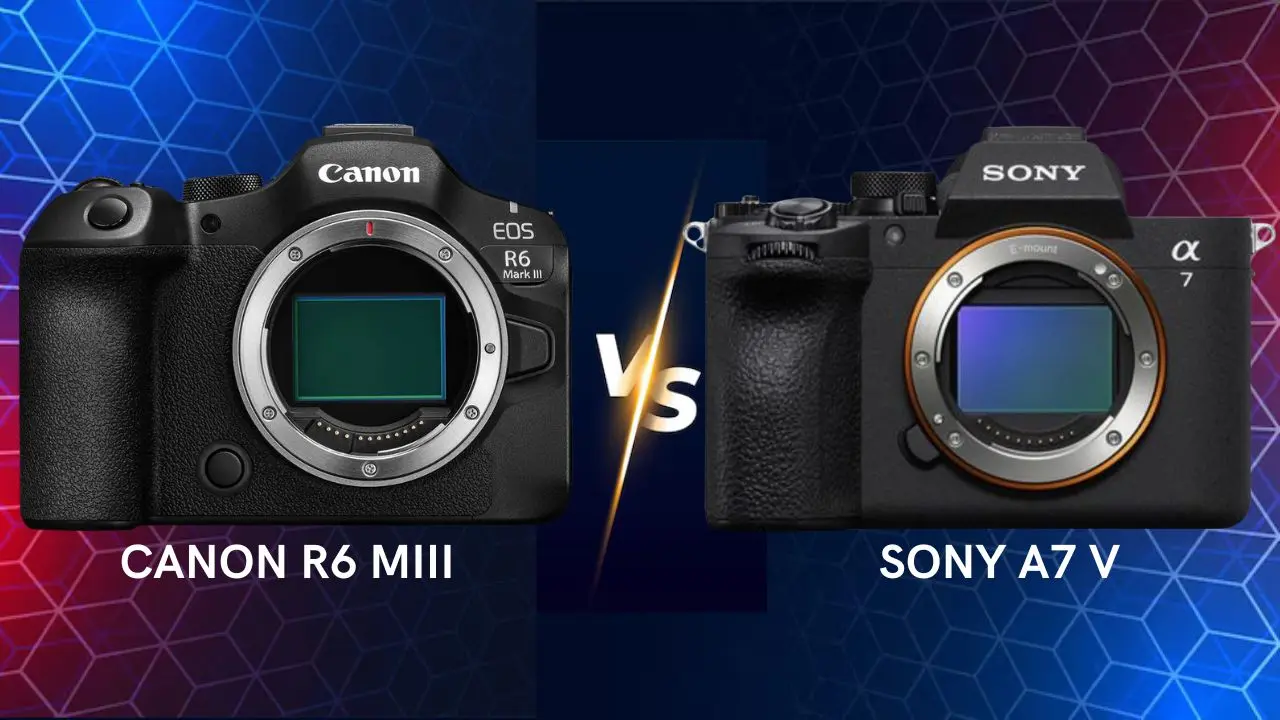
Canon R6 Mark III vs Sony A7 V • Which one is better?
Canon R6 Mark III vs Sony A7 V • Which One Is Better?
The hybrid camera market has never been more competitive – and two of the most talked-about models today are the Canon EOS R6 Mark III and the Sony A7 V. Both are powerful full-frame hybrids aimed at creators, photographers, and filmmakers who want top-tier performance without paying flagship prices.
On paper, these two cameras look surprisingly close: 30–33 MP sensors, next-gen autofocus powered by AI, excellent stabilization, and pro-level 4K video modes. But their philosophies diverge.
Canon pushes toward cinematic capabilities with 7K RAW and high-end video tools, while Sony focuses on speed, responsiveness, and thermal performance, elevating its mid-range hybrid to a near-flagship level.
So which one should you buy? Let’s break it down.
⚙️ Overview – The Cinematic Hybrid vs The Speed-Focused All-Rounder
Canon EOS R6 Mark III
A pro-level hybrid designed for creators who need cinematic tools, excellent low-light performance, and Canon’s renowned color science. With 7K RAW video, 40 fps bursts, and deep AI autofocus refinements, it sits between the R6 II and R5 II as Canon’s “sweet spot” for hybrid shooters.
Sony A7 V
A massive generational upgrade with a partially-stacked 33 MP sensor, blackout-free 30 fps shooting, industry-leading thermal performance, and 4K60 full-frame video. It is Sony’s most advanced hybrid camera short of its flagship Alpha bodies.
In short:
R6 Mark III = The cinematic hybrid for creators and filmmakers.
A7 V = The ultra-responsive all-rounder for action, events, and long-form hybrid work.
📸 Specifications Comparison
| Feature | Canon EOS R6 Mark III | Sony A7 V |
|---|---|---|
| Release Date | 2025 | 2025 |
| Camera Type | Hybrid Full-Frame (Pro-Creator) | Hybrid Full-Frame (Speed-Oriented) |
| Sensor | 32.5 MP CMOS | 33 MP Partially-Stacked CMOS |
| Processor | DIGIC X | Bionz XR2 (with integrated AI) |
| ISO Range | 100–64,000 (50–204,800 exp.) | 100–51,200 (50–204,800 exp.) |
| Dynamic Range | Up to 15 stops (CLog2) | Up to 16 stops |
| IBIS | 8.5 stops | 7.5 stops |
| Autofocus | Dual Pixel CMOS AF II (R1-level AI) | AI AF with 759 points (A1 II-level algorithms) |
| Burst Shooting | 40 fps (electronic) | 30 fps blackout-free + Pre-Capture |
| Pre-Capture | Up to 5 seconds | Up to 1 second |
| Shutter Performance | 1/16000 electronic | 1/16000 electronic (much faster readout) |
| Video | 7K60 RAW, 4K120, 2K180 | 4K60 full-frame, 4K120 APS-C |
| Overheating | Strong thermal design | Best-in-class thermals (6h+ 4K60 measured) |
| LCD | 3” vari-angle, 1.62M dots | Dual-articulation LCD, 2.1M dots |
| Viewfinder | 3.69M dots | 3.69M dots |
| Connectivity | Wi-Fi 5 GHz, Bluetooth 5.1 | Wi-Fi 6, Bluetooth 5.0 |
| Storage | 1× CFexpress Type B + 1× SD UHS-II | 1× CFexpress Type A/SD + 1× SD UHS-II |
| Price | €2899 / 2799$ (Check on Amazon) | €2999 |
🧱 Build and Handling
Canon R6 Mark III
-
Classic Canon ergonomics: comfortable, intuitive, reliable
-
Excellent weather sealing
-
Slightly lighter than Sony
-
Compact body focused on hybrid creators
-
Professional I/O layout with full-size HDMI
Sony A7 V
-
Nearly identical to the A7 IV but with refinements
-
New dual-axis LCD (tilt + vari-angle)
-
Two USB-C ports for simultaneous power + data
-
Better cooling design for long video sessions
-
Slightly heavier, more robust feel
Verdict:
Canon feels more ergonomic and creator-friendly.
Sony feels more robust and workflow-optimized, especially for video longevity.
🎯 Autofocus and Performance
Canon R6 Mark III
-
Dual Pixel CMOS AF II with deep-learning AI
-
Superb eye, animal, and vehicle tracking
-
40 fps burst makes it excellent for wildlife and sports
-
Strong tracking in low light (down to EV -6.5)
Sony A7 V
-
Next-gen AF system derived from A1 II
-
Faster readout = more accurate subject tracking
-
Blackout-free 30 fps + industry-leading pre-capture
-
Exceptional consistency in fast action
-
Better rolling shutter control due to stacked sensor
Reviewers like Gerald Undone and Pierre T. Lambert both note that the A7 V’s action performance approaches flagship levels.
Verdict:
Action photography: Sony A7 V wins (speed, rolling shutter, accuracy).
General hybrid AF: Tie — both are industry-leading.
🎥 Video Capabilities
Video is where their philosophies differ sharply.
Canon R6 Mark III Highlights
-
7K60 RAW internal recording
-
4K120 full readout
-
Canon Log 2 & 3, 10-bit 4:2:2
-
Waveforms, LUT preview, proxy recording
-
Better color science for skin tones
-
Minimal overheating in normal 4K modes
Sony A7 V Highlights
-
4K60 full-frame (no crop)
-
4K120 APS-C
-
Significantly reduced rolling shutter
-
Best overheating performance in its class
(Gerald Undone: “6 hours+ of 4K60 with no heat warning”) -
Dynamic Active IBIS and AI Auto Framing
-
FX-series color improvements
Verdict:
Canon R6 Mark III = Best for filmmakers, colorists, and RAW workflows.
Sony A7 V = Best for long-form video, run-and-gun, and high-motion shooting.
🧠 Image Quality
Canon R6 Mark III
-
32.5 MP: great balance of detail and low light
-
Canon’s signature color science
-
Excellent dynamic range with CLog2
-
Strong highlight roll-off for cinematic looks
Sony A7 V
-
33 MP partially-stacked sensor
-
Up to 16 stops of dynamic range
-
More natural noise texture, better shadows
-
Improved color matching to FX line
-
Cleaner results in high-speed electronic shutter
Verdict:
Canon wins for color science and cinematic rendering.
Sony wins for dynamic range and sensor speed.
🔋 Battery Life & Workflow
Canon R6 Mark III
-
Uses LP-E6 series batteries
-
Good battery efficiency
-
Strong for hybrid shooting
-
Single CFexpress B slot limits cost but also limits redundancy for RAW video
Sony A7 V
-
Z-battery system with 23% better efficiency
-
Dual USB-C ports: power + tether simultaneously
-
Incredible thermal stability
-
CFexpress Type A is slower but more affordable
Verdict:
Sony A7 V is the superior workflow tool for long events, streaming, and continuous video work.
💰 Price and Value
| Model | Approx. Price | Ideal For |
|---|---|---|
| Canon EOS R6 Mark III | ~€2899 | Filmmakers, hybrid creators, Canon shooters |
| Sony A7 V | ~€2999 | Action shooters, event pros, long-form videographers |
–
Price is extremely close — the real difference lies in your shooting style and ecosystem.
Check availability and price on Amazon 🛒
📷 Canon EOS R6 Mark III — Amazon USA / Amazon Canada / Amazon UK / Amazon Australia
📷 Sony A7V — Amazon USA / Amazon Canada / Amazon UK / Amazon Australia
Note: camerafight.com participates in the Amazon Associates Program. As an Amazon Associate, we earn from qualifying purchases.
🏁 Final Verdict — Canon R6 Mark III vs Sony A7 V
| Type of User | Recommended Camera |
|---|---|
| Cinematic Filmmaker | Canon R6 Mark III |
| Hybrid Creator | Tie (Canon for RAW; Sony for workflow) |
| Wildlife / Sports Photographer | Sony A7 V |
| Travel Photographer | Canon R6 Mark III |
| Event / Wedding Shooter | Sony A7 V |
| Handheld Video Shooter | Sony A7 V |
| Colorist / RAW Video Editor | Canon R6 Mark III |
| Budget-Conscious Buyer | Tie (similar price) |
✅ In short:
Choose the Canon R6 Mark III if you want:
-
The best color science
-
7K60 RAW internal recording
-
Full-frame 4K120
-
A cinematic hybrid that rivals cinema cameras
-
Strong low-light AF
Choose the Sony A7 V if you want:
-
Blackout-free 30 fps + elite action performance
-
The best overheating performance on any hybrid camera
-
Better rolling shutter control
-
A more modern LCD, better stabilization, improved workflow tools
-
Longer recording times and high reliability
Both cameras are exceptional – but the Canon R6 Mark III is the filmmaker’s hybrid, while the Sony A7 V is the action-oriented all-rounder built for speed and endurance.