Canon EOS R6 Mark III vs Panasonic Lumix S5IIX • Which one is better?
Canon EOS R6 Mark III vs Panasonic Lumix S5IIX • Which One Is Better?
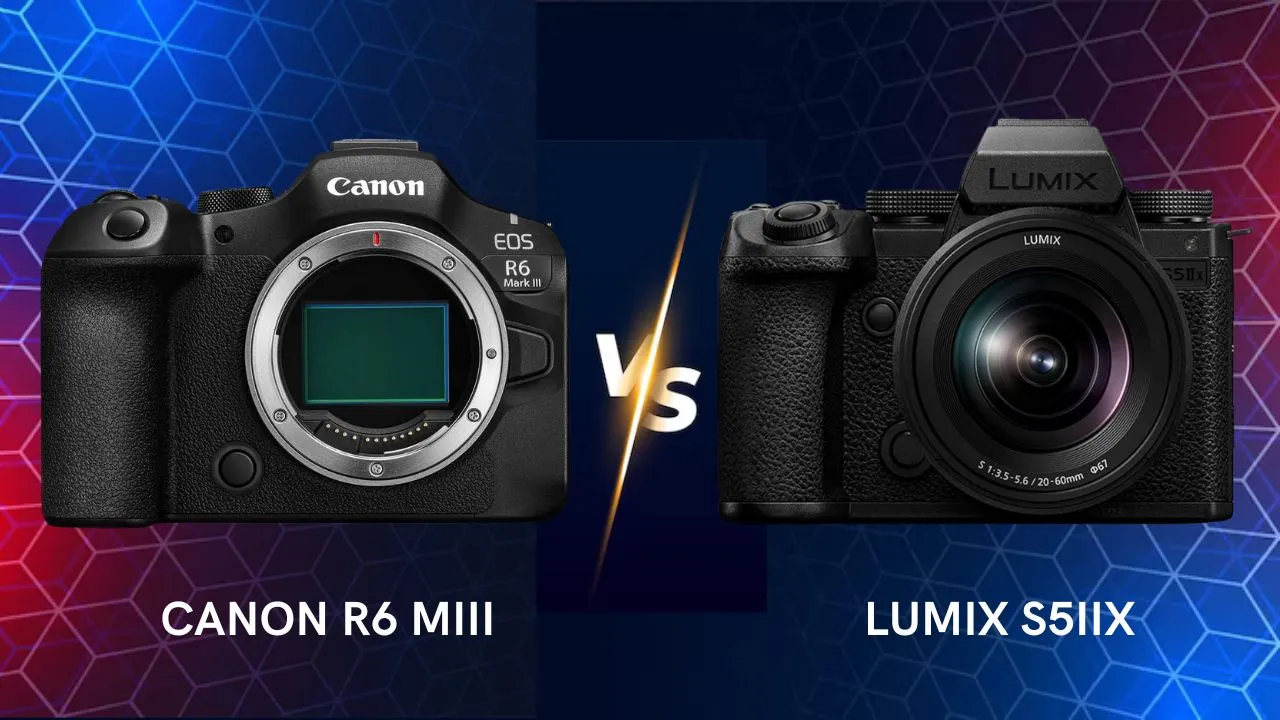
The Canon EOS R6 Mark III and Panasonic Lumix S5IIX are two of the most advanced full-frame hybrid cameras of 2025 — both designed for creators who demand professional-level photo and video performance in a compact, mirrorless form.
The R6 Mark III refines Canon’s hybrid formula, combining a new 32.5 MP sensor, blazing-fast 40 fps bursts, and 7K RAW video. Meanwhile, Panasonic’s S5IIX builds on the S5II platform, adding ProRes recording, direct-to-SSD capture, and all-black stealth styling aimed squarely at filmmakers and production professionals.
Both cameras blur the line between photography and cinema — but they cater to different priorities. Let’s dive in.
⚙️ Overview – Canon’s Balanced Hybrid vs Panasonic’s Video Powerhouse
Canon EOS R6 Mark III:
Canon’s hybrid all-rounder, built for photographers and videographers who need speed, image quality, and flexibility. It features a 32.5 MP full-frame sensor, DIGIC X processor, Dual Pixel CMOS AF II, 7K RAW video, and 8.5 stops of IBIS. It’s ideal for creators who switch between stills and motion regularly.
Panasonic Lumix S5IIX:
An evolution of the S5II that targets professional filmmakers. It shares the same 24.2 MP full-frame sensor and Phase Hybrid AF system but adds ProRes recording, direct SSD capture, All-Intra codecs, and advanced streaming tools — all wrapped in a sleek matte-black body with active cooling for unlimited recording.
In short:
-
R6 Mark III = Premium hybrid camera with speed, detail, and 7K RAW.
-
S5IIX = Cinema-ready workhorse with ProRes, SSD recording, and unlimited runtime.
📸 Specifications Comparison
| Feature | Canon EOS R6 Mark III | Panasonic Lumix S5IIX |
|---|---|---|
| Release Date | 2025 | 2023 |
| Camera Type | Full-Frame Mirrorless (Hybrid) | Full-Frame Mirrorless (Video-Oriented Hybrid) |
| Sensor | 32.5 MP Full-Frame CMOS | 24.2 MP Full-Frame CMOS (Dual Native ISO) |
| Processor | DIGIC X | Venus Engine |
| Lens Mount | Canon RF | L-Mount |
| ISO Range | 100–64,000 (50–204,800 expanded) | 100–51,200 (50–204,800 expanded) |
| Dynamic Range | Up to 15 stops (CLog2) | Up to 14+ stops (V-Log) |
| In-Body Stabilization (IBIS) | ✅ Up to 8.5 stops | ✅ Up to 8 stops |
| Autofocus System | Dual Pixel CMOS AF II (AI-powered) | Phase Hybrid AF (779 points) |
| AF Detection | Humans, Animals, Vehicles | Humans, Animals, Vehicles |
| Continuous Shooting | 12 fps (Mech), 40 fps (Elec) | 9 fps (Mech), 30 fps (Elec, RAW Burst) |
| Shutter Speed | 1/8000 (Mech), 1/16000 (Elec) | 1/8000 (Mech), 1/16000 (Elec) |
| Video Recording | 7K 60p RAW Light / 4K 120p / 2K 180p | 6K 30p Open Gate / 5.8K 30p / 4K 120p |
| Video Formats | Canon RAW Light, H.265/H.264 | ProRes 422 HQ, H.265, H.264, ALL-Intra |
| Recording Media | CFexpress Type B + SD UHS-II | Dual SD UHS-II + External SSD (USB-C) |
| Direct SSD Recording | ❌ No | ✅ Yes (ProRes / H.265) |
| RAW Output | ✅ Internal 7K RAW Light | ✅ External ProRes RAW via HDMI |
| Color Profiles | Canon Log 2, Canon Log 3 | V-Log, V-Gamut, Real-Time LUTs |
| Color Depth | 10-bit 4:2:2 | 10-bit 4:2:2 (All-Intra / LongGOP) |
| Recording Limits | Virtually unlimited | Unlimited (Active Cooling) |
| Viewfinder | 3.69M-dot OLED (120Hz) | 3.68M-dot OLED (120Hz) |
| Screen | 3” Vari-Angle Touch LCD (1.62M dots) | 3” Vari-Angle Touch LCD (1.84M dots) |
| Connectivity | Wi-Fi (2.4 & 5GHz), Bluetooth 5.1, FTP | Wi-Fi (2.4 & 5GHz), Bluetooth 5.0, Wired IP Streaming |
| Ports | Mic, Headphone, HDMI Type-A, USB-C | Mic, Headphone, Full HDMI, USB-C 3.2 (SSD & Streaming) |
| Weather Sealing | ✅ Yes | ✅ Yes |
| Battery | LP-E6P | DMW-BLK22 |
| USB Charging | ✅ Yes | ✅ Yes |
| Body Material | Magnesium Alloy | Magnesium Alloy |
| Weight (Body Only) | 699 g (25.7 oz) | 740 g (26 oz) |
| Price (Body Only) | ~$2,799 / €2,899 (Check on Amazon) | ~$2,499 / €2,599 (check on Amazon) |
🧱 Build and Handling
The Canon R6 Mark III feels refined and well-balanced — its deep grip, intuitive controls, and classic Canon layout make it one of the best-handling mirrorless cameras available. It’s slightly lighter, with a premium feel ideal for both handheld stills and gimbal use.
The S5IIX shares the same body as the S5II but adds an active cooling fan, which slightly increases its depth and weight. Its matte-black design looks professional and stealthy, perfect for video production environments.
Verdict:
-
R6 Mark III: More ergonomic for hybrid handheld work.
-
S5IIX: Better for long-form video and production setups.
🎯 Autofocus and Performance
The R6 Mark III is one of Canon’s best performers, with Dual Pixel CMOS AF II offering lightning-fast tracking across the frame, even in near-darkness (down to EV -6.5). It recognizes humans, animals, and vehicles with precision, making it a strong choice for hybrid and action shooters.
The S5IIX uses Panasonic’s Phase Hybrid AF, a massive leap from the contrast-based AF of older models. It’s accurate and reliable, though Canon still holds the edge for tracking moving subjects in real time and maintaining focus in dim light.
Verdict:
-
R6 Mark III: Still the gold standard for fast, intelligent AF.
-
S5IIX: Much improved — excellent for video, but slightly behind Canon for fast stills.
🎥 Video Capabilities
Here’s where things get serious — both are monsters for video.
Canon EOS R6 Mark III:
-
Internal 7K 60p RAW Light recording
-
4K 120p (no crop), 10-bit 4:2:2
-
Canon Log 2 and Log 3
-
Waveform monitoring, LUT preview
-
Proxy recording and strong heat management
Panasonic Lumix S5IIX:
-
Internal ProRes 422 HQ recording (to SSD)
-
6K 30p Open Gate and 4K 120p 10-bit 4:2:2
-
Direct SSD recording via USB-C
-
All-Intra and LongGOP codecs
-
Unlimited recording with active cooling
-
Wired and wireless IP streaming
The S5IIX clearly dominates the video production space with its codec flexibility, external SSD capture, and broadcast capabilities. The R6 Mark III, however, maintains a quality edge with its internal 7K RAW pipeline and better autofocus tracking during filming.
Verdict:
-
R6 Mark III: Superior autofocus and RAW workflow for hybrid creators.
-
S5IIX: The ultimate video tool for filmmakers and content studios.
🧠 Image Quality
The R6 Mark III features a higher-resolution 32.5 MP sensor, offering crisp detail, excellent color depth, and Canon’s signature color rendering — warm, natural, and filmic. It performs better in mixed lighting and produces cleaner high-ISO files.
The S5IIX, while lower in resolution at 24.2 MP, delivers strong dynamic range and accurate V-Log color straight from Panasonic’s cinema line. It’s less about megapixels and more about cinematic tone and grading flexibility.
Verdict:
-
R6 Mark III: Sharper stills and excellent all-around quality.
-
S5IIX: More cinematic and flexible for post-production work.
🔋 Battery Life and Workflow
Both cameras perform similarly in endurance, though Panasonic’s active cooling ensures unlimited video sessions — a major edge for long-form production.
The R6 Mark III’s CFexpress Type B card slot allows for faster data transfer and RAW performance, while the S5IIX’s ability to record directly to SSDs dramatically streamlines production workflows and reduces costs.
Verdict:
-
R6 Mark III: Best for hybrid creators balancing stills and video.
-
S5IIX: Best for professional filmmakers and SSD-based workflows.
💰 Price and Value
| Model | Approx. Price | Ideal For |
|---|---|---|
| Canon EOS R6 Mark III | ~$2,799 / €2,899 | Hybrid creators, photographers, advanced videographers |
| Panasonic Lumix S5IIX | ~$2,499 / €2,599 | Professional filmmakers, YouTubers, content creators |
The S5IIX undercuts Canon on price while offering higher-end video codecs and direct-to-SSD capture — incredible value for serious filmmakers. The R6 Mark III costs a bit more but provides superior autofocus, faster bursts, and higher stills resolution for hybrid shooters.
Verdict:
-
R6 Mark III: Better hybrid and stills performance.
-
S5IIX: Unmatched value for filmmakers and video pros.
Check availability and price on Amazon 🛒
📷 Canon R6 MIII — Amazon USA / Amazon Canada / Amazon UK / Amazon Australia
📷 Lumix S5 II X — Amazon USA / Amazon Canada / Amazon UK / Amazon Australia
Note: camerafight.com participates in the Amazon Associates Program. As an Amazon Associate, we earn from qualifying purchases.
🏁 Final Verdict — Canon R6 Mark III vs Panasonic S5IIX
| Type of User | Recommended Camera |
|---|---|
| Professional Photographer | Canon R6 Mark III |
| Filmmaker / Videographer | Panasonic S5IIX |
| Hybrid Photo + Video Creator | Canon R6 Mark III |
| YouTuber / Content Creator | Panasonic S5IIX |
| Studio Filmmaker | Panasonic S5IIX |
| Event / Wedding Shooter | Canon R6 Mark III |
| Budget-Conscious Professional | Panasonic S5IIX |
✅ In short:
Choose the Canon EOS R6 Mark III if you want a fast, flexible hybrid camera that excels in both stills and 7K RAW video, with unbeatable autofocus and Canon’s signature image quality.
Choose the Panasonic Lumix S5IIX if your work revolves around video — ProRes, SSD recording, and unlimited runtime make it one of the most capable and affordable cinema-focused full-frame cameras available today.
Both cameras are stellar — but in 2025:
-
The R6 Mark III is the ultimate hybrid tool for creators.
-
The S5IIX is the best full-frame choice for serious filmmakers on a budget.